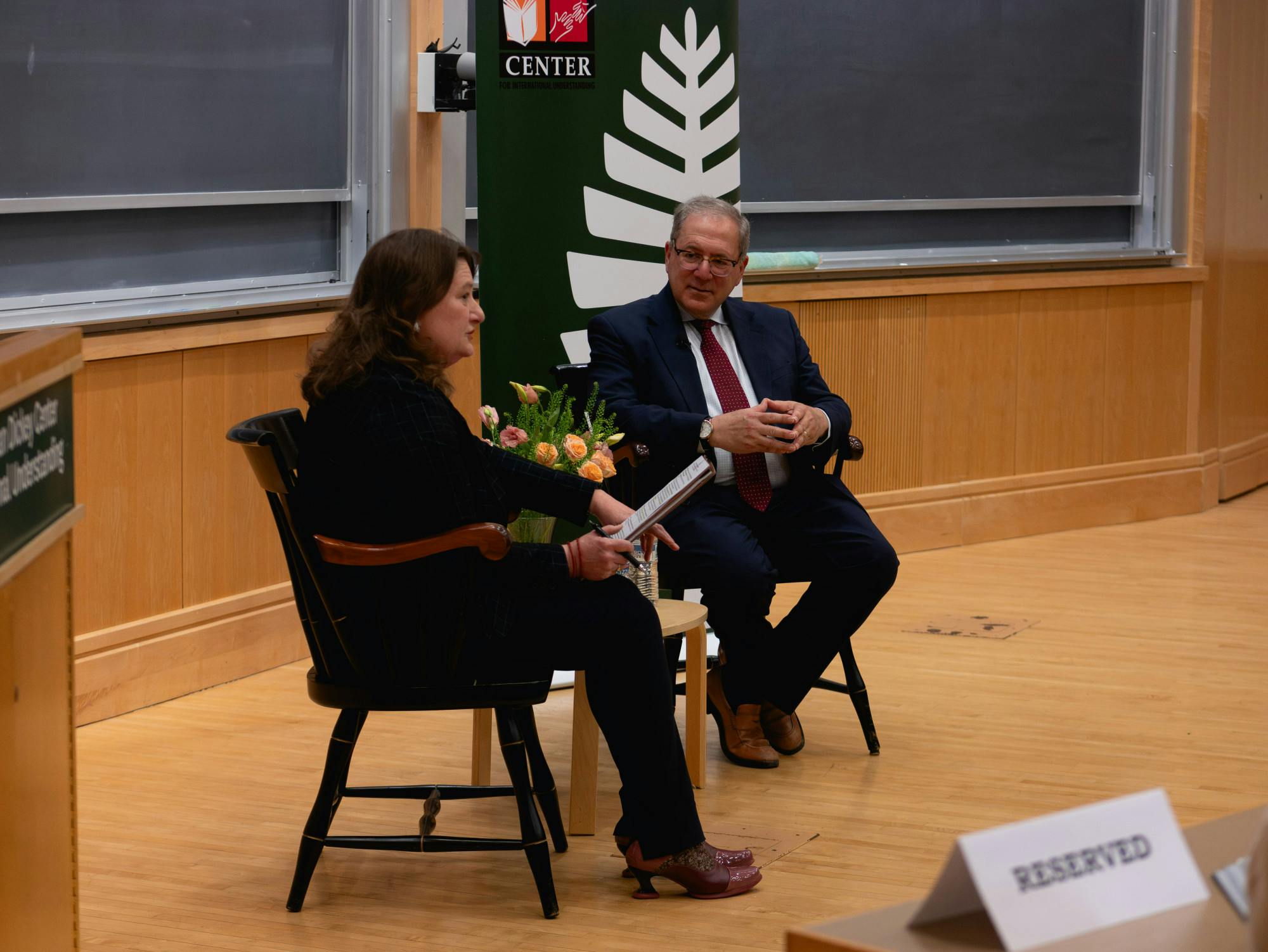
On April 30, New York Times chief White House correspondent David Sanger discussed his decades of experience reporting from Washington, D.C. and abroad at an event hosted by the John Sloan Dickey Center for International Understanding.
The event — moderated by Dickey Center director Victoria Holt — was titled “New Cold Wars: A Journalist’s View of Geopolitics.” Drawing on his reporting experience, Sanger discussed intensifying competition among China, Russia and the United States, as well as the growing role of emerging technologies in shaping modern warfare and information systems and shifting foreign policy priorities.
Approximately 80 people attended the event in Haldeman Hall, with an additional 100 viewers joining the livestream, according to Dickey Center communications manager Lars Blackmore.

In his lecture, Sanger framed the current geopolitical moment as a period of “intensifying” rivalry among major powers, noting that the United States must prioritize “dealing with a rising China and an increasingly aggressive Russia,” as global competition shifts away from counterterrorism and toward great-power conflict.
The U.S. is “entering a Cold War element” of the rising tensions. However, cooperation between global powers like China, Iran, North Korea and Russia is better understood as “mostly bilateral” than as an “alliance.”
Sanger then turned to U.S. foreign policy, arguing that the Trump administration has struggled to clearly define its objectives. The U.S. has “been all over the place,” particularly in addressing Iran’s nuclear program, he said. "The objectives depend on what day you’re listening to the administration.”
The current administration has “had a really hard time” setting goals and setting “objectives to fill those” goals, he said.
In Iran, the administration initially encouraged Iranians to “‘come out and rise up and we’ll … replace your government,’” but later “walked away from that.” Although officials framed the strikes as targeting Iran’s nuclear program, Iran retains significant nuclear capability, with intelligence suggesting it “probably [has] somewhere between 50 and 70% of their [nuclear] launchers still together,” Sanger added.
Sanger pointed to Iran as an immediate source of instability for the U.S., but emphasized that China remains one of the “most important foreign policy problems for each administration since Bill Clinton.”
“Figuring out how to manage China has been one of the most important foreign policy problems for each administration since Bill Clinton,” Sanger said.
The conflict over Taiwan, for example, remains a substantial threat, he said. Currently, the U.S. under the second Trump administration has maintained its long-standing position that the U.S. “does not support an independent Taiwan” while continuing security commitments in the region.
“They want to move the president to subtle changes in wording that may sound like they’re not that big a deal in U.S. policy, but would be a huge deal for the Chinese,” Sanger said.

Upon being asked by an audience member about U.S. relations with Russia during the Q&A period, Sanger said that the threat of a China-Russia relationship would be that they could “decide to do something to gang up on the United States” and “challenge us in different parts of the world,” particularly in the context of the war in Ukraine and broader tensions with North Atlantic Treaty Organization allies.
“Before President [Donald] Trump came in … we were back at the worst relationship [with Russia] we had since the worst day of the Cold War,” Sanger said. Now, Ukraine is the central arena where those tensions are playing out.
The war in Ukraine, he said, has placed direct pressure on U.S. strategy, forcing Washington to rely more heavily on European allies while managing the risk of further escalation, including concerns about nuclear signaling. For example, “the only aid that the Ukrainians are getting is from the Europeans who are buying weapons from us and then transferring them to the Ukrainians,” Sanger said.
An audience member asked Sanger about Trump’s “loose relationship with fact." Sanger replied that Trump’s “overemphasis” on political points, such as his claim that Iran’s key nuclear enrichment facilities were “completely and totally obliterated” in June 2025, and on using military pressure as leverage in diplomacy creates challenges for assessing the accuracy of official statements.
Sanger said that the difficulty of verifying President Trump’s political claims has grown. While past administrations sometimes “overstated” facts, throughout his career, he has never seen “overemphasis” on the “scale” of Trump.
“Everything the president says, you’ve got to go back and fact-check,” Sanger said.
He added that the “decline of traditional newspapers” — and the shift away from local news outlets to bigger corporations and social media — compounded with the “hostility of the government, particularly in this administration” toward journalists “worries” him for the future of the free press.

Finally, Sanger discussed the major geopolitical threat that artificial intelligence poses. Unregulated AI use by governments will “speed up the hacking process” and the “disinformation process,” leading to faster and more scalable cyber and information warfare. However, governments are continuing to “play” with it.
“The fact of the matter is, this technology scares the hell out of every government I know, and yet it’s too irresistible for them not to go play with,” Sanger said.
Given the current state of affairs, even with changes in administration, global systems are changing and allies have “lost their trust in the U.S.” The “only way out” is the “combined power of us and our allies,” he concluded.
Attendee Sophia Sims ’27 said in an interview after the event that she was struck by how “casually” complex and serious issues were discussed, specifically “nuclear weapons.”
Josué Godeme ’26, a Great Issues Scholar and War and Peace Fellow who attended the event, said he “really enjoyed” the breadth of topics covered, and appreciated the audience’s ability to “interact” with Sanger “directly” on topics “like Ukraine, the war in the Middle East and the Pacific with China.”
Attendee Barry Harwick ’77 said Sanger’s ability to move between topics made the talk particularly engaging.
“He could pivot from one topic to another very easily,” Harwick said. “I thought he had particularly good insights about the future of journalism. He was trying to be positive for young people in the audience, but at the same time, pointed out the possible changes in the media environment right now and how tough it is going to be going forward.”