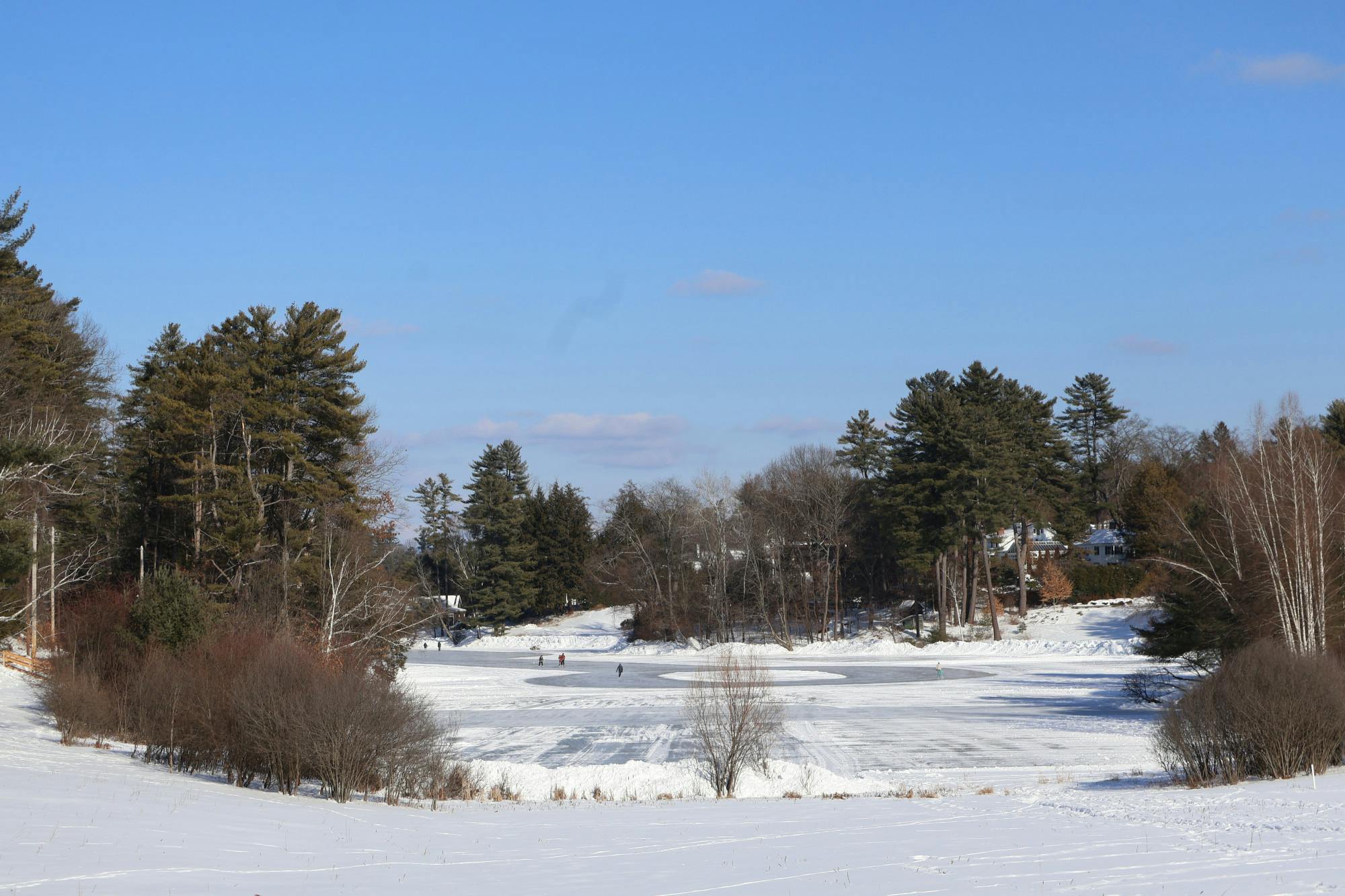
On May 4, the Hanover Selectboard voted unanimously to ban parking on both sides of Occom Ridge after a public hearing. The unmarked street, which runs along the northwestern side of Occom Pond, previously permitted parking on the farther side of the pond. Vehicles parked on either side of Occom Ridge now may receive a $40 fine.
Twelve residents attended the public hearing portion of the Selectboard meeting in support of the ban. Nobody attended in opposition.
In a memorandum to town manager Robert Houseman on April 15, Hanover Police Department lieutenant Christopher Swain recommended the town ban parking on both sides of Occom Ridge from Hilton Field Lane, the south end of the pond, to Clement Road, at the north end. The roadway is “too narrow” to accommodate parked cars, “creating a hazard for pedestrians mixing with vehicle traffic,” Swain wrote.
“Two-way vehicle traffic requires a minimum of 11 feet per lane with an additional 8-foot shoulder to accommodate parking,” Swain wrote. “However, because there are no fog lines on Occom Ridge Road, vehicles are not currently restricted from using part of the roadway for parking.”
Swain urged the town to paint fog lines — white lines marking the where the shoulder begins — and add 10 reflective “No Parking” signs along the side of the Occom Ridge.
Government professor emeritus Linda Fowler, who lives near Occom Pond, organized a group of town residents to support the parking ban at the public hearing. In an interview with The Dartmouth, she said the two-lane road “effectively [becomes] a one-way, one-lane street.”
“About three years ago, a group of faculty and then graduate students discovered that this was a very pretty neighborhood to park in for free,” Fowler said. “The word spread, and we now have 25 to 30 cars there every day, all day.”
Fowler added that parked cars disrupted walking traffic. Students, faculty and community members frequently walk on Occom Ridge in what is called a “woccom.”
“It’s also one of the most popular walks in town because it’s so pretty,” she said. “I think [my neighbors] felt that it wasn’t just their neighborhood being disrupted. It was the whole community because so many people in Hanover use [the road].”
Occom Ridge resident and Geisel School of Medicine professor emeritus William Young said at the public hearing that he supported the ban “for safety reasons,” though he added that he understands people who park on the road will be “disappointed” because of its convenience.
After voting to approve the parking ban, Hanover Finance Committee vice chair Gregory Snyder read a statement from the Hanover Finance Committee — an unelected group of residents that advises the Selectboard on town spending — about the budget proposal for fiscal year 2027, which begins on July 1, 2026. On March 30, the Selectboard approved the budget, which totals $40.8 million and must also be approved by residents at the town meeting on May 12.
If all budget-related warrant articles receive a majority of votes at the town meeting, the tax rate will increase of 3.1% in the combined Town General Fund and Fire Fund District 1 tax rates, according to the Finance Committee statement.
In a public meeting on April 9, the Hanover Finance Committee voted unanimously to recommend adoption of the proposed budget, according to Snyder. In the Hanover Finance Committee’s statement, Snyder praised the town’s “commendable fiscal management” strategy of zero-based budgeting, in which expenses are reviewed from the ground up rather than automatically carried over from the previous year.
Given future capital expenditures from 2028 to 2033, including infrastructure improvements on South Main Street and West Wheelock Street that could cost the town $74 million over five years, Snyder recommended at the Selectboard meeting that “fresh eyes” review the budget each year to ensure there is “public support” for major expenditures.
Snyder told The Dartmouth that he values “transparency” about the town budget.
“The more you communicate, the better off you are, because then the people understand what they’re voting for and where their money is going,” he said.
The Selectboard concluded the meeting with an explanation of its plans for the May 12 town meeting. Polls will open at 7 a.m. and close at 7 p.m. for voting on Article 1 — uncontested elections for town positions — and zoning Articles 2 through 7.
At the business portion of the meeting, which will begin at 7 p.m. and take place in the Hanover High School gymnasium, Hanover residents will vote on Articles 8 through 23, which include the fiscal year 2027 budget and other policy proposals brought by resident petitions. Residents will also have the opportunity to speak about the articles in “good old-fashioned New England style,” Selectboard chairman Carey Callaghan ’83 said at the meeting.
The Selectboard meets every other Monday in the Hanover Town Offices at 41 South Main Street. Meetings are open to the public.
Max Hubbard '29 is a reporter from Boston, Mass., and is majoring in government and minoring in French. In his free time, he enjoys listening to music, running and watching movies.