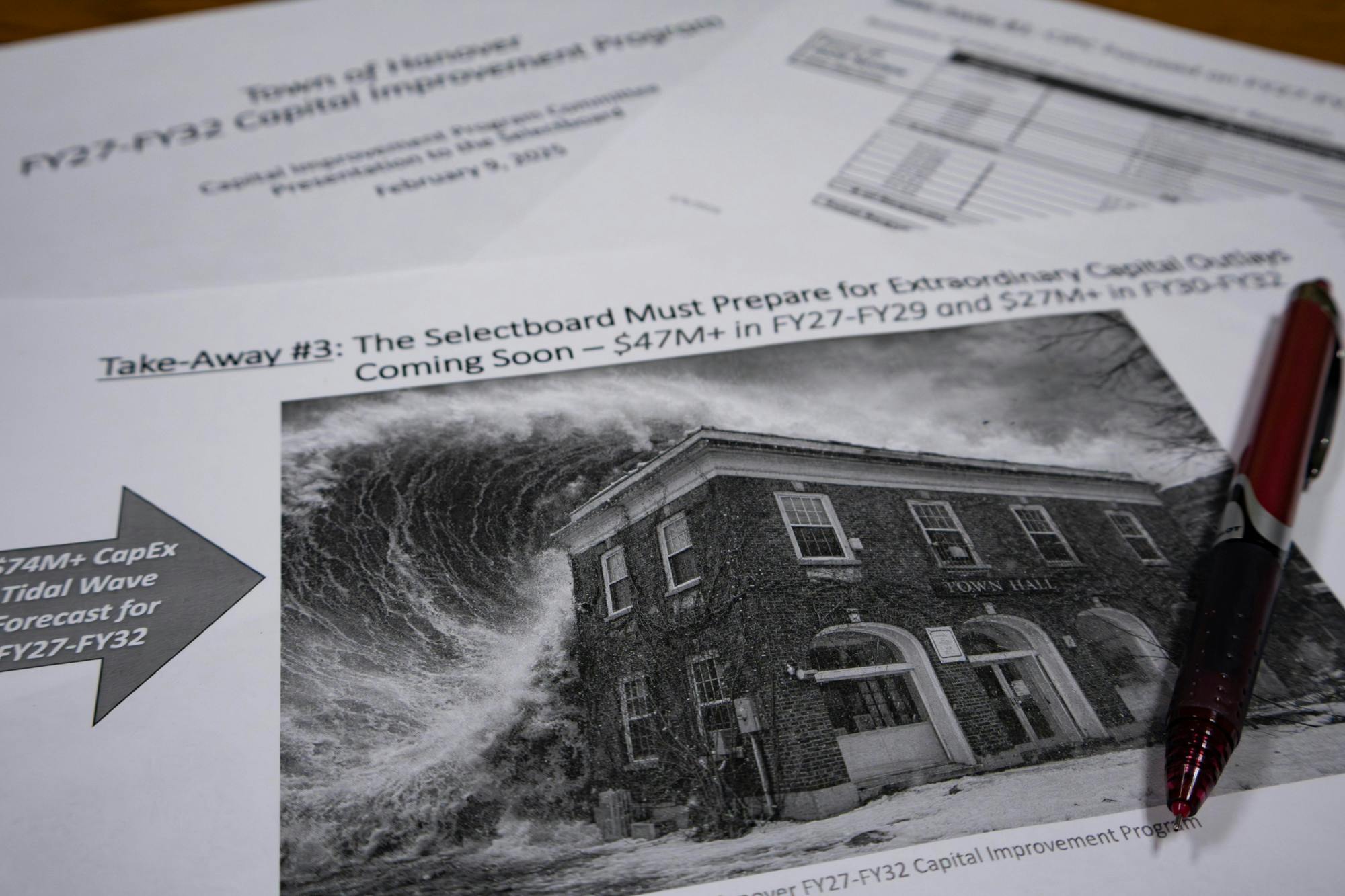
At a meeting of the Hanover Selectboard on Feb. 9, the Hanover Capital Improvement Program Committee warned the Selectboard that the town will face hard decisions about spending priorities over the next five years, which may raise resident tax rates and stress financial reserves, according to Capital Improvement Program Committee chair and finance committee member John Dolan.
From 2027 to 2029, the Selectboard should prepare to allocate $47 million to major infrastructure projects and the replacement of aging assets, Dolan said during his presentation.
The Department of Public Works also presented expected water management spending and work on its agenda for the budget during the meeting.
“Extraordinary capital outlays” in the coming five years
Over the next two fiscal years, the Capital Improvement Program Committee recommends that the Selectboard prepare to spend $40.9 million in large infrastructure projects and $6.5 million in replacements for capital assets such as fire trucks, boilers and roofs.
Expenses for major infrastructure projects on West Wheelock Street and South Main Street are “not yet proposed in detail and could be much greater,” according to Dolan. The College is building Russo Hall and Shonda Rhimes Hall on West Wheelock Street, while the proposed South Main Street revisions would restructure Hanover’s downtown area. The costs on these projects are the bulk of the $40.9 million price tag.
In a graph presented to the Selectboard, Dolan projected that only $2.53 million will be deposited into the town’s financial reserves yearly relative to the projected $2.78 million that will be withdrawn each year.
Town manager Robert Houseman wrote in an email statement to The Dartmouth that the town will strictly manage these reserves in the coming five years.
The town will use these funds to replace old equipment with new and more effective infrastructure ranging from town vehicles such as ambulances and fire trucks to “capital items” such as roofs and boilers.
“Failure to properly fund the program will result in either a financial deficit requiring additional funding or a reduction in services,” he wrote.
During the presentation, the Committee suggested that the town reprioritize its planned expenses and “educate residents about the upcoming changes.”
Selectboard chair Carey Callaghan wrote in an email statement to The Dartmouth that project prioritization depends on voter preferences. The cost of the projects on West Wheelock Street and South Main Street will require the town to issue bonds, which will be put to a vote at the May 12 Town Meeting, Callaghan wrote.
“At this point, [without] detailed proposals and a fully developed fiscal and tax framework, the timing of voter approval is still a question,” Callaghan wrote. “Whether this year or next, voter education and engagement will be key to voters making an informed decision.”
Aging water systems to be replaced
Department of Public Works director Peter Kulbacki presented the department’s budget expectations for the current fiscal year, as well as the department’s challenges with key personnel approaching retirement, loss of critical knowledge and understaffing.
Water management budgets are mostly unchanged for the year — the town will spend $3 million for water, a decrease of 7% and $4.2 million for wastewater, an increase of 1%.
Callaghan noted that new water expenditures will be part of the capital expense category. The improvements include investments in “water distributions in town” and a “major overhaul” of the wastewater facility to enable nutrient removal.
“Until we have the plans done, we won’t know the magnitude of the cost of construction,” Kulbacki said at the presentation regarding new sewage pump systems.
“Aging water infrastructure and environmental requirements to protect the Connecticut River drive the need for these projects,” he wrote.
Max Hubbard '29 is a reporter from Boston, Mass., and is majoring in government and minoring in French. In his free time, he enjoys listening to music, running and watching movies.
Olivia Sapper ’29 is a reporter from Darien, Conn., and is majoring in Government.