
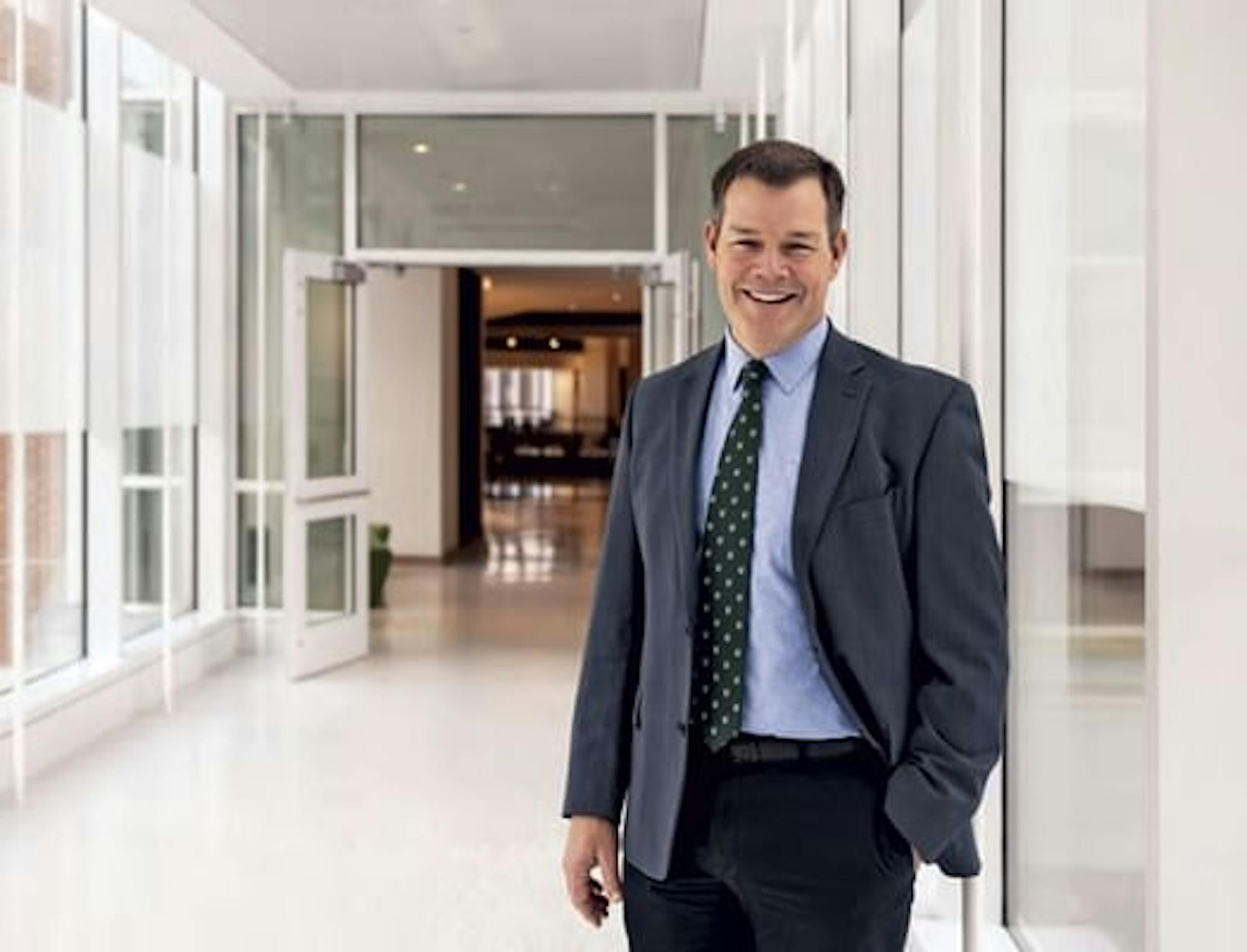
Engineering professor and former Dartmouth heavyweight rower Douglas Van Citters ’99, Th’03, GR’06 has served as the interim dean of the Thayer School of Engineering since former dean Alexis Abramson’s departure from the College after the fall term in 2024. Van Citters also leads the Dartmouth Biomedical Engineering Center for Orthopaedics, which researches musculoskeletal biomaterials, biomechanics and design applications. His team holds over a dozen U.S. patents for various biomedical technologies. Van Citters previously served as the associate dean for undergraduate education at Thayer and received the 2019 Woodhouse Excellence in Teaching award, which is given to the best teacher-scholar among Dartmouth faculty.
Outside of his academic appointments, Van Citters is the faculty advisor for the men’s heavyweight rowing team and a former Dartmouth faculty athletics representative. Before graduate school, Van Citters worked as a hydrogeologist — a scientist who studies groundwater.
The Dartmouth sat down with Van Citters to discuss his time at the College, athletic and academic career and goals for Thayer.
How did you get into rowing?
DVC: I started rowing in eighth grade because my mother and I were looking for something to do together, and there was a “learn to row” program at the Annapolis Rowing Club in Maryland. We decided to do the program together after school. I enjoyed the sport, and eventually I joined the junior program.
How did you end up rowing for Dartmouth?
DVC: I knew I wanted to row in college. Dartmouth’s coach reached out to me after seeing some of my competition results. I visited Dartmouth for the first time in September 1994. The thing that was different about Dartmouth was that I sat down with an engineering professor, the late Stu Trembley Th’83, who was a rower at Yale. He explained how the engineering curriculum worked so I could understand my options, and how that curriculum permits students to do other extracurriculars, like rowing.
What was life like as a student-athlete?
DVC: Athletics requires a lot of dedication outside of the classroom and occasionally some very strange hours to fit in practice classes, labs and so forth. I still had a very active social life. I had friends outside of the rowing team and I learned how to ski.
Today, athletes have more support through Dartmouth Peak Performance, which supports their nutrition, academics and time management.
Why did you come back to Dartmouth for graduate school?
DVC: If you don’t have an Accreditation Board for Engineering and Technology accredited engineering degree, it’s a long road to become a professional engineer. When I was working outside of Dartmouth, my firm was populated with PEs [who are licensed by state or provincial boards to provide engineering services to the public]. If I wanted to get promoted or move forward, I needed an accredited engineering degree. I returned to Dartmouth for the bachelor of engineering and engaged in the master’s program to learn more about material science. When I combined material science with my biomedical engineering laboratory, I started studying biomaterials and discovered my true joy: artificial joints and biomaterials.
What made you move to academia?
DVC: I thought I would return to industry, but I worked with two interns during my master’s through the Women in Science Program, now the Early Research Access in the Sciences program. I discovered I enjoyed teaching and sharing laboratory research with others.
Why did you stay at Dartmouth for your Ph.D.?
DVC: We obtained funding that was unique to my area of research: biomaterials of artificial knees and hips. My spouse had a job at Dartmouth and was pursuing her graduate degree. This is a wonderful place to live and research artificial joints. There are few laboratories in the world that have a collection of failed artificial joints like mine, where we derive data that drives our research questions as we pursue the basic science and design side of artificial joints.
What made you interested in artificial joints?
DVC: I called my ENGS 21 professor when I was a hydrogeologist and asked him about the process of getting my BE. He suggested that I return to study bearings, which made sense to me, as I was a summer mechanic in college, but he was actually thinking of artificial knee bearings. I joined an orthopaedics laboratory and started studying knee bearings. There, I used mechanical engineering and material science in a way that incorporated economics, law, medicine and the human side of having a person attached to this artificial joint. If we could identify failures and produce better designs, then we would help humanity. I could incorporate all the things that I loved from Dartmouth, my graduate programs and my desire to be able to make an impact on people.
How has your rowing background influenced your research?
DVC: You have to understand the biomechanics of the person who is using artificial joints. What I’ve learned about biomechanics translates to the biomechanics of being an athlete. Each sport has different biomechanics and their own injuries. It’s been interesting for me as a practitioner to look at athletics and have a richer understanding of the biomechanics in the sport and some of the injuries that might come with the sport or injury prevention.
What is your vision for the engineering program?
DVC: My vision is to ensure the next permanent dean of the Thayer School has a financially and administratively stable foundation where information provided to them permits them to make decisions immediately regarding programs, research, education and more. We need to ensure that engineers are teaching and researching in ways that are human-centered and demonstrate the highest impact on society. We take pride in being engineers in the liberal arts — we take into account society’s challenges and outcomes when we make technical decisions.
What are your favorite Dartmouth rowing memories?
DVC: There’s something special where you train so long and hard for these moments of absolute bliss on the water: Everything is working together; you’re moving as fast as humanly possible and you’re doing it with people in your boat who know there’s no one you’d rather be with. That’s the pinnacle of existence. It happened during a sophomore year race in Madison, Wisconsin against the University of Wisconsin and a couple of times at the Henley Royal Regatta in Henley-on-Thames, U.K. Each time, you’re on top of the world and you train to get to that point again. It’s so much fun to push together as a team toward that kind of goal.
How do you stay involved with athletics?
DVC: I’ve been the academic advisor for the men’s heavyweight team for many years. I want to be the professor who sat down and talked with me when I was a high school senior. I served as the faculty athletics representative prior to becoming the interim dean. I’m Dartmouth’s voting member in the Ivy League Policy Committee.
I have a single and row on the Connecticut River. I love to ski and I compete in an annual ski marathon called the American Birkebeiner. In the summers, I run on the trails.
This interview has been edited for clarity and length.


