
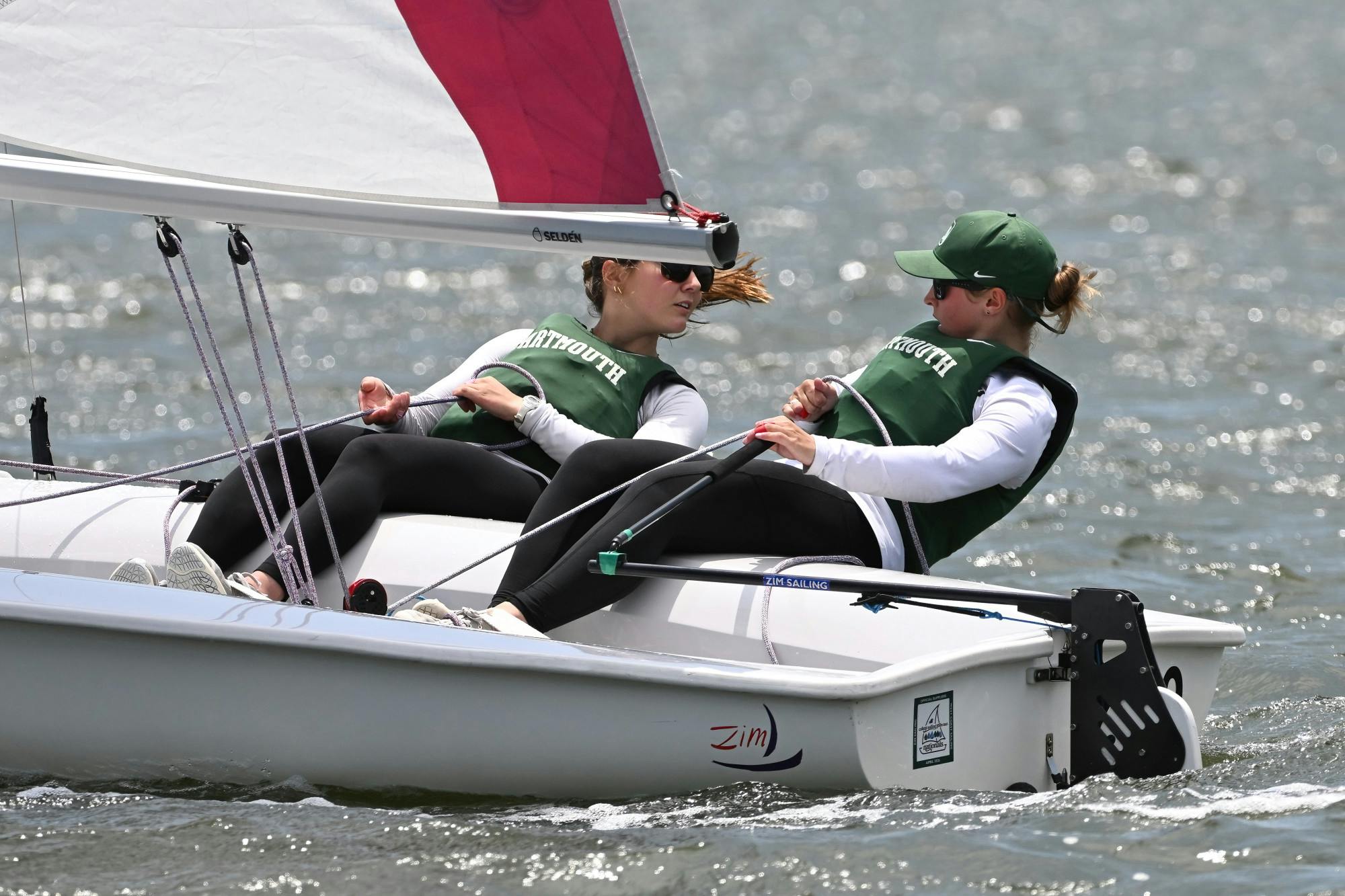
For Charlotte West ’28, sailing is as much about mindset as it is about speed. As a helm on the women’s sailing team, she is responsible for driving the boat by steering with the rudder and trimming the mainsail.
West has already made an impact on Dartmouth’s nationally-competitive sailing team, racing in eleven regattas during her first season and finishing in the top ten in every event — making her a consistent and resilient force on the team. Ahead of the ICSA Fleet Race National Championships in St. Petersburg, Florida later this month, West sat down with The Dartmouth to discuss her success, her mindset and her goals for her collegiate career.
How long have you been sailing, and how did you get into the sport?
CW: I’ve been sailing for about thirteen years. I live in a coastal town in Massachusetts so I grew up on the water and sailing was a big cultural part of that town, but my parents weren’t big sailors. They just enjoyed spending time on the water, and I think they just wanted me to do something during my free time in the summer. I just started sailing and never really looked back.
Why did you choose to come to Dartmouth?
CW: There’s a lot of history with our program. We’ve been one of the best sailing teams in the country for about the past 10 years. I also really loved the coaching staff. Interim head coach Rebecca McElvain ’19 is the Ivy League’s first ever female [sailing] head coach, and I really love that. Also, Justin Assad, our former head coach, was a big reason why I came here. I really like the intensity of everyone on the team and I also liked how much the team pushes each other. You don’t really get that at some other programs.
How would you describe your overall experience here as a student-athlete?
CW: It’s been pretty positive. A lot of professors try to be pretty lenient with giving extensions. I just had one of my earth science professors give me extensions for assignments I was missing when I was away at nationals for a whole week. I do feel like sometimes there can be a little bit of difficulty with trying to balance social life, athletics and academics. It took me a while to adjust to the fact that you can’t always get all three of those right at the same time.
What is the most challenging thing about sailing?
CW: The most challenging part about sailing is that everything is out of your control. For example, you can’t control what the wind is going to do or what anyone else on the course is going to do. You kind of have to be able to pick yourself back up and be okay with the fact that you can do everything possible to win this race but you can’t guarantee that. You just have to put that aside and try to sail your best.
How do you deal with pressure and expectations during big races like nationals?
CW: Our head coach does a really good job of making sure we’re pretty level-headed. We have this phrase called “no peaks, no valleys,” which means if you’ve had a bad race, don’t think about it and move on; or, if you’ve won four races in a row, don’t think about it and move on. You need to focus on what you have to do in the next race, not what happened in the last one. We also make a big effort to not talk about standings throughout the day. I also make a big effort not to even know where we are in the standings because it helps me focus and put aside the pressure, especially if the race is important.
What’s the sailing team culture like?
CW: I really love our team. I feel like it’s very special because we spend so much time together, especially because we’re an off-campus sport. We spend 20 to 25 minutes in a van driving to practice every day since we sail on Lake Mascoma in Enfield, New Hampshire. We then spend our whole weekends together as a team, so we get really close to one another. I also think my teammates are the biggest reason why I feel like I can push myself as much as I do. I know that they’re going to support me.
What is it like being one of two members of the Class of 2028 on the team?
CW: I think having a small class at first was a big adjustment. We had three ’28s for most of last year, and now it’s down to two, and it was a little bit hard trying to figure out my place on the team. But we’ve gotten to know the other classes very well. The other sophomore, Chase Decker ’28, and I are good friends with the ’26s. Our ’29 class is huge. They’ve been a lot of fun to show around the school and we’ve been making sure that they’re enjoying their time here. There’s a lot of intermingling between the classes, which is something I really appreciate.
How do you train in the off-season?
CW: We watch a lot of film, especially for team racing. It’s harder to watch film for fleet racing because you are just kind of watching boats trying to go fast, but for team racing it’s really helpful. In fleet racing, the goal is to get the fastest time, while in team racing, the focus shifts to strategic position and coordination to beat the other team. We also have weekly quizzes based on the team racing film which helps us go over play recognition and things like that. We also lift in the off seasons and do other workouts to stay in shape.
What are your goals for the next season?
CW: I really would like to make a more of an impact on the women’s team as I go into my junior year. I would like to be starting for the women’s team more consistently, especially for fleet racing. I currently start for team racing, but I’d really like to do well and start for fleet racing. Also, at some point I’d love to be an All-American. We have a history of producing some incredible sailors. Everyone around me sets a really high bar, so I want to see what I’m capable of.
This interview has been edited for clarity and length.
Gabriella Messina ’27 is a sports writer. She is from Rye, N.Y. and is majoring in Engineering and minoring in French. On campus, Gabriella is on the club lacrosse and taekwondo teams. She is also a member of the 2027 class council.


