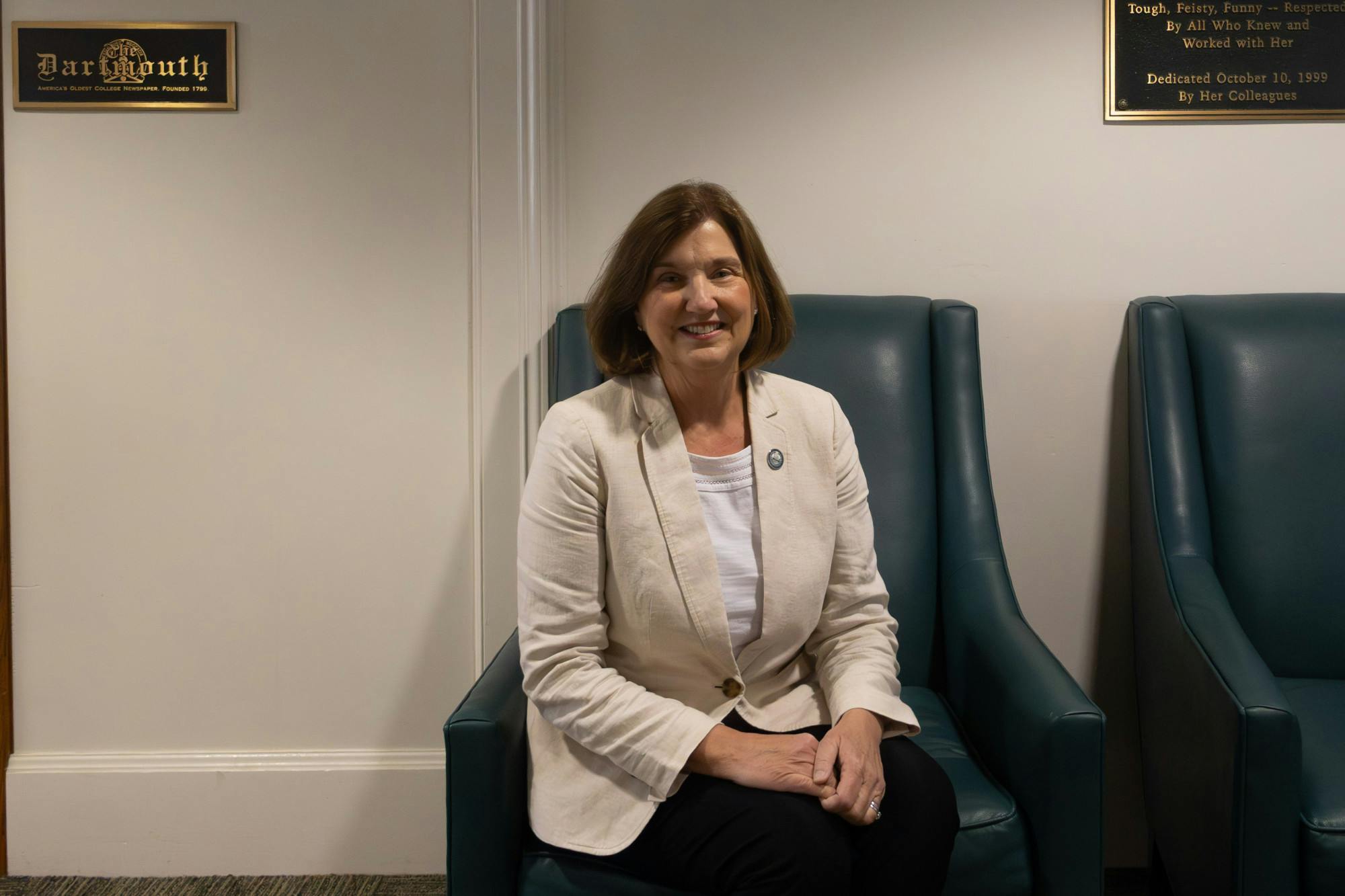
As part of The Dartmouth’s coverage of the upcoming 2026 midterm and gubernatorial elections, the paper is publishing an interview series, “A Sit-Down with The Dartmouth,” featuring in-depth conversations with candidates for statewide and New Hampshire district offices.
In this installment, The Dartmouth interviewed Cinde Warmington, the only Democratic candidate for governor of New Hampshire after Jon Kiper exited the Democratic Party to form the Community First Party in April with which he is continuing his gubernatorial race. Warmington previously ran unsuccessfully for governor in 2024 and served on New Hampshire’s Executive Council from 2021 to 2025.
Warmington has made affordability the center of her campaign, with a focus on increasing housing supply and health care access while lowering energy costs and property taxes. She also sharply criticized Gov. Kelly Ayotte, arguing that Ayotte has aligned herself too closely with President Donald Trump.
New Hampshire primaries will take place on September 8, 2026.
You previously ran for governor in 2024 but lost in the Democratic primary. Why are you the right candidate now?
CW: As I travel around this state, I am hearing from people everywhere that skyrocketing costs are crushing them. From small businesses to families, people are being crushed. They cannot afford housing. Property taxes are through the roof. Health care premiums are doubling in some cases. We need a new direction.
Republicans have had control of the governor’s office for 10 years now, and this is where it has brought us. The economy is broken. They can not fix it.
You have made affordability central to your campaign. If elected, what is the single biggest thing you would do to address the issue?
CW: Housing supply is a red-alert issue. It has been the primary issue in our state for several years now. If we do not do something about it now, we will fall further behind. We need someone in state government who is actually responsible for housing. Right now, nobody can tell you how many housing units we have, how many we need or what the plan is to get there.
What would you do to increase housing supply and lower prices?
CW: We need to invest in affordable housing. When we put one dollar into the affordable housing fund, we can leverage that into three additional federal dollars [according to New Hampshire Housing]. We are leaving millions of federal dollars on the table every year.
We should also restore funding for the Housing Champions program, which incentivizes cities to approve housing developments. Nearly half of the housing projects started in the last year came from Housing Champion communities.
What, specifically, has Ayotte done wrong?
CW: She has increased healthcare premiums on some of the most vulnerable people among us. Small premium increases result in people losing coverage and not getting care. Her obsession with fossil fuels and refusal to embrace renewable energy and energy efficiency are also completely wrong.
Do you think she is tied too closely to Trump?
CW: She said from the beginning that she is a supporter of Donald Trump, and it shows in everything that she does. She refuses to stand up to him whatsoever. Trump’s tariffs are costing an average Granite State family money every year, and she refuses to challenge them.
How would you address New Hampshire’s opioid crisis?
CW: This is personal for me. My dad, a Korean War veteran, struggled with alcohol addiction his entire life. It has motivated me as an adult to work on this issue. We need a four-legged stool approach: prevention, harm reduction, treatment and enforcement. You need all of them working together.
Some commentators have critiqued your past lobbying work for pharmaceutical companies, including Purdue Pharma. Why should voters trust your judgment now?
CW: Ayotte wants to attack me for something from 24 years ago because she does not want anyone focused on what she did after Purdue Pharma’s lies were known. She failed to join opioid litigation that could have brought money to the state, then later collected money from pharmaceutical interests, including opioid manufacturers.
If elected, what would a successful first term look like?
CW: My North Star is that every Granite Stater should be able to put a roof over their kids’ heads, feed them, clothe them, give them a great education and retire with dignity. Those are the basics. It is hard work, but it is not rocket science.
What should voters understand about you that they may not see on your resume?
CW: When I was 17 years old, I was financially independent. My family went bankrupt when I was a teenager, and I was on my own to pay for housing, food, gas and college. I worked two jobs all the way through school and was the first person in my family to go to college. Through hard work, I was able to live the American dream. That is what I want for every Granite Stater.
This interview has been edited for clarity and length.
Corrections Appended (May 4, 2:58 p.m.): A previous version of this article erroneously cited the National Low Income Housing Coalition for a statistic that came from New Hampshire Housing.
A previous version of this article used the phrase "governor's mansion" to refer to the New Hampshire governorship. This has since been corrected to "governor's office."
Isabel Menna ‘29 is a reporter from Leavenworth, Wash., is majoring in economics and is a member of the Dartmouth Ski Patrol.