
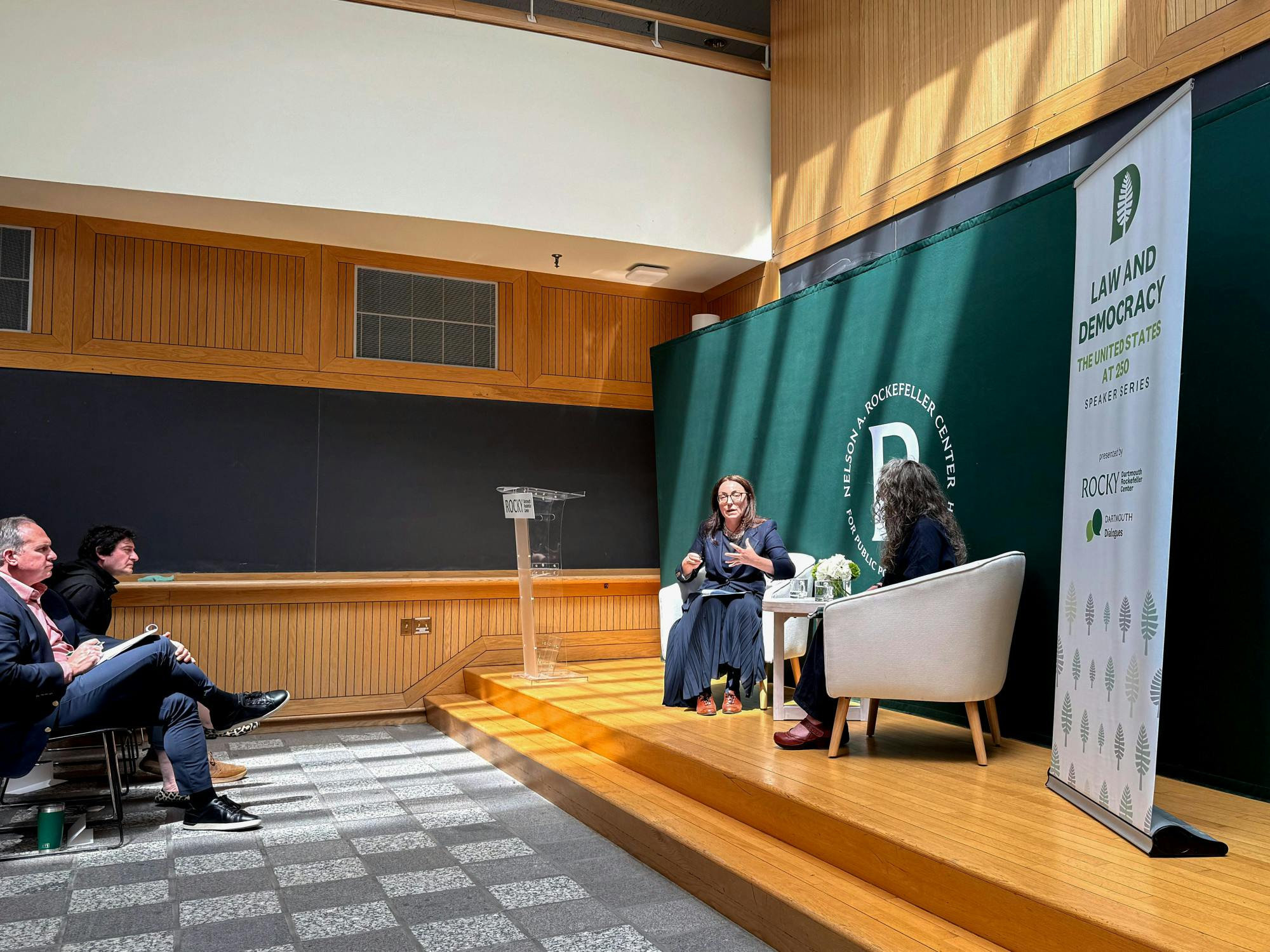
At a May 8 event hosted by the Rockefeller Center for Public Policy, New York University law professor Maggie Blackhawk discussed the centrality of American colonialism and Native American history to legal understandings of the United States Constitution.
The event, moderated by Rockefeller Center lecturer Julie Kalish, was part of the Rockefeller Center’s “Law and Democracy: The United States at 250” speaker series, which examines democracy and governance leading up to the 250th anniversary of the nation’s founding. Approximately 65 people attended the talk in the Hinman Forum in Rockefeller Center, while another 300 watched the livestream, according to Dartmouth News.
Blackhawk, a member of the Fond du Lac Band of Lake Superior Ojibwe tribe, studies federal Indian law, constitutional law and American colonialism. In an interview before the event, she said her work focuses on how the U.S. has governed “non-subject populations — people that the U.S. doesn’t think are really part of its main polity.”
“The governing of all these areas and peoples has a continuous, almost uniform history,” Blackhawk said. “We understand it all so much better if we see the western expansion over the Mississippi with the Louisiana Purchase and the government before the Northwest Territory as related to Indian country, Puerto Rico and the overseas territories.”
Blackhawk added that the U.S. is “stuck” in a narrative about its founding “that we’ve told ourselves over and over again.”
“It’s important to both learn how to be comfortable with these hard histories and … understand the present by engaging with Native communities and understanding the legal structure in which tribal governments exist,” Blackhawk said.
During the event, Blackhawk presented the history of the U.S.’s legal relationship with Native Americans, explaining that New England colonists viewed westward expansion as a “right of conquest” after the Seven Years’ War.
“One of [the colonists’] big disputes with Britain wasn’t just taxation without representation,” Blackhawk said. “It was whether or not they could go over and take land over the 1763 proclamation line.”
According to Blackhawk, narratives about the founding of the United States have often excluded Native perspectives. She discussed her participation in filmmaker Ken Burns’ 2025 documentary series “The American Revolution,” which Blackhawk said brought “Native history into big national conversations about the revolution and the founding for the first time.”
“There are over 570 federally recognized tribes in the U.S., and they govern several land masses, so that visibility is step one” for starting these conversations, Blackhawk said. “Step two is generating interest in the topic, learning more about Native history, its relationship to US constitutional history and how they relate to things that are happening today.”
Blackhawk explained that Native history is significant not just in “governing Puerto Rico, American Samoa, and Indian country,” but also in other legal areas.
“These laws and histories are contributing to how we handle immigration law, foreign affairs, citizenship, treaty power, the war on terror and the war powers of the United States in the context of exigency or emergency powers,” she said.
During the interview before the event, Blackhawk explained that her conception of a “mature constitutionalism” aims to “think outside” rights granted by the American government and directly consider the “power, self-determination and sovereignty” of Natives and other groups that the United States doesn’t consider part of its traditional polity.
“Looking at subordination in the context of Native people, citizenship and rights actually make the problem worse,” Blackhawk said. “What helps is to empower that group and allow them to have their own government.”
Attendee Mattea Pipestem ’28 said that, as a Native American student, it was “great” to hear a perspective “people really don’t know” spoken about on campus.
“It was nice to have somebody so involved with Indian country come and speak from the heart,” Pipestem said. “I’m always surprised to hear how a lot of U.S. citizens don’t know how much land in the U.S. is owned by federally recognized tribes.”
Hanover resident John Wheaton, who grew up on the Coeur d’Alene reservation in northern Idaho, said he was “surprised” at the country’s overreliance on the Supreme Court for establishing federal Indian law over history.
“I always understood tribal law as based on the rule of Congress,” Wheaton said. “In terms of how [federal Indian law] squares with current politics, that’s really a challenge.”


