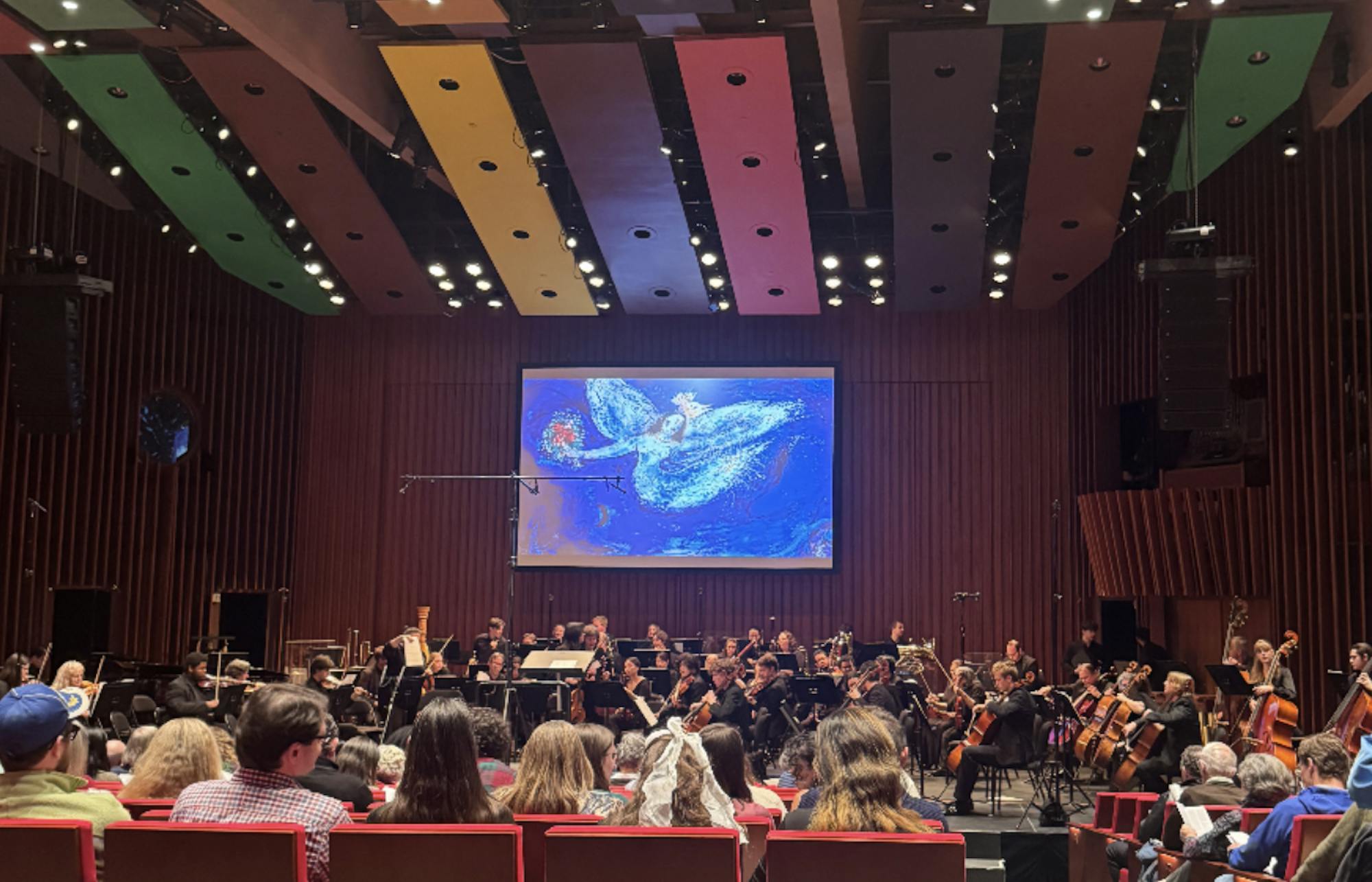
On May 8 and 9, Dartmouth Symphony Orchestra and the Dartmouth Dance Ensemble presented “Firebird,” a simulcast performance of Russian composer Igor Stravinsky’s “The Firebird,” a 1910 ballet. The DSO performed live in Spaulding Auditorium in the Hopkins Center for the Arts, while a projection of the dance ensemble played behind the musicians. In the Daryl Roth Studio Theater, the dance ensemble performed to a live audio feed of the orchestra.
The idea originated from a casual conversation among DSO music director Filippo Ciabatti, DDE director John Heginbotham and choreographer-in-residence Rebecca Stenn. Ciabatti wanted to stage all three of Stravinsky’s major ballets: “The Firebird,” “Petrushka” and “The Rite of Spring.” The Hop launched the series in 2018 with “Petrushka,” which a team led by the late Todd Campbell simulcast across the Moore Theater and Spaulding Auditorium to accommodate the production’s scale. “The Firebird” is the second installment.
Heginbotham said that the “ambitious” project felt “appropriate” given the size and scope of the Hop renovations.
“We had such a great experience combining the theaters, before, that we were excited to do it again — and with the new revitalized Hop,” said Heginbotham.
Russian art critic Sergei Diaghilev commissioned Stravinsky to compose “The Firebird” for the Ballets Russes in Paris in 1910. Ciabatti said Stravinsky wrote the score “with the concept that Diaghilev had in mind about this Russian fairytale,” drawing inspiration from his teacher Nikolai Rimsky-Korsakov and other composers of the period. “The Firebird” tells the story of a prince’s quest to defeat an evil sorcerer, and the intervention of the magical Firebird.
“This piece then became so popular and iconic very fast,” Ciabatti added.
Ciabatti said he approached the “demanding” piece with “great discipline and great care.” “It’s a very episodic score because the score is very narrative, very descriptive,” he explained. “It’s also very fragmented.”
This piece highlighted the potential of DSO, which “has grown tremendously in both the quality of the music and the ambitiousness of the projects we’ve been facing,” he said.
The DSO is composed of students, faculty, graduate students and professional musicians. Cellist Ava Rosenbaum ’26 opened the concert with Erich Korngold’s “Cello Concerto, Op. 37,” which she selected when auditioning for the soloist role. In an interview, Rosenbaum explained that she first learned the Korngold concerto in high school. Returning to it for her DSO solo audition felt “obvious” and “full circle,” she explained.
The Korngold piece is featured in the 1946 film “Deception,” which is about a love triangle between a wife, a cellist and a composer. After watching the movie in high school, Rosenbaum recalled the joy in noticing the plot-driven musical choices.
“It’s very cool to be able to draw the connections to a real-life film,” she said. Rosenbaum’s solo moves through “contrasts in emotion.”
“The main opening theme is very proud and exciting and declaratory,” she said. “Then this middle section is a complete opposite — this beautiful Hollywood, rolling, romantic music. It ends at this really high note on the cello and the orchestra's very atmospheric. Then it slowly leads into the original fast allegro.”
Rosenbaum said that she was able to “lose [herself] a bit more in the music” during her second performance, calling the chance to perform the piece twice — once on Friday and once on Saturday — “incredible.”
While Rosenbaum performed, a painting by Stenn titled “After Chagall” was projected behind the orchestra in Spaulding Auditorium. According to Heginbotham, Stenn’s painting was inspired by painter Marc Chagall’s backdrops used in the 1945 American Ballet Theater performance of “The Firebird.”
The DDE’s costumes, designed by guest choreographer Trebien Pollard, and the lighting design were also heavily influenced by Stenn’s painting.
“Everything in that show [at the Hop] is sort of based on the blue and red which are very present in Rebecca Stenn’s painting,” Heginbotham said.
During Rosenbaum’s solo, Pollard and Stenn performed a duet in the studio to music by composer Jay Weissman, Stenn’s husband.
The program then moved to Stravinsky's “Firebird,” which was performed simultaneously across both theaters.
The dance was choreographed by Heginbotham, Stenn, Pollard, tap choreographer Jessica Volan Trout-Haney, student choreographer Noemi Mesropian ’26 and members of Theater 29, a class offered by the Department of Theater to create work with the guidance of Heginbotham and Stenn. The dance was performed by DDE, Theater 29 students, Dartmouth graduate students, community members, Dartmouth faculty and Hopkins Center staff.
Early in the production process, Ciabatti recommended DDE rehearse a specific recording of “The Firebird” that matched the DSO’s intended tempo, which the dance ensemble used in rehearsals throughout the year. Although “The Firebird” is traditionally performed as a ballet, Heginbotham said he and his colleagues “knew from the very beginning that we were not going to attempt to do a traditional version of the tale, which so many companies do.”
Instead, the dance is a “collage” of styles and influences. Heginbotham said he wanted the rendition to focus on “energy and emotion and color and texture” rather than on “Russian fairy tales, which were strewn together in the original version.”
Heginbotham said this performance was “a more abstract storytelling, a more pure dance, pure music style rather than something being anchored in text.”
In the finale, the theatrical lighting expanded from the stage to shine on the audience as well as the performers, placing everyone inside the show as the music swelled from the other theater. “We're all in this together — we’re all literally in the show together,” Heginbotham said.
Rosenbaum said that the simulcast experience changes the way the audience understands the performance.
“I think it adds another meaning to the musical choices you’re making. There’s quite a story behind ‘The Firebird,’ and being able to think about that story while you're playing is a better experience.”
Ciabatti said he hoped audiences responded to the full scope of the production.
“I hope [the audience] feels really engaged by the music, by the performance, the colors of it, the story and I think, just a great impressionistic painting of what this story wants to be,” he said.