
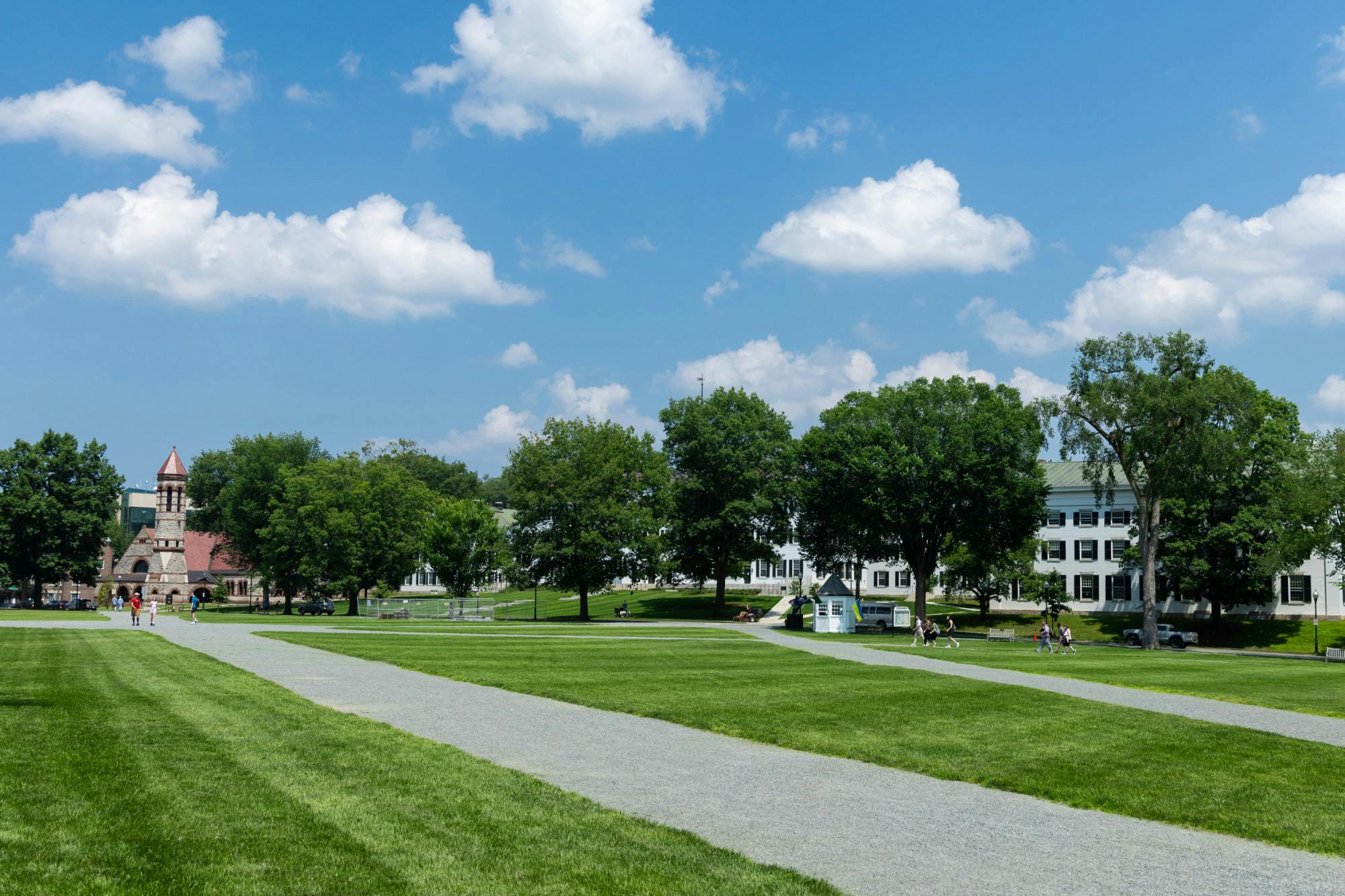
Upon first glance, it is hard to pinpoint exactly what makes the energy of spring term feel so immensely different from winter. Is it simply the absence of the snow that once blanketed the Green? Is it the rejuvenation students feel returning to Dartmouth after off-terms, or a much needed two-week reprise? Either way, walking across campus on the first day of spring term was like walking through an idyllic college brochure, with the almost startlingly blue sky, relaxing breeze and hundreds of students sprawled across the Green soaking in the sun. Everything was a quintessential representation of what college should be — fun, friends, freedom. But while my fellow students were bathing leisurely in the fresh spring air, I was trapped in a hell of my own creation.
Recently, my time at Dartmouth has been characterized by a kind of desperation that is hard to fully encapsulate. Maybe it started in my Introduction to Public Policy course this past winter, where I watched my peers dazzle our professor with clever questions, niche background knowledge and an almost photographic recitation of our readings. Maybe it began when, trying to schedule lunch with friends, I realized that nearly every minute of their day was occupied with clubs, pre-professional meetings and jobs. Looking at my own schedule — which I had once considered to be a healthy balance of work and fun — my days began to look disconcertingly sparse.
So I entered spring term with a new resolution: to make myself as busy as I possibly could. This involved enrolling in four courses, throwing myself into every club whose email landed in my inbox and convincing myself that I now possessed a myriad of previously-unknown academic passions.
For the first week or so, it worked. My days quickly became swallowed by classes, homework, dance, miscellaneous meetings and new clubs. I attended speaker events, like when the Dartmouth Investment and Philanthropy Program hosted CEO Gregg Lemkau, despite having no interest whatsoever in investment banking. My Google calendar looked like a child’s sidewalk chalk art piece. I was able to call my parents at the end of a long day and tell them just how much work I’d done, how productive I had been. But somewhere along the way, this almost fanatical frenzy gave way to sheer exhaustion. I had to turn down social invitations that I was looking forward to; I found that I no longer had time to read novels, write poetry or even just spend time with my friends. The scary thing was that I no longer even wanted to. The things that had once brought me joy were now mere barriers to my thirst for success.
When I arrived at this realization, I knew that something had to change. But when I tried to drop the class that I didn’t enjoy as much as the others, I found myself confronted with a bizarre friction. In truth, there was absolutely no need for me to subject myself to a four-course term. No, I enrolled in four classes just to prove to myself that I could not only handle it but excel, the way I’d seen my peers do, the way I believed I had to. To drop a class would mean admitting failure — a validation of my perceived incompetence.
Going to an Ivy League university means that you spend your days surrounded primarily by some of the smartest and most driven young adults in the world. While this is a privilege and an incredibly inspiring experience, it is simultaneously disorienting. Students who lose sight of the real world begin to believe that everyone is smarter, better connected, more passionate than them. Rather than striving to become better, such students feel defeated and unworthy.
In reality, I was not behind in winter term. Even though I’d taken three courses, not four, and had opted to take COLT 10: Children on the Streets, a course that I was genuinely interested in, instead of a government or economics class that many would consider to be the practical, career-oriented choice, I was still doing well and not falling behind. The difference was, in the winter, I had enough free time to truly enjoy and revel in the courses I was taking. I was not so swamped by readings, exams, papers and extracurriculars that I could not take a step back and realize just how much I relished my professors’ lectures and class discussions, and how simply invigorating it felt to be able to study something I loved. This is the true purpose of a collegiate education — to pursue passions and interests because you want to, not because you feel compelled to.
Even so, I haven’t quit all of the new activities I started this term. Going to meetings for clubs like Cabin and Trail, Planned Parenthood and World Affairs Council that I would never have previously considered introduced me to new passions to explore and people I wouldn’t have encountered otherwise. Exploration is a deeply valuable experience as well, even more so when done out of genuine interest and not an attempt to merely fill your Google calendar.
Prioritizing yourself and the things you enjoy does not put you behind. Instead of flying from meeting to class to club to meeting again, I now leave myself time each day to indulge in my interests, spend time with friends or else simply appreciate the sporadically pleasant weather. In doing so, I have found that it is easier to complete assignments and participate in clubs, because this time my efforts derive from a genuine love for learning and not an artificial desperation. So as we move further into spring term, I hope that more students will take a moment to truly reflect on why they do what they do and allow themselves time to take advantage of all the new pursuits that spring term at Dartmouth has to offer.


