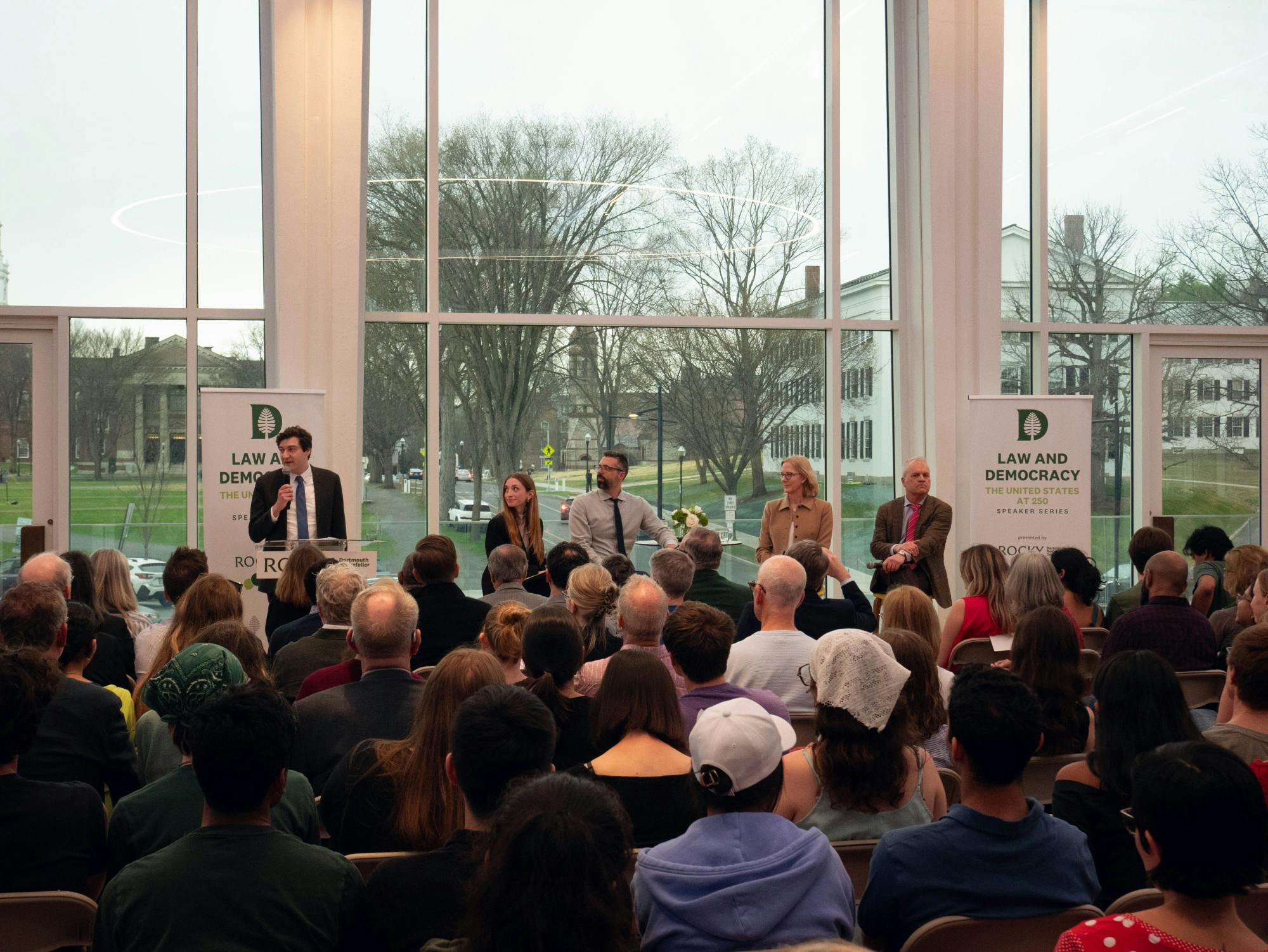
New York Times opinion columnist and host of “The Ezra Klein Show” Ezra Klein said Democrats must treat “communicating with the American people” as “part of democracy” in the next election cycle during an event hosted by the Rockefeller Center for Public Policy on April 16. The event also featured Ford Foundation president Heather Gerken, who formerly served as the dean of Yale Law School. The Ford Foundation is a non-profit that aims “to reduce poverty and injustice, strengthen democratic values, promote international cooperation, and advance human achievement,” according to their website. It has one of the largest private endowments in the United States.
The event — which was moderated by government professor Russell Muirhead and Dartmouth Political Union ambassador Grace Wilkins ’26 — was part of the Rockefeller Center’s “Law and Democracy: The United States at 250” speaker series, which has invited numerous speakers to campus for conversations about “the nation’s founding ideals by focusing on the laws, policies and institutions in which those ideals are embedded,” according to the Rockefeller Center’s website. Approximately 220 people attended the event in the Hopkins Center for the Arts, according to Rockefeller Center associate director for public programs and special events Dvora Greenberg Koelling. An additional 180 people watched the livestream.

The event centered around the future of American democracy and featured discussion about Klein’s 2025 book “Abundance.” In an interview with The Dartmouth before the event, Klein said he took “some of the achievements of liberalism and some of the guardrails that existed in our politics” for granted before President Donald Trump’s second term.
“I just assumed they would always be there,” Klein said. “Something about the two Trump eras made me realize maybe they won’t be. It made me understand that what it took to get to the more stable political systems of the late 20th century was a kind of miracle, and an inheritance worth fighting for.”
Gerken was not available for an interview with The Dartmouth.
During the event, Gerken said she believes that it is “wrong” to think that the next election will be “vulnerable” because democracy is resilient. She discouraged people from “talk[ing] themselves out of” voting.
“It is a pretty sturdy system,” Gerken said. “There are a lot of protections in there, and there’s one step after another to protect it,” such as the “decentralization” of elections.

Klein said the Democratic Party agenda must be “impatient” with institutions that “aren’t working” to connect with voters.
“For the left … to succeed in this country, it has to fundamentally chart a course between the destructive relationship to institutions that the right has developed as a kind of anti-system party, and the defensive relationship to institutions,” Klein said.
Gerken said when Democrats come back into power, they cannot “go back and try to rebuild what existed,” but must use “an act of imagination” to ensure that “institutions can deliver on the promises that they should be making.”
“We are going to have the task of dreaming a new democracy into existence,” Gerken said.
Klein criticized the Democratic Party for being “a party of lawyers” who are “more attached to process than outcomes.”
“What makes a system legitimate is if it solves [constituents’] problems,” Klein said. “If you are not solving their problems, if their problems are getting worse under your tenure, then your system is becoming illegitimate.”
Gerken pushed back against Klein’s criticism of Democrats, saying that lawyers are “incredibly useful” when defending democracy.
“If you look across the world, you will often see that the last bastion of defense on the rule of law is the lawyers … because deep in their bones they understand there are some things where the rules are so basic that if you don’t have them, society can’t function,” she explained.

Klein said that in terms of reforms, he would advocate for a national ban on gerrymandering and “expansive” campaign finance reform, as well as changes to the filibuster, a Senate procedure which requires 60 votes instead of a majority for bills to pass.
The filibuster — from which budget reconciliation bills are exempted — creates a “weird tilt” in the American system towards financial issues, Klein said.
“The reasons you need to change your system are the reasons your system is hard to change,” he said.
Gerken agreed that there are “too many veto gates” in the federal government and that the country lacks an opposition that dissents but is “loyal” to the government and its authority.
“We just have opposition,” she said. “If we had a loyal opposition, people could get things done when they have a mandate.”
Klein said he thinks the “single biggest danger to democracy” is that the Democratic Party has become “fundamentally uncompetitive” in rural America. He explained that rural states Democrats could previously win — such as West Virginia and Ohio — are now “unwinnable” because Democrats don’t appeal to voters there.
Instead, the Democratic Party “needs a bigger tent” of viewpoints that can win across the country, Klein said.
“You have to just hate losing more than you’re annoyed by disagreement,” Klein added. “You have to be more afraid of fascism than you are upset about people only being with you on 70% of the issues.”

Attendee Jude Poirier ’28, who asked a question about the difference between policymaking in state legislatures versus in municipalities during the Q&A portion, said he believed Gerken gave an “excellent response” to his question. She said that states are run by “amateur legislatures” and are “highly dependent on lobbyists and networks” to pass legislation.
“In a lot of town legislatures, for some reason, it’s just a lot of old retired people,” Poirier said. “But at the state legislature side, there are a lot of amateur legislators that make it easy to get stuff through.”
Eliza Dorton '29 is a reporter from Washington, D.C. and is studying English and public policy. Outside the classroom, she enjoys reading and going on walks.