
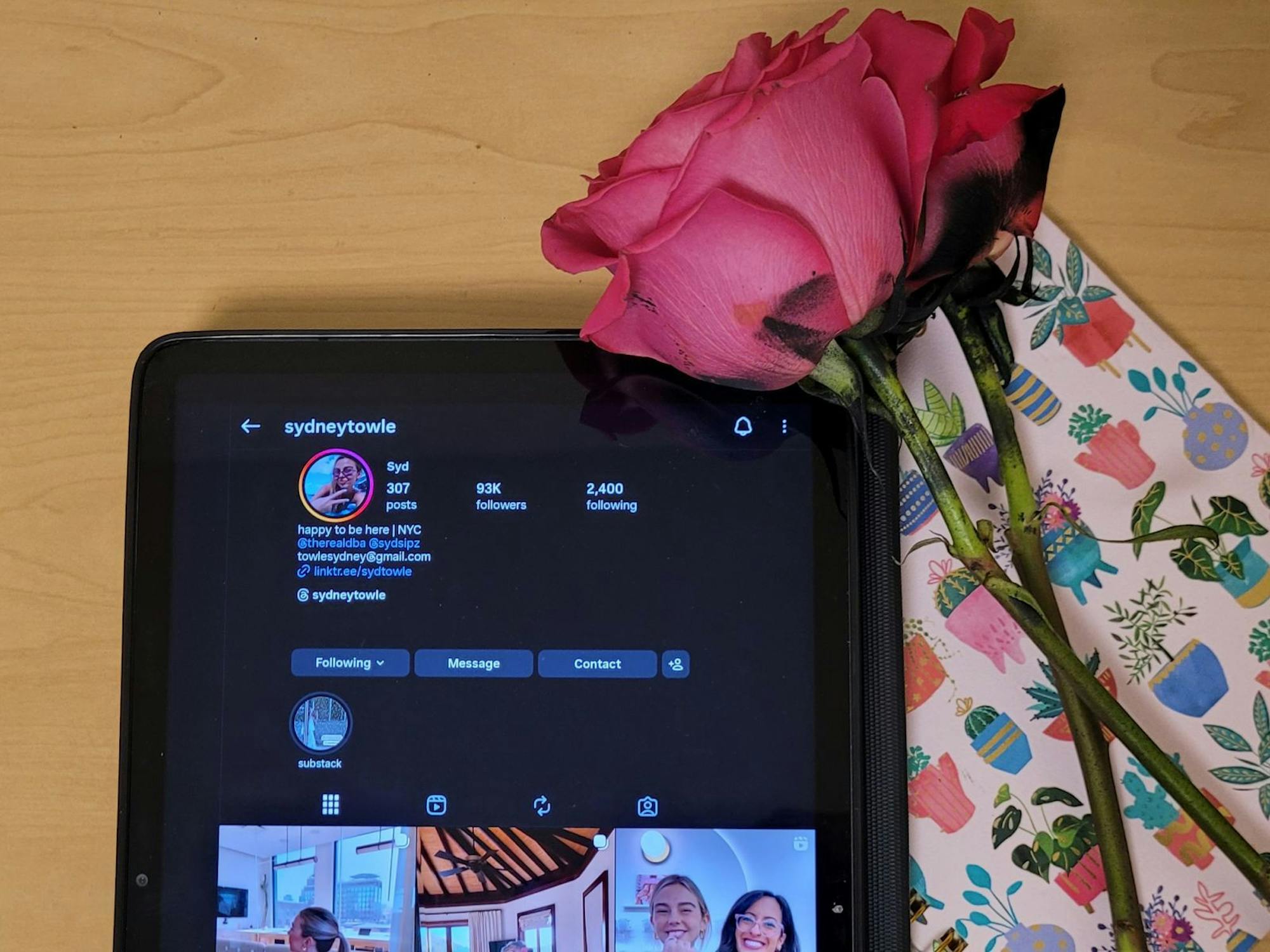
After being diagnosed with a rare and aggressive cancer shortly following her Dartmouth graduation, Sydney Towle ’22 turned to social media. Towle has since gained celebrity online for her raw, candid account of fighting cancer. As of January 2026, Towle’s TikTok account has over 800,000 followers and her Instagram has over 60,000 followers.
Towle’s content has drawn criticism from Reddit groups that accused her of faking her diagnosis. A May 2025 New York Times article about Towle confirmed with her doctor that she had cancer.
Towle started posting dance videos to her TikTok account as a Dartmouth student during the COVID-19 pandemic and later began to post about her struggles with mental health and cancer. During her time at the College, Towle majored in government and environmental science. She was involved with the Sustainability Office, Alpha Phi sorority and was a columnist for The Dartmouth. The Dartmouth sat down with Towle to discuss her career as an influencer and why she chose to share her cancer story online.

How did you start your TikTok account? What has been your journey since graduating from Dartmouth?
ST: I started making TikToks at Dartmouth during COVID-19. Because we were all sent home from school, I didn’t really have anything to do. I started doing silly TikToks, like dances. When I graduated and moved to Los Angeles, I started talking directly to the camera about things I was dealing with because I struggled a lot with mental health at Dartmouth and right after Dartmouth. When I was diagnosed with cancer, I began sharing that story as well because I was already posting everything already.
What inspired you to begin sharing your cancer story on social media?
ST: There honestly wasn’t one point where I thought, “Oh, I’m going to share my story.” I came home from getting the paper that said I had cancer. I was in tears and just didn’t know what to do. I was like, “Well, you guys have been through it all. You’ve seen me the past few years, and now I have cancer.” That video went viral because I was a young person and didn’t have any symptoms prior to having cancer. From then on, it turned into this much larger community.
How do you navigate both online support and criticism of your social media accounts?
ST: I took criticism really, really hard before, especially last year. The Reddit and the New York Times article situation was a really hard point for me. I had just moved to New York and my treatment had stopped and was not working as much anymore, so I was already mentally really, really challenged. Then I saw on the Reddit thread that people were saying that I was faking having cancer. That made me think, why did I share it on social media in the first place? It made me really regret it. When the New York Times article came out, it completely did a 180 and people were like, okay, she does have cancer. All the criticism stopped. I remembered why I started posting in the first place — it’s for all the people that I am helping. I’m building a community now. If I do get criticism, it is really rare now, and if I see it, I just block people.
What has been the most meaningful part about being an influencer?
ST: It’s hard to even consider myself an influencer. The most meaningful part to me is being able to connect with people who have also gone through something challenging and who are still going through something challenging. What’s most impactful for me is when people stop me on the street and they say, “I got a mammogram because of you, and I did this test because you did it, and it turns out I had cancer.” Advocating for cancer, especially rare cancer among young people, has been such a passion of mine that I obviously never thought that I would get into when I graduated from Dartmouth.
What parts of the job have been most challenging?
ST: I share a lot of my life online and that obviously opens up a lot to criticism and people expecting a lot from me. If I’m having a really bad day or week and am physically unable to post, people think something bad happened. It’s hard to keep people updated while also preserving your own mental health and your own peace.
How does your experience at Dartmouth impact who you are today and influence you in this career choice?
ST: A lot of people have a very mixed experience at Dartmouth. Overall it was positive, but I definitely struggled a lot with my mental health. In several ways, it was some of the happiest times I’ve ever had in my life but also some of the darkest and loneliest times. That has carried through with how I treat people now. In addition to having cancer, I’m very, very empathetic towards others, and I know that we’re all going through something. I saw at Dartmouth a lot of what other people were going through. My experience handling adversity there has made this slightly easier because I’ve been in a situation where I felt lonely and down before.
What do you hope people take away from your account and your story?
ST: Treat people with kindness and empathy first because you never know what they’re going through. One of the most common comments I get from other people is that you don’t look like you have cancer. Then I find that people treat you significantly differently when they find out that you do. You never know what someone is going through. There are so many invisible illnesses, whether they be mental health or physical, and we should always be kinder to each other. That’s a common theme that I express a lot. The other thing is that things can sneak up on you when you least expect them. I would always, always advocate for people to, if they feel like something is wrong with their health and out of place, listen to yourself and go to the doctor. It’s always better to be safe than sorry. That’s what I wish I could say a lot, especially to young people who are oftentimes dismissed.
What advice would you give young people who are looking to tell their personal stories through social media?
ST: Just be as authentic and vulnerable as possible. I cry online, and I know some people feel like that’s cringey, but I try to show every emotion of what I’m going through. That’s what helps people relate because you see me going through every single up and down and anxiety. If you want to tell your story, try to tell it in the most honest and authentic way so people resonate with you and make connections.
This interview has been edited for clarity and length.
Isabela Pierry '29 is a reporter from New York and is majoring in comparative literature and government.
Madeline Kahn Ehrlich '29 is a reporter from upstate New York. She is considering studying English and Public Policy. She enjoys creative writing, art and reading historical fiction.


