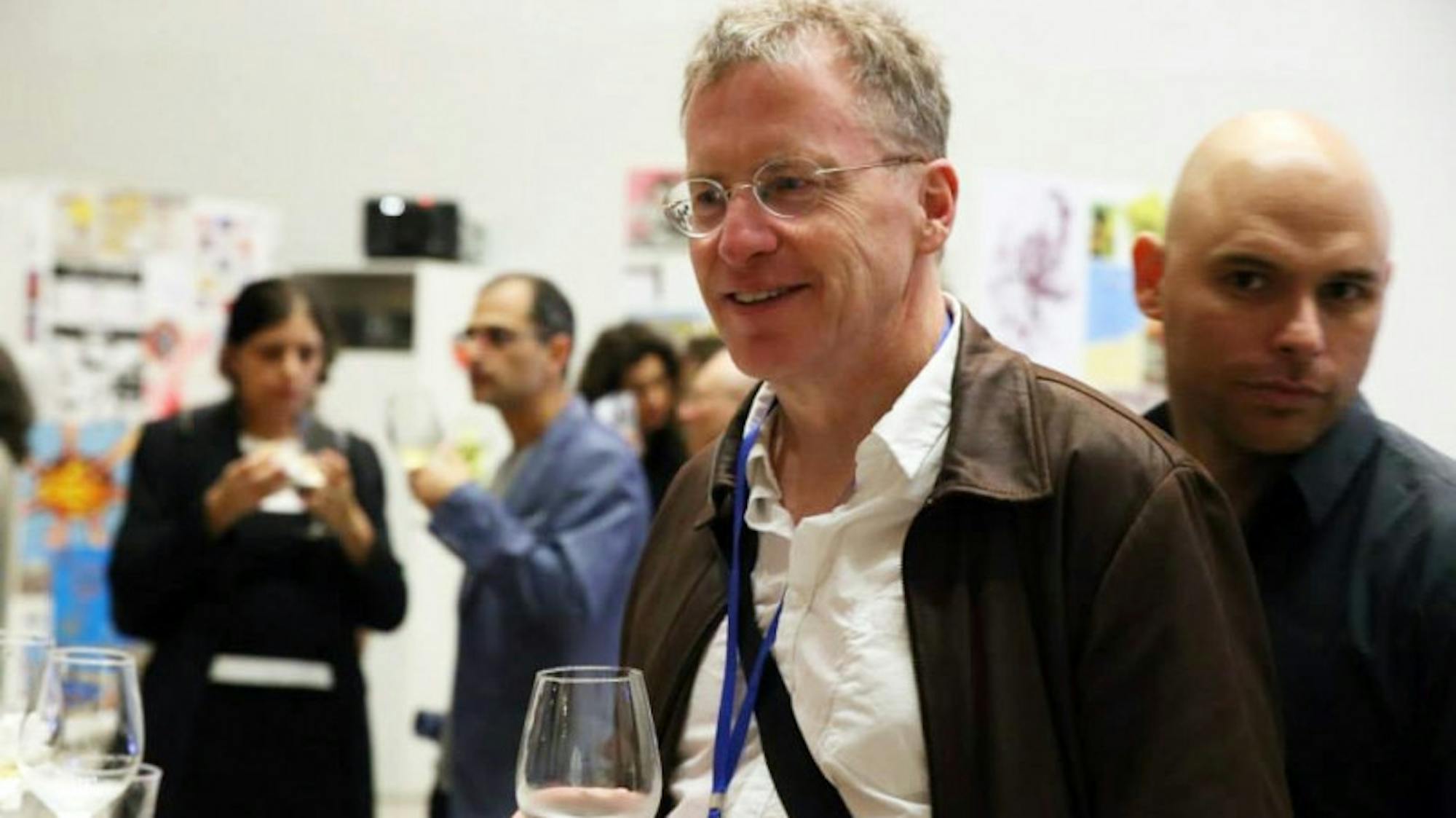
The Hopkins Center for the Arts celebrated film and media professor Jeffrey Ruoff’s 24-year career at the College in an event on Oct. 5. Hop Film showed five of Jeffrey Ruoff’s films and held a reception in his honor.
One of the highlights was a short 2024 film titled “Bon Voyage.” The movie documents Ruoff’s struggle with clinical depression and his relationship with his family. Over the course of three years, his brother sent him a postcard every day with messages of love and support.
“When I got better, I realized that … it’s unlikely or even impossible that anyone else would have an archive like that,” Ruoff said. “So I felt somewhat compelled to make that film as a result of that thought.”
Visiting professor of film and media studies Joanna Rapf said she “admired” Ruoff for making the film “and even more for sharing it.”
“It is profoundly moving and eloquent,” Rapf said. “It is about life, and coming to life.”
Film and media studies professor William Phillips ’71 further praised Ruoff’s “touching” approach to the story.
“To me, that is the hardest kind of filmmaking — the kind of filmmaking that makes you almost squeamish, yet reaches out to you and engages you in something,” Phillips said.
The Hop’s film program manager Peter Ciardelli hoped the film can “help” viewers who may relate to Ruoff’s struggles.
“I know it has helped a lot of people already,” Ciardelli said.
Also shown at the screening, Ruoff’s 2021 film “You Know, Like, Zoom” is made up of a sequence of recordings of his history of documentary class at Dartmouth during the pandemic. Ruoff explained that the film plays with “pragmatic or practical markers” in speech such as “oh, um, ah, you know.” In the film, Ruoff repeatedly uses many of these filler words, while the film has been edited so these words are removed from the students’ speech.
“I have friends who think that way of speaking is the end of Western civilization,” Ruoff said. “I think I side with the sociolinguistic linguists who argue that it’s not possible for people speaking their own language to make mistakes.”
Ruoff explained that the impetus for the film was his interest in “tracking all of the things that make Zoom a hassle for everyone.”
“I was very glad that people laughed,” Ruoff said. “It’s meant to be a funny film.”
Ciardelli said he believes that the movie can serve as a memento of the pandemic because though it “felt like forever” in the moment, now sometimes it feels like “a weird leap in our history.”
Another film by Ruoff featured in the screening, titled “Still Moving,” uses live action footage, archival materials and interviews to tell the story of the dance company Pilobolus, which formed at Dartmouth when Phillips was a student.
The other two short films by Ruoff included in the screening were “By Any Means,” which transforms audio from Dartmouth College Radio’s 1965 interview with Malcom X into spoken word poetry, and “Through the Looking Glass,” which uses recordings of NBA broadcasts to juxtapose the league’s hyper-masculine athletes with commercials featuring eroticized women.
Besides his work as a filmmaker, Ruoff’s colleagues praise him for the range and depth of his contributions to Dartmouth’s film and media studies program.
“What I respect most about Jeff, more than anybody else in our department, is that he covers both the academic side of the equation of film education and the production side,” Phillips said.
Beyond his professional achievements, Rapf praised Ruoff’s “down to earth” demeanor.
“He loves movies; he knows movies. He is a fine scholar, but he is just first of all a good human being, the kind of person you like to have as a friend,” she said.