Misoo Bang is a Vermont-based Korean-American artist whose paintings and drawings engage with both personal and cultural experience, exploring themes of trauma alongside identity, healing and empowerment. Named as one of the 10 emerging artists of New England by Art New England in 2019 and one of the Vermont artists to watch by the Vermont Arts Council in 2020, her work has been exhibited across the U.S. and internationally. She is also a lecturer at the University of Vermont, teaching Studio Art.
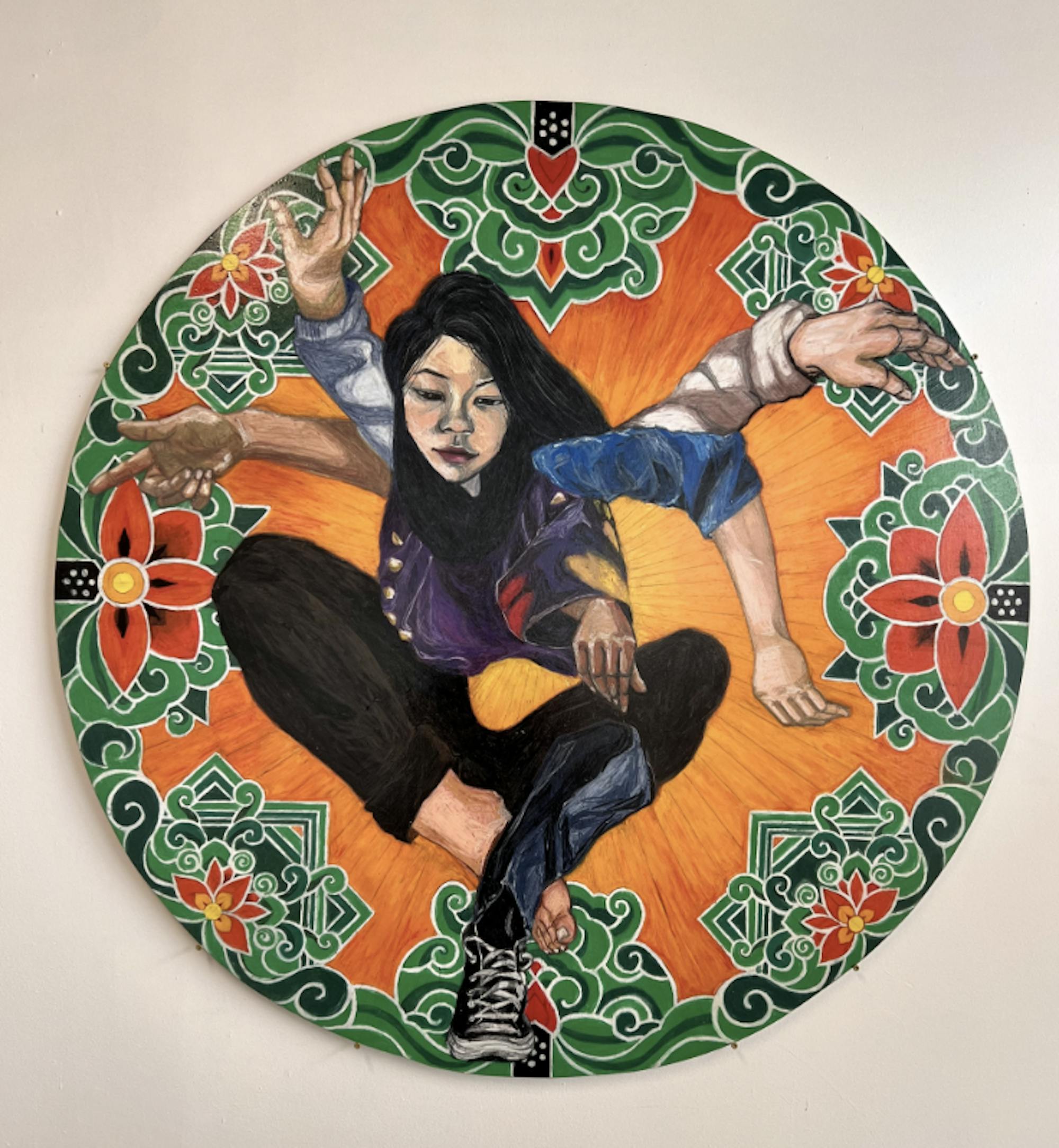
Bang’s exhibition “전미개오 轉迷開悟: Buddhist Teaching of Being Freed of Anguish and Reaching Nirvana” opens at the Alliance for the Visual Arts Gallery in Lebanon on August 22. The featured works include those from her “Giantess” series depicting sexual violence survivors alongside her “Giant Asian Girls” series depicting Asian-American women and “Lotus Flowers” series depicting Buddhas and female Bodhisattvas using the technique of Taenghwa. A traditional Buddhist technique, it involves the meditative application of stone pigments.
The Dartmouth spoke with Bang to discuss her upcoming exhibition.
What inspired the “Giant Asian Girls” series and “The Giantess” series, respectively?
MB: As an Asian American woman, I have experienced that we are kind of looked at in a certain way: people compliment our small body type or how young we look. A lot of these things can sound nice, but it also kind of emphasizes how small and quiet we are, and I was upset with that. Even though I’ve lived in the U.S. for many years, I’ve felt that Asian women living here are sometimes treated like outsiders. This series was my expression of how to react to that.
The shooting of Asian Americans in Atlanta during the pandemic also made me really upset. So I started making more of the Giantess Series, which are about how big we are and that we are not how the Western male sees us. Sometimes they see us as exotic female figures, and I wanted to fight that. I also sometimes put images of Western culture behind the Asian women as a collage. I make the Asian woman really big and the images of Western culture a lot smaller because I want to show that we’re not that powerless or quiet. I’m reversing the power dynamic.
The Giantess Series depicts survivors of domestic sexual violence. Because I’m also a survivor, I wanted to talk about the subject. Local women who are survivors of domestic violence volunteered to be my models. In my painting, I empower them. The models who came to me were the number one inspiration for my work. I’ve thought about how these survivors of domestic violence or Asian women living in America live in this confined society where they’re not able to talk about it. There’s the societal taboo of not talking about these things, especially sexual abuse.
So to come to me saying, ‘I want to be a model in the Giantess Series,’ and showing their face and name and sharing their story was very courageous and a big inspiration for me. When they see the painting, sometimes they say, ‘I will keep this image in my mind all the time.’ And that makes me very happy. That’s a big reason for why I’m making the art.
What inspired your paintings of the Buddhas and Bodhisattvas?
MB: The main inspiration was finding my heritage. After I moved to Vermont in 2014, I always had the urge to go back to Korea and learn more there, because all of my art education was from America. The art history classes that I took were concentrated in Western history, and the techniques that I was using, like acrylic painting, were also based on Western techniques. I always thought I had a responsibility to go back and know my roots, so I started going back to Korea every summer.
I partly wanted to make religious Western culture smaller. I was upset with how so many Korean people are Christians today because I was like, ‘What about our gods that we used to worship before Western culture came into our country?’ The message is all about love, but Christianity also has a history of conquering and changing people’s faith.
Buddhism started in India, but as it transferred to different countries, it also accepted other cultures and their existing religions. So every Buddhist painting is a little bit different: if you look at Korean Buddhist art, we have our own gods in the Buddhist painting too, like our traditional gods are in there. So I was also really attracted to how accepting Buddhism is.
I was also interested in the teaching of Buddha that nothing lasts forever: our wealth and possessions and youthfulness, but also our feelings. That gave me relief to know that whatever nightmare or bad situation I’m going through, or even the luckiest or happiest part in my life, doesn’t last forever.
So I started studying Buddhist art; that’s how I started making the Buddha and Bodhisattva images. I am not Buddhist — I am not a religious person — but I love the teachings.
Can you tell me more about the Taenghwa painting technique?
MB: I use stone pigments. They are not easy to buy here, so I need to go to Korea or sometimes Japan. They are like actual jewels that I mix with oil and then apply. The reason that Asian paintings last thousands of years without fading is because they use these pigments: they apply very fine powders of lapis lazuli on top of the paper until it cannot absorb anymore. When you use these powders, the painting also shines, so I was drawn to that.
It’s very meditative, but it’s also very frustrating because I’m an artist who likes to make everything fast. Asian painting, especially the Taenghwa technique, needs so much patience. It needs like a whole day to prepare paper and then prepare the paint. Everything is from nature, so when I prepare the paper, I need to make my own glue with flowers, and boil them.
Unlike the Giantess paintings that I can just sketch and paint, it takes six months to multiple years to finish the Taenghwa paintings. Sometimes when I’m working on one, I have to stop and make my abstract painting because I get shaky, like, ‘I can’t do this anymore.’ They say your line needs to be still, so it’s like you need to stop breathing and draw the line; it’s a part of meditation. That’s why ancient monks painted Taenghwa as part of their training.
What do you hope people take away from this show?
MB: There's not many opportunities to see Asian art in Vermont or New Hampshire because they’re mostly white-populated areas. I don’t know how many people here have seen Buddhist art in person. So just opening people’s eyes to how there are things other than Western art is a goal.
This interview has been edited for clarity and length.
Avery Lin ’27 is an arts editor and writer from New York City. She studies Comparative Literature, including French and Classical Greek, at Dartmouth and also writes for Spare Rib Magazine.