
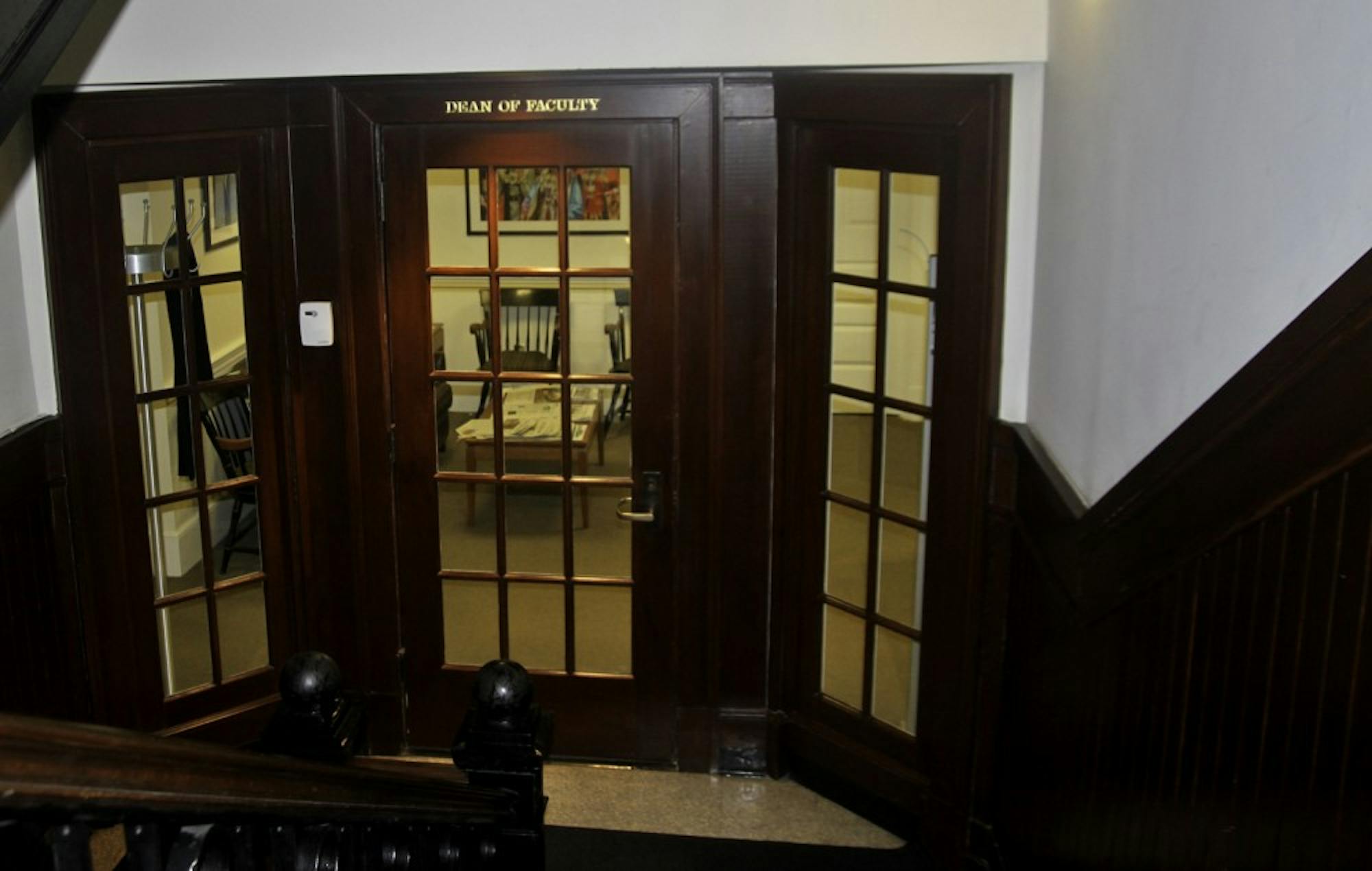
Potential changes to distributive requirements, class meeting times, grade inflation and upperclassmen advising were discussed at yesterday’s meeting of the faculty of arts and sciences. The meeting served as an open forum for both proposal and discussion, as several of the ideas discussed will potentially be put to a vote on June 1, dean of the faculty Michael Mastanduno said.
The session, which was introduced by College President Phil Hanlon and led by Mastanduno, featured both a vote on the proposal to revise an open-access policy that was originally proposed this past fall, as well presentations from Mastanduno and biology professor Mark McPeek about the means to increase academic rigor through a reexamination of current distributive requirements and grading practices.
Geography professor and chair of the committee on organization and policy Frank Magilligan began the meeting by proposing a revised resolution for an open-access policy, which was debated at the faculty’s last meeting in November. After Magilligan presented the revised measure, it was put to a vote and passed unanimously.
The goal of the policy, Magilligan said during his speech, is to allow publishers to access research produced by Dartmouth faculty for wider dissemination by developing an open college institutional repository, which will archive all subsequent research.
Previous concerns about the proposal addressed in the meeting included the difficulty of obtaining waivers to the policy. The revised policy will allow professors to access waivers online, both before and after publishing.
After the vote, the discussion turned toward academic rigor, with Mastanduno and McPeek discussing different aspects of the topic.
Mastanduno spoke about strengthening the College’s academic advising program and revising the distributive requirements for graduation.
While he said the first-year advising program is strong at the moment, the College must further bolster upperclassman advising, particularly in a student’s sophomore year.
“The second year is really important since its the bridge year before the major,” he said. “We have a great first-year advising program, but after that it doesn’t really exist.”
He said that upperclassman advising is imperative to thinking about the distributive requirements’ place in a broader liberal arts education.
Much of the later part of his talk then turned toward a discussion of distributive requirements, which he said were last changed in 1992.
Mastanduno explained that prior to the change, students at the College were required to take three classes in the social sciences, three in the natural sciences and three in the humanities, contributing to a much broader and less specific distribution of courses. He further noted that possible scheduling changes, with more time slots for course meetings added in the morning and the evening, as well as the implementation of 15-minute breaks between classes in order to allot more time for students to walk between buildings.
Mastanduno said that he thought that students were losing the core message of a liberal arts education.
“With the current system, students feel like they have to go around the curriculum, rather than work with it,” he said.
In order to aid this problem, Mastanduno said that the main focus of the curriculum review committee is to give students more ownership of their education by broadening distributive requirements and potentially reverting back to a model more similar to what existed at the College before 1992. Mastanduno also discussed a possible change to the non-Western distributive requirement and proposed lowering the number of courses which satisfy it from 200 to approximately 40 or 50. He said the change will provide students with a broader world view.
In the following discussion, several professors, particularly from the humanities and social sciences, voiced concerns about the proposed change to the non-Western requirement.
Native American studies and anthropology professor Sergei Kan said in response to Mastanduno that he felt that this change would diminish cultural understanding at the school and expressed concern that these classes might focus around a central bias dictated by administrators.
Other suggestions by the present faculty members were to develop a common core system similar to Columbia University’s model, though no concrete steps were offered.
After the lecture, Mastanduno said that he anticipates vigorous discussion amongst the student body about the proposed changes once they are officially announced to campus.
“There will definitely be a lot of different opinions,” he said. “It was obvious in this meeting that there are a lot of discussions to be had.”
He added that the increase in academic rigor serves only to show other institutions the high expectations that exist at the College for both students and faculty.
McPeek spoke after Mastanduno about diversifying grades at the College.
He explained as well as showing on a graph that since 1974, when the College switched from a 5.0 grade point average scale to a 4.0 scale, A-letter grades have become increasingly more common, with As and A-minuses making up just under 60 percent of the grades awarded to students at the College.
He said that professors must remember the fact that As are indicative of excellence, not adequacy.
“It’s not the grading system, it’s the graders,” he said.
He said that grades have increased at the same rate, saying that all grades will eventually all be a 4.0 if the trend of inflation does not end.
McPeek refuted the reasoning that students admitted to the College are of higher caliber, saying that SAT scores are not indicative of projected performance in higher education. He also addressed concerns about graduate school placement, saying that even poor-performers in the pre-medical program have been admitted to medical school from the College.
Several professors, including Kan, said that professors are more likely to award higher grades before achieving tenure, since professors with good student reports are rewarded with promotions and pay raises. Professors also said that standards of grading have changed, with stigmas around Bs and Cs becoming increasingly common among students.
Biology professor Ryan Calsbeek, a member of the faculty coordinating committee, said that he felt many of the points made in the meeting were legitimate. He also said that he understood the worry amongst humanity professors in regards to changes in distributive requirements.
“Enrollments might go down as students don’t take a class to fulfill a requirement,” he said, “I agree largely with the sentiment that a liberal arts education is about exploring all disciplines to a certain extent.”
He also said that he was frustrated by some of the backlash to diversify the grades given to students at the College, saying that he felt only excellence should be rewarded.


