
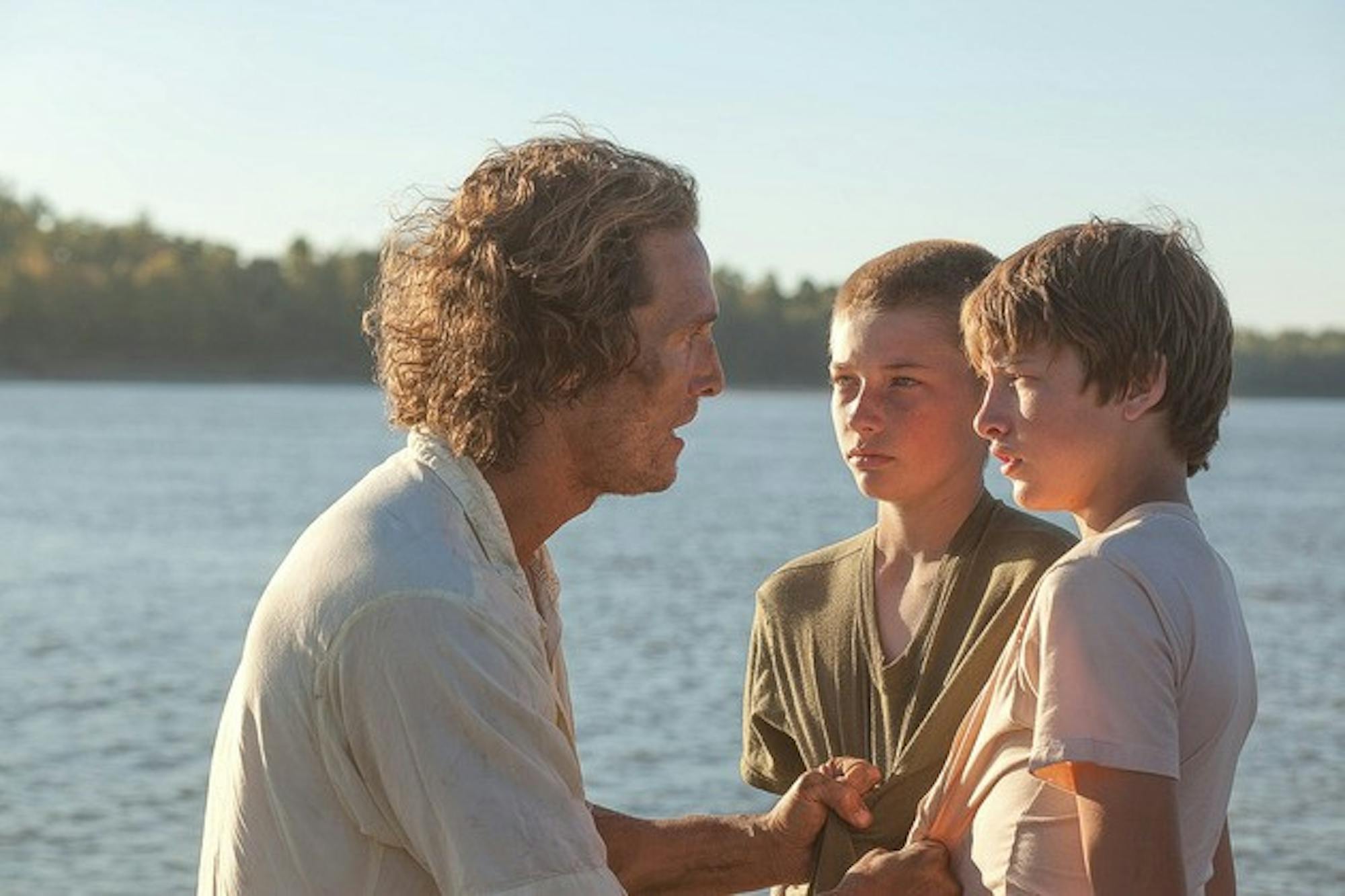
"Mud" starts during the impressionable middle school years of Ellis (Tye Sheridan). As he explores the rivers around his Arkansas home with his best friend Neckbone (Jacob Lofland), he stumbles upon a man living in a boat in a tree, the enigmatic and handsome Mud (Matthew McConaughey). The boys are enthralled by Mud and help him in his search for his girlfriend, Juniper (Reese Witherspoon), while protecting him from the law and the unsavory characters who want him dead.
Of the various works "Mud" pays homage to, Mark Twain is the most obvious. Ellis and Neckbone could be the Huckleberry Finn and Tom Sawyer of the 21st century. Of course, who else is Mud in this analogy besides Jim? Even the river that Ellis loves so dearly transcends mere symbolism and can be considered a full-blown character.
"Mud" actively engages in interactive symbolism with biblical references to snakes, the innocence of small-town America and the boat in a tree that Mud and the boys try to make seaworthy again.
What truly makes "Mud" so endearing is how realistically it portrays the process of growing up, especially as we watch Ellis's experiences. His parents are going through a rough patch, he's not exactly a lady killer and, when things go south, he acts like the scared kid he is. Ellis is only as good as Sheridan, who seems reminiscent of a young Joseph Gordon-Levitt and has potential staying power.
Lofland is also great as his sexcrazed, foul-mouthed side-kick who's loyal to a fault. Lofland channels a young Jack Nicholson, which is all the more amazing considering that this is his first acting role.
I feel like I should address McConaughey because he seems to get a bad rap. I like to consider McConaughey's career resurgence as a sort of milder and more PG version of Robert Downey Jr. After being pigeon-holed in some god-awful romantic comedies for most of the early 2000s. McConaughey has been on a hot streak lately with "The Lincoln Lawyer", "Killer Joe", "Bernie" and "Magic Mike." He's still the charming southern gentleman with that ubiquitous drawl and washboard abs, but he's managed to find the sweet spot for his niche and explore it in subtle ways. In "Mud," he channels a sort of deadbeat Jay Gatsby, but with a little less hopefulness and a lot more rugged caution of a man burned by a hot stove he can't help but go near again.
I can't finish my wrap-up without talking about its director, Jeff Nichols. I was excited to see "Mud" primarily because of his previous film, "Take Shelter," one of my all-time favorites. After watching "Mud," I would say that Nichols, along with "The Place Beyond the Pines" director Derek Cianfrance, will lead the next wave of American auteurs.
My earlier comparisons to Mark Twain were not completely pointless, as Nichols seems itching to take up Twain's place as the author of a whimsical and fantastical America, but he wants to do it while maintaining some sort of artistic range. Whereas "Take Shelter" concerned a man who was convinced the world was going to end, "Mud" focuses on a boy whose world seems to be ending, yet beginning at the same time.
Nichols is an Arkansas native himself, but to assert that "Mud" is a derivation of his life would not only be pure speculation, but would dilute the power of the film. The best coming of age stories are the ones that you can identify with, the ones that speak to you. "Mud" will strike up a conversation with you that'll last for hours.
"Mud" is currently playing at the Nugget.


