
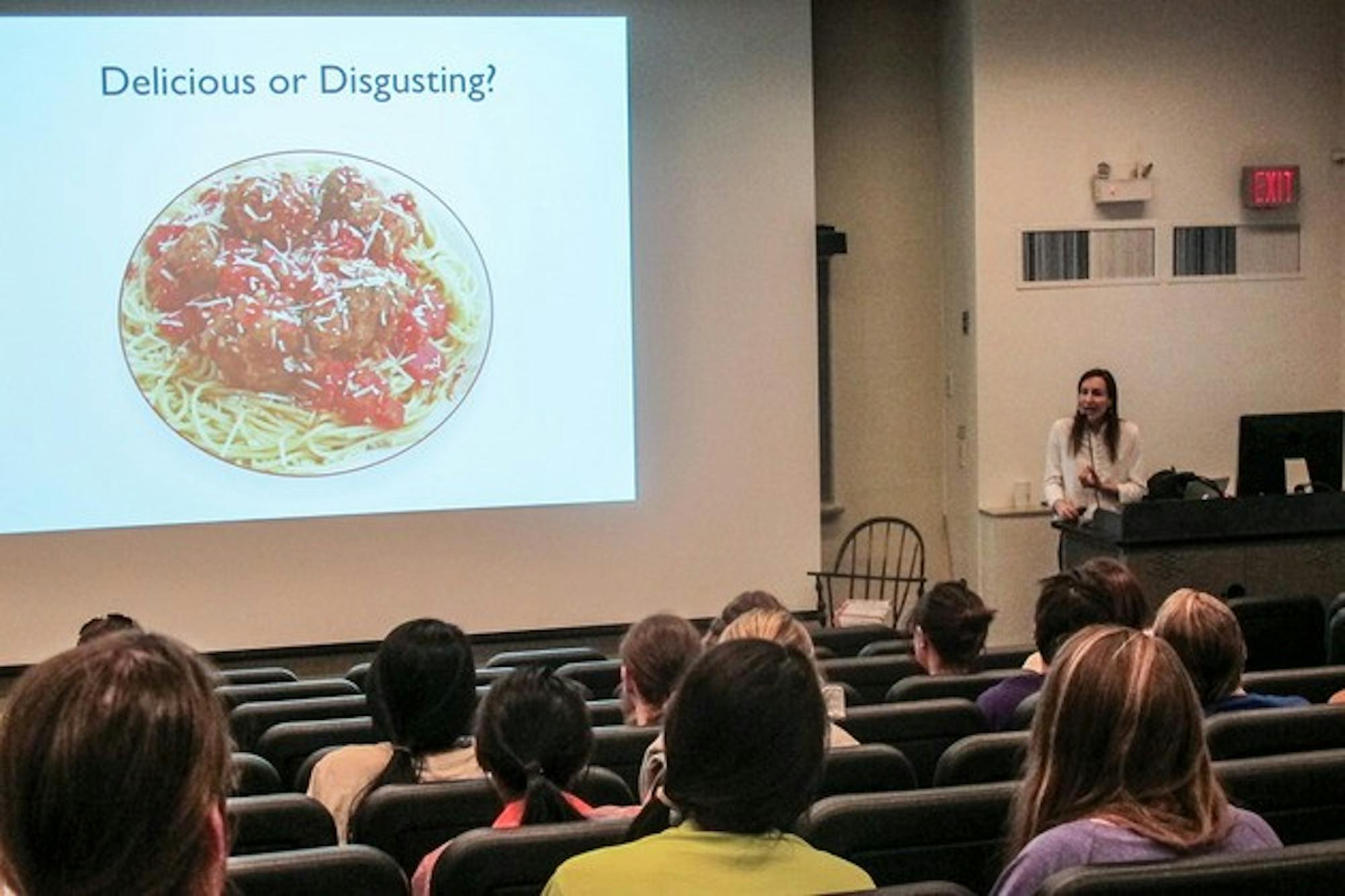
Joy, a University of Massachusetts, Boston psychology and sociology professor, questioned why there exists a disconnect between the relationships humans have with animals and the decision of what to eat for dinner. Joy credited this partly to the human consciousness that acts as defense mechanism to justify everyday actions.
"Because this gap in our consciousness blocks the awareness of the reality of our meats, it also blocks our authentic feelings towards our meats," she said.
Culture often influences whether a type of meat is acceptable to eat.
"Why aren't we disgusted by the thought of eating certain species but not others?" Joy asked.
This lack of disgust reveals an invisible ideology, which Joy called "carnism." Joy argued that humans are not aware of the implications of their meal choices, as most people are capable of petting their dog under the dinner table while eating a plate of pork chops.
"Without awareness, there is no free choice," Joy said. "It's striking that our culture teaches us to take more time to consider what shampoo we are buying rather than which species we are eating and why."
Joy showed a short clip of an undercover documentary of the meat industry, and though she warned the audience of its disturbing content, many gasped at the first scenes of the slaughters.
Joy said the choice to consume meat is more than just personal ethics but also a social justice issue.
"There are reasons to be hopeful," she said, adding that the vegan culture is currently thriving, and many influential leaders are choosing to become vegan or vegetarian.
"Our choice is not whether we participate, but how we participate," Joy said.
DAWG co-presidents Jennifer Davidson '15 and Laura Bergsten '15 said beyond encouraging students to become vegan or vegetarian, the group hopes to provide venues for discussions of morality, religion, animal testing and environmental impacts.
This term, the organization has been working with Dartmouth Dining Services to organize Meatless Mondays, which encourages students to pledge to go vegetarian one day per week. On Earth Day, DDS took away many of its meat options and put up signs to encourage the initiative.
"The administration has been very receptive, and it has been really great for the organization." Bergsten said.


