
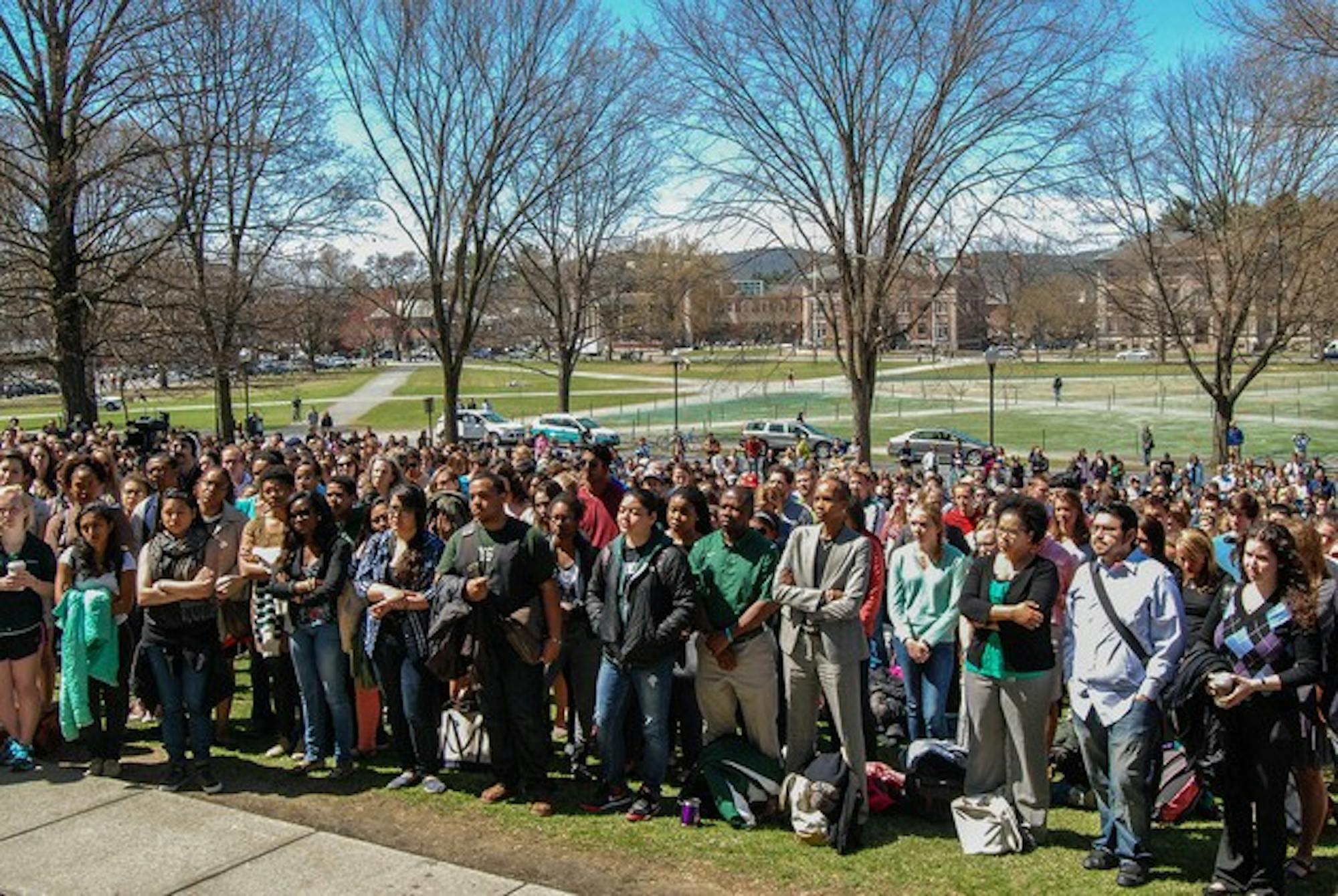
The Hanover Police is currently looking into the legal ramifications of the welcome show protest, acting police chief Frank Moran said. While records of the investigation were not completed by press time, Moran said he expects more conclusive details by Friday.
The department's two primary concerns lie in the protesters' trespass on the Class of 1953 Commons during a private event and their violation of fire codes by exceeding building capacity. Although the College is not filing charges and has requested that the police not take legal action against the protesters, Moran said a protester has filed complaints that she was physically mistreated when attempting to enter the Dimensions show.
Moran declined to comment on whom the complaints were filed against.
Since the protest, Real Talk Dartmouth has posted a list of proposed solutions to their concerns about campus climate on its website.
The website includes five links to past campus initiatives and opinion articles from The Dartmouth, as well as petitions led by other organizations.
One former proposal was the Student Life Initiative, created in 1999 under former College President James Wright, that sought to overhaul the Greek system through campus-wide social and residential reform. Student and alumni backlash at the time was so severe that the initiative was ultimately abandoned.
Real Talk's site also provides the link to an opinion piece published in The Dartmouth last year by a group of professors who advocated for increased residential clusters such as East Wheelock, as well as mandatory security guards or bouncers at parties.
Another solution links to the Dartmouth College Diversity Curriculum Project, which aims to address campus issues such as exclusivity, intolerance and prejudice by instituting a student-taught curriculum that introduces freshmen to discussions about the campus climate.
The last two proposed solutions direct viewers to petitions to end sexual assault on campus from a women's and gender studies class on Change.org and from DartmouthChange, an independent organization of alumni, faculty, staff and community members.
Real Talk Dartmouth has been using Twitter to gather support, with over 200 posts and more than 60 followers.
English professor Jeff Sharlet, who frequently interacts with the group on Twitter, said he admires the protesters' courage to speak up about campus climate.
"I'm troubled by those who say that you shouldn't say anything if you don't have solutions," Sharlet said. "I don't think we're in a place where we're capable of a solution. Given the history of these issues, our work needs to be like that of any researcher, any scholar we need to look and look and look."
Sharlet said institutional change should originate from the student body, and can only be possible with greater student involvement.
Women's and gender studies chair Ivy Schweitzer said that in addition to greater campus discourse, she is interested in understanding how social structures like the Greek system shape the student body.
While the existing Greek system has admirable qualities, Schweitzer said its "dark side" requires extensive reformation.
"These structures have a certain tradition in history that hold people in place," she said. "To some extent, the nature of organizations is self-segregating. We unthinkingly allow these structures to shape us."
Schweitzer said the Greek system perpetuates many of the social issues that the protesters are addressing. Much of the fault, however, lies in the structure itself and not with its student members. She blamed groupthink for reducing members of Greek houses to the "lowest common denominator."
Despite the widespread campus backlash against protesters, Travis Mushett '08 said he wants to ensure the protesters know they have alumni support.
Mushett, the editor of the literary magazine Blunderbuss, said that Nathan Gusdorf '12 asked him to assist with a petition after reading a Blunderbuss article supporting the protest.
The petition, which will soon be publicly available, is a "show of solidarity for the protesters," Mushett said.
"We are unequivocally on their side," he said. "We want to make it clear that the backlash is by no means the full or unanimous community reaction."
The petition will not make specific demands of College administrators, nor would it propose solutions to the issues regarding campus climate. Mushett's personal position, however, calls for a major restructuring of the current Greek system.
Because institutional change takes place at a "glacial pace," it requires centralized administrative effort that extends beyond students' four years at the College, Schweitzer said.
Although the Dartmouth Plan challenges the continuity of campus activism at the College, Mushett said he hopes that students will find ways to maintain the protest's momentum and continue the discussion that Real Talk Dartmouth has created.


