
President-elect Philip Hanlon is expected to lead the College's strategic planning process after taking office on July 1. Hanlon will evaluate suggestions from the working groups' reports, which will build upon the College's current strengths and allow for a smoother implementation process, Alumni Association president John Daukas '84 said.
STRUCTURE
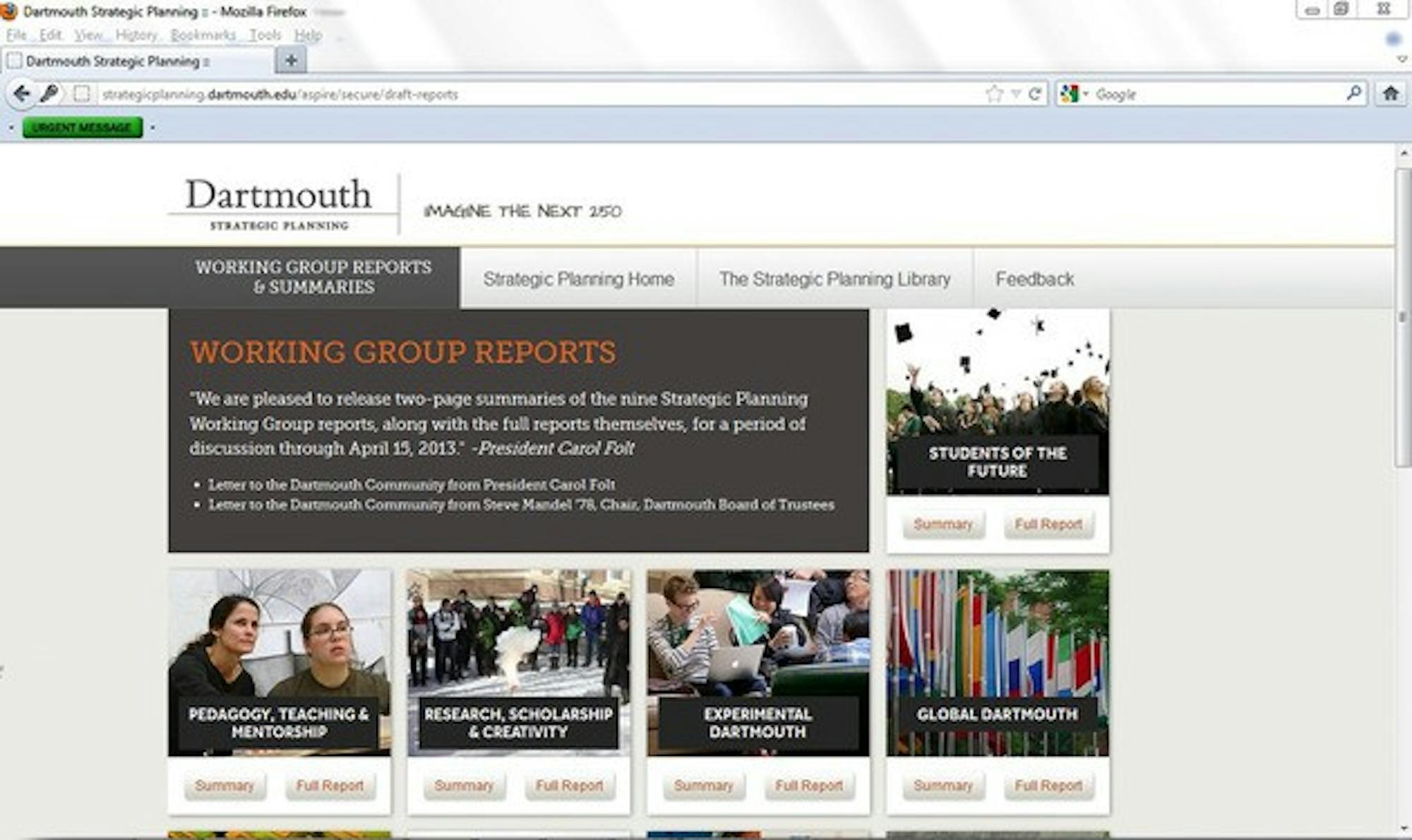
Faculty, administrators, staff and students worked over the last 18 months in nine working groups: Students of the Future; Pedagogy, Teaching and Mentorship; Research, Scholarship and Creativity; Experimental Dartmouth; Global Dartmouth; Digital Dartmouth; Graduate Education for the Future; Workforce of the Future and Alumni Involvement for Life. Groups released two-page summaries alongside their full reports, which range from eight to 17 pages long.
The working groups function under the faculty strategic planning advisory committee and the senior executive strategic planning advisory committee. The faculty advisory committee consists of junior and senior faculty, while the senior executive advisory committee comprises senior administrators and is co-chaired by Dean of Admissions and Financial Aid Maria Laskaris and Interim Provost Martin Wybourne. The faculty and senior executive advisory committees are governed by the strategic planning steering committee, which currently reports to Interim President Carol Folt and will report to Hanlon when he arrives.
Faculty advisory committee chair and sociology professor Denise Anthony did not respond to requests for comment by press time.
Despite common misconceptions, the working group reports are not the finalized strategic plan, Experimental Dartmouth co-chair and computer science professor Thomas Cormen said.
"Our working reports are aspirational documents," he said. "We're all awaiting the arrival of Phil Hanlon to see what aspects of our reports he will implement."
Many ideas presented in the working group reports support the College's efforts to expand its global profile, said Jon Kull '88, dean of graduate studies and a member of four working groups.
"Dartmouth has a brand, and that brand is undergraduate education," Kull said. "We always need to emphasize teaching first. We need to be the best place in the world that does the scholar-teacher model."
The strategic plan that emerges from the working group reports will lay the foundation for the College's next capital campaign. The last strategic planning report and capital campaign, titled the Campaign for the Dartmouth Experience, began in 2002 under the former College President James Wright's administration. That was Dartmouth's largest in history, and reached its target total of $1.3 billion.
When creating the reports, the working groups were told not to take into account the cost of their suggestions, Kull said.
FEEDBACK
The strategic planning committees are accepting feedback from College faculty, student and alumni on ideas presented in the working group reports until April 15. The reports are available on the strategic planning website to members of the Dartmouth community.
Although some working group members were under the impression that the reports would be kept confidential, there was a last-minute decision to release the reports to a wider audience, Kull said.
On March 7, the President's Office sent an email inviting all students, faculty, staff and alumni to offer feedback to the reports. Suggestions can be made either through a form on the strategic planning website or through Twitter by posting a response with the hashtag "#next250," a reference to former College President Jim Yong Kim's anticipation of the College's 250th anniversary in 2019.
Since the reports' release nearly a month ago, no feedback has yet been submitted through Twitter.
Media relations director Justin Anderson could not be reached by press time to comment on the number of responses submitted through the College's strategic planning website.
Student body president Suril Kantaria '13 said that he did not know any students who had suggested feedback.
Daukas and representatives from numerous local alumni clubs said that they had not heard of alumni who had submitted feedback.
While the working group reports may be attracting attention at the College, alumni who are away from Hanover are relatively "unaware and uninterested" in the strategic planning process at its current state, Daukas said.
"I think if you asked a lot of alumni about the strategic report, their reactions would be, What strategic report?'" he said.
College administrators consulted the Alumni Council while compiling working group reports, council president Mark Davis '81 said.
Daukas expects the College to work more closely with the Alumni Council as the strategic plan becomes more concrete, he said.
PRESIDENT KIM'S INFLUENCE
Kim initiated the College's current strategic planning process in 2009 before departing for the World Bank last June. Although Kim's role in the planning process was cut short, many of his visions are reflected in the recently released working group reports.
When Folt was appointed interim president, many professors predicted that she would continue Kim's administrative agenda, focusing on interdisciplinary education and expanding Dartmouth's global visibility.
Wright, Kim's predecessor, directed many social initiatives most notably the Student Life Initiative, which included five central principles that called for decentralized dining, increased housing and instituting coeducation within the Greek system. Kim, on the other hand, concentrated on Dartmouth's financial issues and international perception.
Under Kim's administration, the Board of Trustees introduced "One Dartmouth," an effort to increase interaction between the College's undergraduate and graduate departments.
The working group reports released as a part of the College's strategic planning process reflect many of Kim's ideas, said Richard Kremer, history professor and member of the Global Dartmouth and Experimental Dartmouth working groups.
"Our discussions focused much more on Dartmouth's global reputation and global engagements, the classroom environment and faculty involvement with teaching and research," Kremer said. "Issues of Greek life and the social aspect really have not been a very central concern."
GLOBAL DARTMOUTH
The Global Dartmouth working group's report emphasizes the importance of establishing Dartmouth's international reputation as a leader in higher education. Citing the gap between the College's national and global rankings, the report highlights fields where Dartmouth could expand its international profile.
Key areas include study abroad programs, international student recruitment and faculty research collaboration with international institutions.
In the process of compiling the Global Dartmouth report, faculty members conducted research on other universities to observe their strengths, Kremer said.
For example, Yale University recently created a new administrative position for a vice president of global affairs, he said. The Global Dartmouth report likewise suggests establishing a central office to track the College's international engagement.
Kremer said that one of the most fundamental assumptions of the working group was that the size of the student body should remain constant, despite efforts to expand the College's international presence.
"We could be building new campuses all around the world, but that might detract from the quality of education that we pride," Kremer said. "The idea of not changing the size of Dartmouth is really a pillar in the documents."
The report also suggests decreasing the student-to-faculty ratio by hiring more professors, which would increase Dartmouth's global profile by allowing faculty to devote more time to research without sacrificing the College's dedication to undergraduate education.
EXPERIMENTAL DARTMOUTH
Experimental Dartmouth was not originally one of the working groups under the faculty advisory committee, but as other groups increasingly discovered that they were working within restricted areas, faculty members suggested creating an "even more radical" group, Kremer said.
Cormen said group members were told to imagine they had a clean slate.
"If we could start over in a subset, what could we do?" he asked.
Based on faculty experience, the group sought to explore ways to integrate the College's academic and residential spheres. One of the ideas in the working group report suggests creating a "College within the College," a living-learning community that would encourage closer interaction among undergraduate students, graduate students, faculty and staff.
The program would involve roughly 10 percent of the student body and would be an experiment, Cormen said. Because of the intimate learning environment, students would have the opportunity to continue their education beyond the classroom.
One of the proposed initiatives for the experimental group is to break away from traditional learning structures, such as the Dartmouth Plan and the 10-week term, instead instituting a "question-based approach" that would involve two years of a common core curriculum followed by two years for participants to investigate a chosen topic.
Although plans are still tentative, the Experimental Dartmouth working group is enthusiastic about its report, Kremer said.
"Our mission was to think about innovation," Kremer said. "We wanted to lay out an experimental platform for innovation where the sky's the limit."
Daukas warned that the "College within the College" initiative may have drawbacks. While students in the program would not be isolated from the rest of the student body, using a section of the school as an experimental population could be problematic, he said.
"What happens if things don't go well?" he said. "There's still a lot of development that needs to be done with this idea."


