
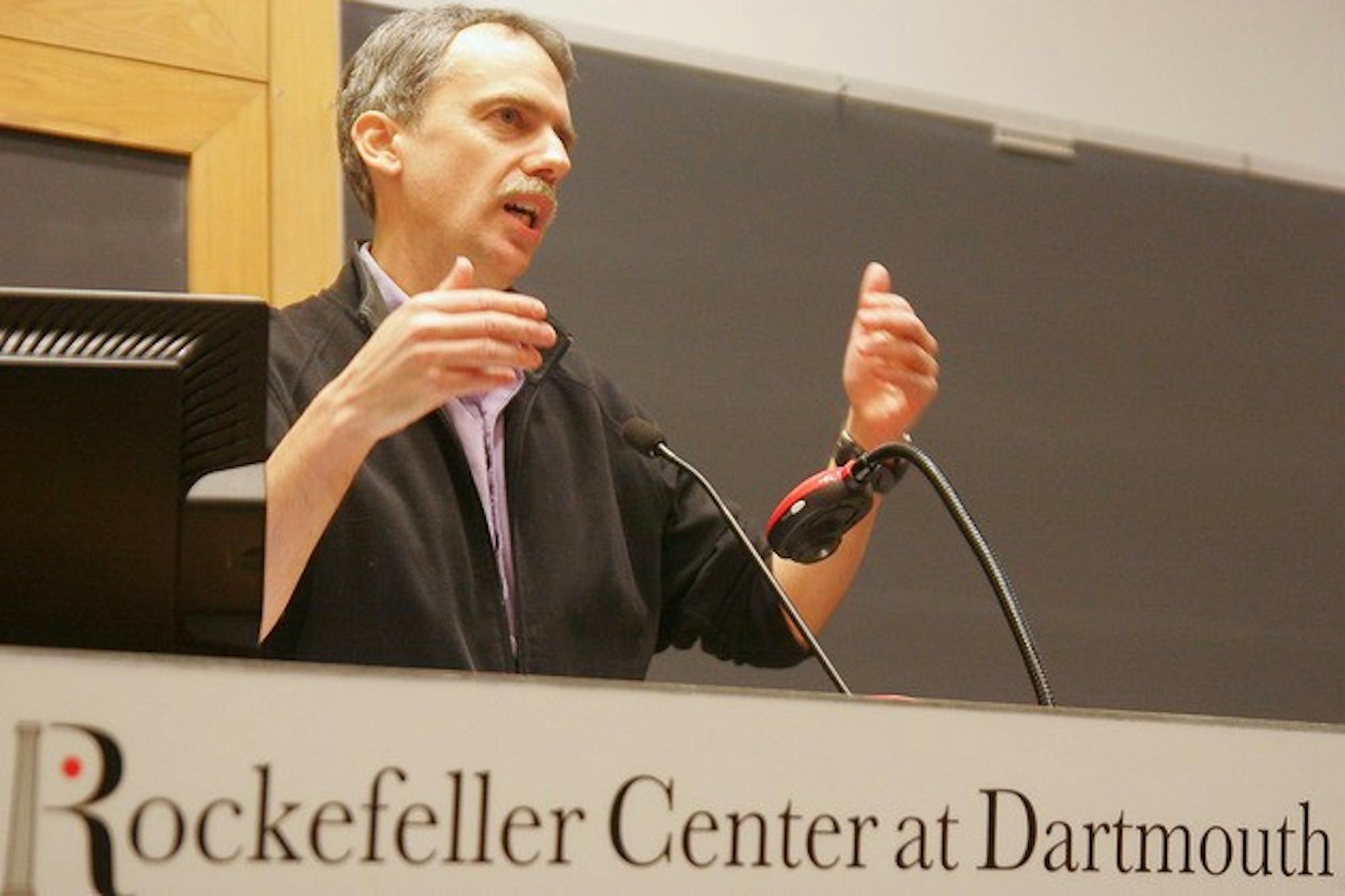
Kymlicka began the lecture by legally and practically defining citizenship as a tool to quantify someone as a member of society. It is a cooperative relationship that involves both rights and responsibilities, he said.
Only domestic animals should be considered for citizenship, while wild animals should have the right to their own territory.
Possible privileges for domestic animals include protection from harm and abuse, access to emergency troops and access to health care. Humans should also consider animals' interests when determining which activities they should participate in, Kymlicka said.
Kymlicka encourages a positive relationship between animals and humans, differing from traditional animal rights theories that focus exclusively on restricting negative relationships. Trusting all humans to treat animals compassionately, however, is an optimistic but impractical expectation. Society often exploits animals for selfish uses more so today than ever before.
"It's based on mutual concern and not exploitation," he said. "Many people want to have a relationship with an animal that is a good relationship. That is ethical."
Because domestic animals are dependent on humans, they are too vulnerable to independently exercise their citizenship rights. Dependency is universal, and humans are often dependent on others as well.
"This preoccupation with trying to identify something that only humans have that makes us superior to animals I think it's bad for humans," Kymlicka said. "It's a really false vision as to who we are. After all, we too are animals."
Humans should only participate in activities with animals if they cooperate, he said, and he envisions a society that would create a "good life" for animals.
At Green Mountain College in Poultney, Vt., where two oxen no longer benefiting the school were slaughtered. If the oxen were recognized as citizens, the college would have reconsidered its decision to kill them, Kymlicka said.
"There are certain things we owe to sentient beings simply because they are sentient beings," Kymlicka said.
Just as people in society have the responsibility to provide for the well-being of children, they also have an obligation to ensure the safety of animals.
"We need to recognize that animals have a phase of their own childhood but then grow into maturity," Kymlicka said. "There is a process of transitioning children into society and there is a point at which you can no longer mold them. The same goes for domesticated animals."
McTavish McArdle '16 said that Kymlicka's advocacy for animal citizenship, though compelling, may be overly idealistic.
"If you look at the way we treat other humans in marginalized groups, there's still enormously large populations in society who don't think they have any responsibility for others," McArdle said. "I think citizenship of domesticated animals is just an extension of that idea that we should take care of members in society, especially when they can't take care of themselves." Paige Elliot '13, who is interested in animal welfare issues, said that when she first heard about the lecture, she thought it sounded "outlandish."
"I think one of the most worthwhile aspects of the lecture is that it causes people to think about these issues," Elliot said. "It was useful in that it could spark discussion of a plethora of issues."
Although Elliot said she appreciated that the lecture drew attention to animal rights issues, she does not believe animal citizenship will be implemented soon.
Kymlicka and his wife, Sue Donaldson, have been vegans for 20 years and co-wrote "Zoopolis," in which they advocate for domestic animal citizenship.
The lecture, titled "Animals and the Frontiers of Citizenship," was co-sponsored by the Dartmouth Legal Studies Faculty Group and the Dartmouth Lawyers Association.


