
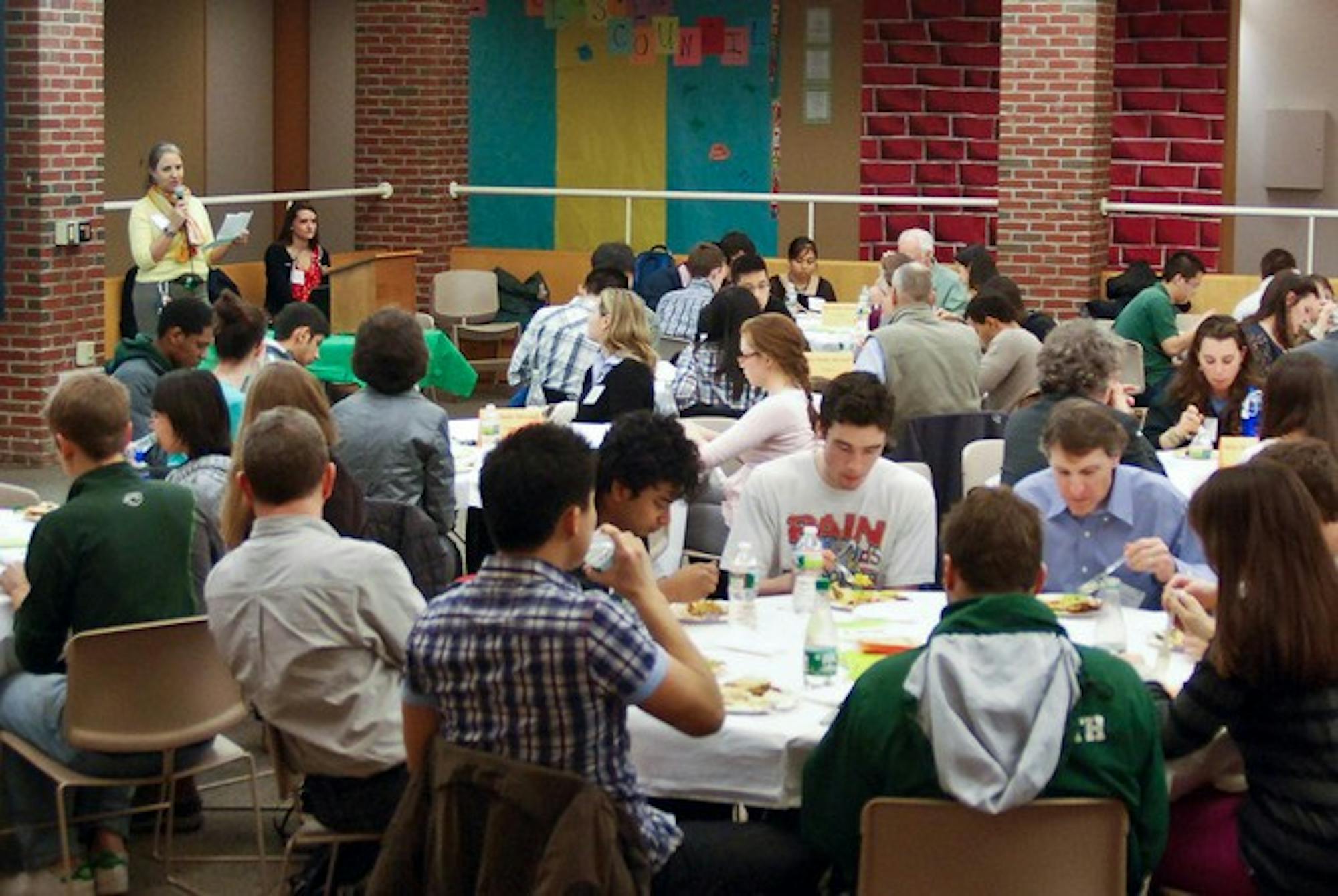
The program featured members of the Off-Campus Programs student advisory board a committee founded two years ago to improve off-campus study who presented general information about College offerings alongside anecdotes and advice from their own experiences abroad.
Assistant director of Off-Campus Programs Lynn White Cloud said that the program was designed to encourage dialogue between past program participants and students who are considering off-campus study in the future. She said she hopes it will prompt students to ask more critical questions about off-campus experiences and introduce them to resources that can provide answers.
"I think the message tonight would be to think about what you want to get out of your Dartmouth experience and to consider different ways of learning," White Cloud said.
Faculty directors reflected on their experiences running College programs abroad in order to add context to program information for students, according to Off-Campus Programs director John Tansey.
French and women's and gender studies professor Faith Beasley discussed how the integration of on-campus and off-campus academics distinguishes the College from other universities. The design of Language Study Abroad programs allows students to "hit the ground running," she said.
Biology professor David Peart highlighted the close bonds students form with each other and with faculty while studying abroad.
"You're all on the same boat together," he said. "There's no escape from it, but there doesn't need to be an escape from it."
Advisory board presenters, including Mandy Bowers '14, Chase Renick '13 and Christine O'Keefe '13, shared personal experiences as well as practical advice about choosing among College programs, exchange and transfer terms.
O'Keefe is a former member of The Dartmouth Staff.
Bowers said she did not anticipate how she would eventually develop cross-cultural perspective through her term on the Berlin Foreign Study Program.
"You're going to be thrust among people that make you question your own background and where you're coming from," she said.
Renick suggested that students set specific language goals to allow them to experience more meaningful interactions with native speakers. On his program that he participated in two years ago, students integrated jobs as museum tour guides, and he encouraged students to take similar initiatives.
"You'll get a lot more out of the program if you get out of the mentality of, I'm going to ride the Dartmouth bus,'" Renick said. "Instead think of, What can I get out of this program?'"
The student advisory board came together for the first time in Fall 2010, according to Tansey. He said that he conceived the idea during a site visit to Tangier, Morocco program.
He then approached Renick, who had expressed interest in improving the program, with the idea of leading the group.
By capitalizing on the experiential feedback of its members, the committee looks for ways to improve in how the College runs its spectrum of off-campus programs, Tansey said. Major projects aim to make them more responsive to students, he said.
The group is currently working with the Off-Campus Programs office to improve the solicitation of student feedback both during and after a program's completion and to implement more engaging information sessions for students.
Other past initiatives have included a photography exhibition and the creation of a wiki, where students can upload practical information for the benefit of future program participants, according to White Cloud.
Professors were initially reluctant to support the wiki's creation due to fears of general rather than specific and useful negative comments, according to Rennick. Over time, however, faculty members have warmed up to the idea, he said.
Tansey said that the advisory board enables greater communication among students, faculty and administration. For instance, it allows faculty directors to obtain student input on specific problems, such as student reluctance to share medical needs.
The board has also discussed suggestions with the committee on off-campus activities, a faculty board and the Global Dartmouth working group of the College's strategic planning initiative, according to Tansey.
Future projects may include changes to program-specific orientations and the creation of a database for students to compare grading policies of partner universities to College standards.
The Undergraduate Deans Office and the Off-Campus Programs office co-sponsored Monday night's program, according to White Cloud. The program was targeted mainly at freshmen and sophomores, she said.
Students said that they came to the meeting hoping to find out more information about study abroad opportunities at the College.
"I'm really interested in studying abroad because I have never been abroad in my life," Emily Rutherford '16 said. "I thought it would be cool to find out more about the programs because it's such a big part of the Dartmouth experience."
Elena Zinski '15, who also spoke during the presentation, said that students should be open to opportunities that arise in the midst of their program.
Students should also keep in mind that off-campus programs are still academic terms with added challenges outside of the classroom, she said.
"I would tell students to not expect it to be perfect," she said. "It's a privilege to be in a country not as a tourist, but as a student, and to be open to figuring out what that means."


