
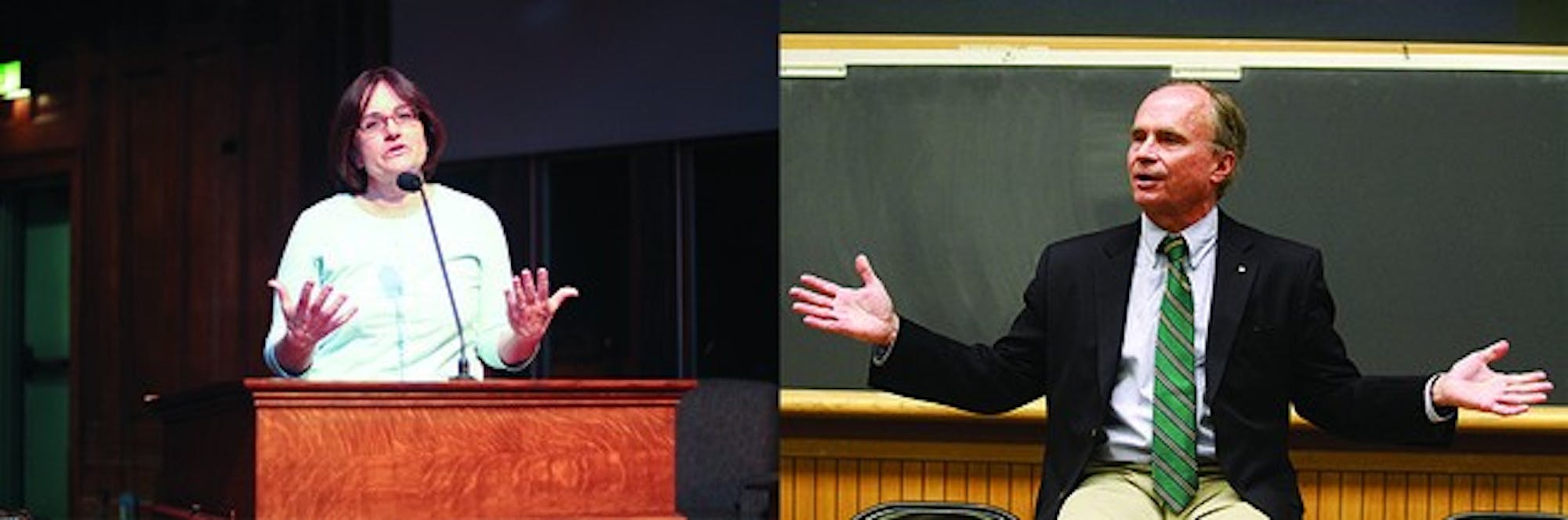
In the gubernatorial race, Republican candidate Ovide LaMontagne and former State Sen. Maggie Hassan, D-Exeter, lead their respective primary challengers, former State Rep. Kevin Smith, R-Londonderry, and former State Sen. Jackie Cilley, D-Barrington, in both funds raised and favorability ratings.
LaMontagne, who has amassed nearly $1.2 million since his unsuccessful 2010 U.S. Senate run, holds a 28-point lead over Smith, a former state representative, according to an Aug. 12 Public Policy Polling poll. By contrast, Smith's campaign had raised $324,000 as of the Aug. 22 filing deadline.
LaMontagne's financial advantage and greater name recognition give him a considerable edge heading into Tuesday's primary, according to Dante Scala, associate professor of political science at the University of New Hampshire and a specialist in campaigns, elections and voting behavior.
"You really have to be a Republican insider to have heard of Kevin Smith, whereas an average republican primary voter has heard of Ovide LaMontagne," Scala said.
Between the two Democratic candidates, Hassan holds a 30-24 percentage point lead over fellow former state senator Cilley, though 46 percent of voters remain undecided.
"If you look at Hassan's numbers and Cilley's numbers, the numbers look remarkably similar," Scala said. "Although Hassan has had more success in fundraising, and one would think that would give her an advantage in the home stretch, the numbers look closer on the Democratic side than on the Republican side."
Hassan has outraised Cilley $930,000 to $233,000 and earned the endorsement of former President Bill Clinton in July.
The two Democratic candidates have so far distinguished themselves on the issue of implementing a broad, statewide base tax, according to Scala. Hassan has pledged to veto any attempt to pass a broad base sales or income tax as governor, a position in line with current Gov. John Lynch, D-N.H., who will retire after four terms in office. Cilley's refusal to pledge such a veto is partially an attempt to rally progressive Democrats who may want a change from Lynch's more centrist policies, according to Scala.
Cilley is currently tied with LaMontage at 42 percent, while Hassan holds a 45-43 percent lead over Montagne in the Public Policy Polling poll. But poll numbers can be difficult to interpret given the difficulty pollsters face in identifying likely primary voters and an expected low turnout in the primary, according to Scala.
Given the tightness of the race, a presidential candidate's ability to build a large lead in New Hampshire could influence the gubernatorial race, according to Harry Enten '11, who writes for The Guardian and his political blog Margin of Error.
"When it comes to the governor's race, my best guess is who wins the presidential race, wins the governor's race," Enten said.
Enten referenced the 2004 election cycle, when democratic presidential nominee Sen. John Kerry, D-Mass., and gubernatorial candidate Lynch both won New Hampshire in nearly identical results.
Since New Hampshire is considered a swing state, however, Democratic candidates may not be able to count on boosts in support from other Democratic candidates, according to College government professor Joseph Bafumi.
"It really is about who turns out to vote in a presidential year that otherwise wouldn't have," Bafumi said.
In the 2nd Congressional District, Rep. Charlie Bass '74, R-N.H., will try to fend off Democratic challenger Ann McLane Kuster '78 in a rematch of an incredibly close 2010 race, in which Bass beat Kuster by roughly 1.5 percent. The 2nd District covers the entire western half of the state, including Hanover and Concord.
The high-profile race will likely garner both national media attention and support from super PACs, according to Enten.
"That race is widely acknowledged to be a seat that's truly up for grabs, and typically, the number of seats up for grabs is a small list," Scala said.
As a moderate Republican, Bass very well represents the 2nd congressional district, considered the more liberal of New Hampshire's two districts, according to Enten.
"The Republican caucus in the last 15 years has shifted to the right; Charlie Bass really hasn't," Enten said. "In reality, he is one of the few New England Republicans left."
Kuster, however, who has remained active in New Hampshire politics since 2010, is a highly effective fundraiser, according to Scala.
Kuster has so far raised over $800,000 compared to $540,000 for Bass, according to a July 15 campaign filing report.
"It's one of the most vulnerable Republican seats if the Democrats are going to make up their deficit, which I doubt they will, but if so they'll have to win districts like [New Hampshire's 2nd Congressional District]," Enten said.
In the 1st Congressional District, Rep. Frank Guinta, R-N.H., will face former Rep. Carol Shea-Porter, D-N.H., whom he unseated in 2010.
"I think [Shea-Porter] has a steeper perceptions hurdle to overcome than Kuster," Scala said. "You look at Guinta's numbers it doesn't suggest a completely invulnerable incumbent."
Shea-Porter's fundraising ability, not historically her strongest campaign tool, and the Democratic Congressional Campaign Committee's willingness to support the race will factor into who eventually wins, according to Scala.
The College Democrats will support the Democratic candidates in all three races, according to College Democrats President Mason Cole '13. In addition to these endorsements, Cole cited engaging Dartmouth students with guest speakers and attending political events in Hanover as the group's key priorities for the fall.
"One of our big pushes is to get students registered and ready to vote," Cole said.
Representatives from the College Republicans did not respond for comment by press time, though the group has previously stated its commitment to supporting Republican candidates through phone banking, canvassing and other campaign activities.
While the current set of polls predict certain candidates to win in November, a great deal can change between now and Election Day, according to Enten.
"What I say now, on Aug. 24 check in on Sept. 24, and then we'll have a fairly good idea of where it's all going," he said.


