
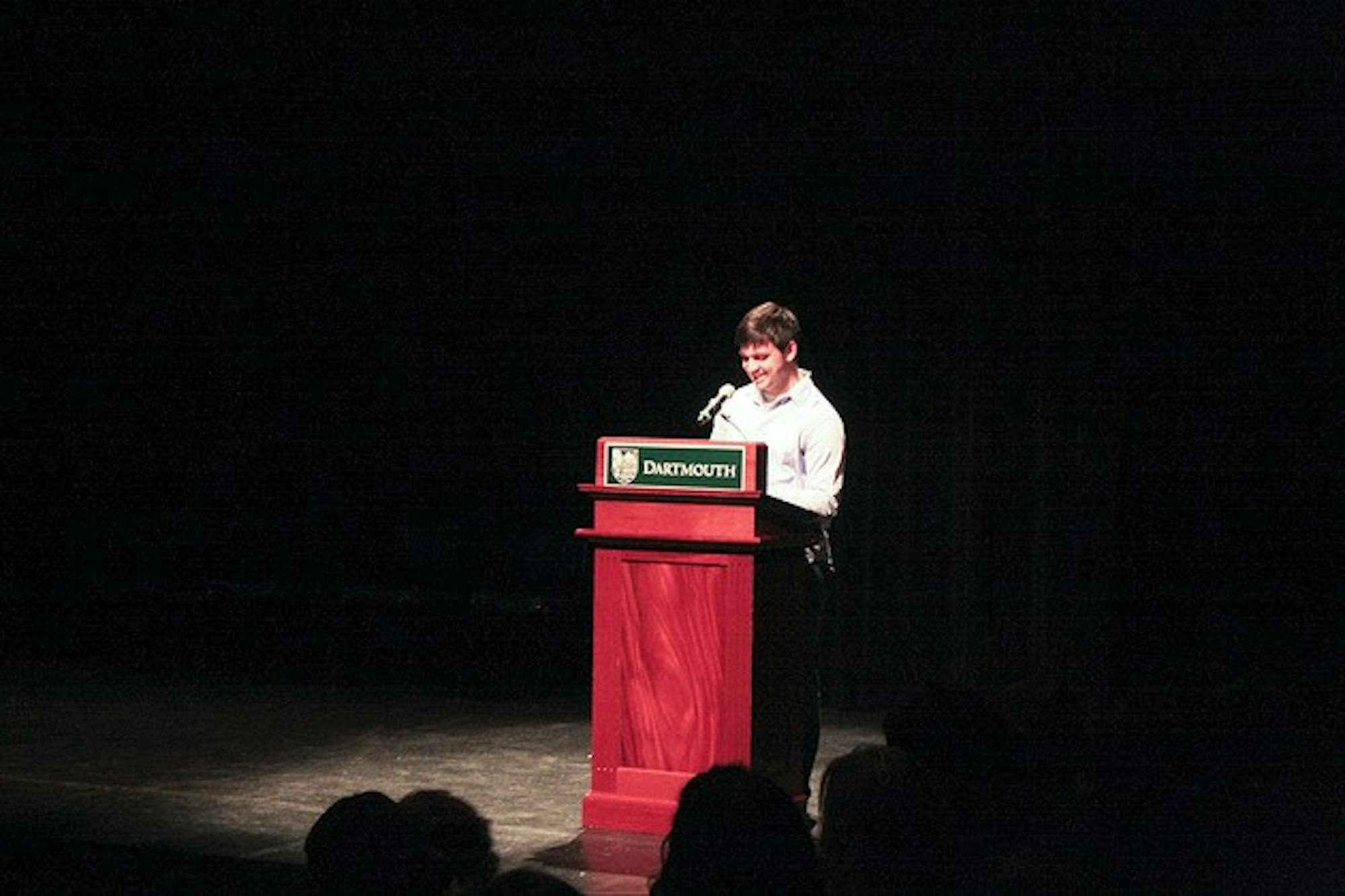
Christian Brandt '12, the first speaker, said it is important for him and other members of the LGBT community to feel safe sharing their concerns without having to worry about criticism.
"As Dartmouth students, we are conditioned by our own experiences here while simultaneously creating them," Brandt said.
Tuition dollars fund the perpetuation of homophobia and heteronormativity unless students collectively work to combat it, he said. In order to end campus homophobia and heteronormativity, students must stop making excuses for the inappropriate behavior of their friends.
The second speaker, a male member of the Class of 2013 who wished to remain anonymous, said he spent his freshman fall in a state of euphoria because he felt that his sexual orientation was completely embraced by the Dartmouth community. His comfort changed one night when he was walking across the Green to a fraternity and a stranger accosted him by calling him the word "faggot."
"It's sort of crazy when you have an idea of what the school is and who you are," he said. "It's amazing how fast that can all crash down."
Following the incident, the speaker said he questioned his decision to attend Dartmouth.
"I've spent a lot of time at this school trying not to be defined by my sexuality," he said. "But I think now that I'm a junior ... I'm going to spend my next year just trying to be me."
A female member of the Class of 2013, who wished to remain anonymous, said she used to be homophobic even though she now identifies as a lesbian.
"What we need is to create an inclusive environment with our words and our actions," she said. "We cannot be a campus that conditions the marginalization of issues that affect my daily life. We really need to talk it out."
Kurt Prescott '12, the final speaker, related his struggle with coming out, which coincided with his parents' divorce. He said his experience was worsened because 90 percent of Dartmouth students have married parents, a statistic much higher than the national average.
"My hope is that what I say will engender discussion afterwards," Prescott said. "Talk to your friends, because the people that need to hear this the most are not in the room."
Johnson introduced the event and said that her responsibilities include building a more "inclusive" community, she remained at the event for two of the four "Talk It Out" presentations. Following her departure, a group of four audience members including Stew Towle '12 and three individuals who wished to remain anonymous said their attempts to meet with Johnson to discuss grievances proved unsuccessful.
"The administration needs to be held accountable for their inaction," yelled one student member of the audience, posing the question, "Where is Dean Johnson?"
One student said that although she complained to Johnson about being called a "faggot" by members of Alpha Delta and Chi Heorot fraternities as she walked home to East Wheelock, Johnson told her to "come back when [she] was more cooperative."
Maia Matsushita '13, who organized the event, said she approached the group of students after hearing rumors about their plans.
"I think it did call attention to the fact that Dean Johnson left early, which I think should have been addressed," Matsushita said in an interview with The Dartmouth.
At the event's start, the four students distributed a list of their demands, which included making all Greek organizations coeducational and implementing gender-neutral bathrooms in all campus buildings.
"LGBTQ students at Dartmouth have been marginalized for far too long," they said. "If you want to make a difference, if you are committed to activism for the LGBTQ community on campus, it will be necessary to put your reputation on the line and to insist on radical change that starts now."
Towle said his group's protest was inspired by the concern that students would leave the event feeling that they had done their part to prevent homophobia and therefore not continue combatting the issue on campus. Members of the group said they wanted students to know that in order to make change, they must actively demand cooperation from the administration.
"We are not in the position of power," Towle said. "This is particularly the job of those in a position of power, a position of privilege."
Towle said the issue of homophobia has touched his life because he spent the first half of his Dartmouth career "living the dominant male paradigm" of joining a fraternity and sleeping with women.
"How can we as queer individuals come together and change things so the next person who comes to Dartmouth like me doesn't feel the need to be that heterosexual frat boy?" he asked.
Sharang Biswas '12, who attended the event, said that homophobia affects everyone on campus, though it should not occur in a college community.
Although Biswas said he did not experience outright homophobia until this year, many of his friends complain about the lack of acceptance of the LGBT community at the College, he said.
"I don't think [homophobia] is a huge epidemic, but it's definitely there," he said, citing an incident in November when derogatory words were found written on a window of a common room in Fahey-McLane residence hall, home to a gender-neutral wing.
Justin Sha '15 said the event made him realize the true pervasiveness of homophobia, which he called a "hidden truth" at Dartmouth.
"It definitely made me see things in a new light," he said. "I felt like these issues were definitely prevalent but unspoken."
Matsushita said she was inspired by the annual "Speak Out" event against sexual assault and felt there was a "hole" in the campus dialogue surrounding homophobia. She said she hopes "Talk It Out" planned a few weeks before Pride Week this year becomes an annual event.


