
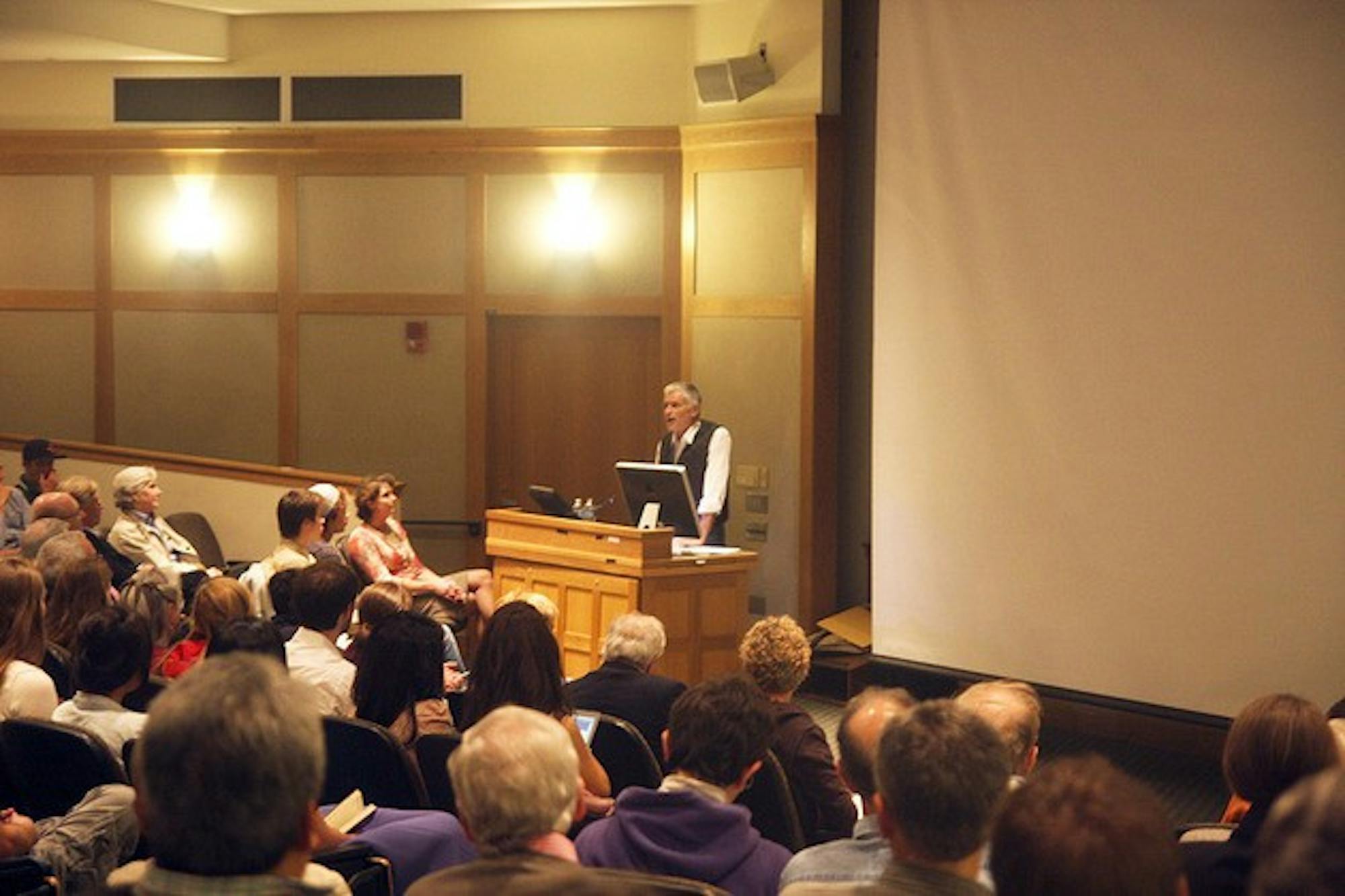
Nachtwey chose to pursue his career after seeing photographs documenting the Vietnam War and Civil Rights Movement in the United States, in which he recognized the power of journalism and the press to create mass awareness and heighten understanding, he said.
"Photographs have the ability to show a mass audience things they can't see for themselves, things they should try to understand and try to change, and generate a refusal to accept the unacceptable," he said.
Photography both provides the public with access to serious social and political issues and offers a voice to those who may not otherwise be heard, he said. Often, when his subjects whom he called "silenced individuals" encounter a photographer who is willing to share their risk and care about their circumstances, they "realize their grief will speak" through the photographs.
"I was driven by the idea that a picture that revealed the true definition of war would be an anti-war photo," Nachtwey said. "Images fueled resistance because they not only reported history but also changed history. When an image enters our collective conscience, change became possible and inevitable."
Nachtwey presented the historical, social and political significance of images from his first book, "Deeds of War," which documents his experience from 1981-89 on the front lines in Central America, Eastern Europe and the Middle East. He said that these experiences led him to document "injustice crying out to be corrected."
Following the collapse of the Berlin Wall, Nachtwey visited Romania and experienced first-hand the HIV/AIDS epidemic and terrible conditions in state orphanages and elderly homes, which he characterized as "nothing less than a crime against humanity." This experience inspired a new trajectory in his career documenting crimes against humanity.
"Just because [my subjects] suffer does not mean they lack dignity, just because they live in poverty doesn't mean they lack hope," he said. "I have had to learn to channel my anger to clarify my vision as opposed to clouding it."
Since 1981, Nachtwey has worked on extensive photographic essays in Central and South America, the Middle East, Eastern Europe, Asia and Africa. The recipient of numerous honors and photographic awards, Nachtwey became the third recipient of the Dresden International Peace Prize in 2012, which recognizes individuals whose work helps prevent escalation of violence.
Nachtwey said a crucial part of his sense of "journalistic responsibility" derives from his belief that photographs are essential for citizens and political figures to understand crises and conflicts. By raising awareness, Nachtwey he hopes to "galvanize support on behalf of the people in the photographs," he said.
His coverage of the Africa HIV/AIDS epidemic in 2000 that was featured in a 20-page Time magazine spread "transcended" journalistic orthodoxy, rendering the story and photographs more important than the advertisers and magazine itself and ultimately encouraging both increased funding and awareness of the epidemic, he said.
"Journalists know that the stories we work on are far bigger than we are," Nachtwey said. "This story is a triumph of journalism."
Acting Director of the Dickey Center for International Understanding Chris Wohlforth praised Nachtwey's work, which compels viewers to recognize and accept responsibility for the world's problems.
"Art is about beauty and being provocative, and it is the beauty of his images that contrasts with the tragedy they depict that force us to truly see," she said. "Through his unwavering dedication to the prevention of further crimes against humanity, Nachtwey reminds us that the world's troubles are our troubles because we made them, and with this message his photographs inspire us to be better people."
Remy Grosbard '12, who plans to work for Internews, a Bosnian non-governmental organization focused on promoting free press and media transparency in developing countries, said that Nachtwey's experiences reassured her that magazines and newspapers take their role of informing the public seriously and are not just corporate enterprises.
"Throughout the lecture, I just kept thinking, How is this man still alive?'" she said. "He is incredibly brave but doesn't see himself as a hero. That being said, he fully understands the importance of his work and it is clear that what he does and what he witnesses matter to him very deeply."
In addition to shedding light on those directly culpable for atrocities, Nachtwey's work also challenges nations in the developed world who failed to prevent them, Grosbard said, adding that the photographs maintained each subject's dignity despite the "horrific and appalling" conditions.
Janie Abernethy '12, who attended the lecture for her English class, "Narrative and Literary Journalism" , said she has discussed the obligation of the journalist to provide a voice to people on the margins of society.
"It is clear that he is constantly curious and purposeful about the choices he makes through his photographs while applying all that he does to his greater mission, and it's interesting that he never took pictures that were not of human suffering, especially in areas where conflicts are resolved," Abernethy said. "That he is able to jump from tragedy to tragedy and still remain a balanced, normal person is also pretty incredible."
Sophia Pedlow '15 said Nachtwey is the Dartmouth alumnus she most admires, as his work demonstrates that the field of journalism is still characterized by integrity and is an essential force for change.
"I Googled him when I was on my gap year, and, like him, I hope to work for National Geographic one day," she said. "This afternoon, I was inspired to start taking photographs, even though the world is full of photographers, because he revealed that the quality of the picture is the only qualification required to be a photojournalist."
Nachtwey is in residence for the week at the Dickey Center as a Class of 1950 Senior Foreign Affairs Fellow, a fellowship created to inspire students and faculty through interaction with distinguished scholars and practitioners who act as engaged members of the global community. In addition to Wednesday's lecture, Nachtwey will visit several classes, including "Narrative and Literary Journalism" and "War and Peace in the Modern Age."
Pedlow is a member of The Dartmouth Staff.


