
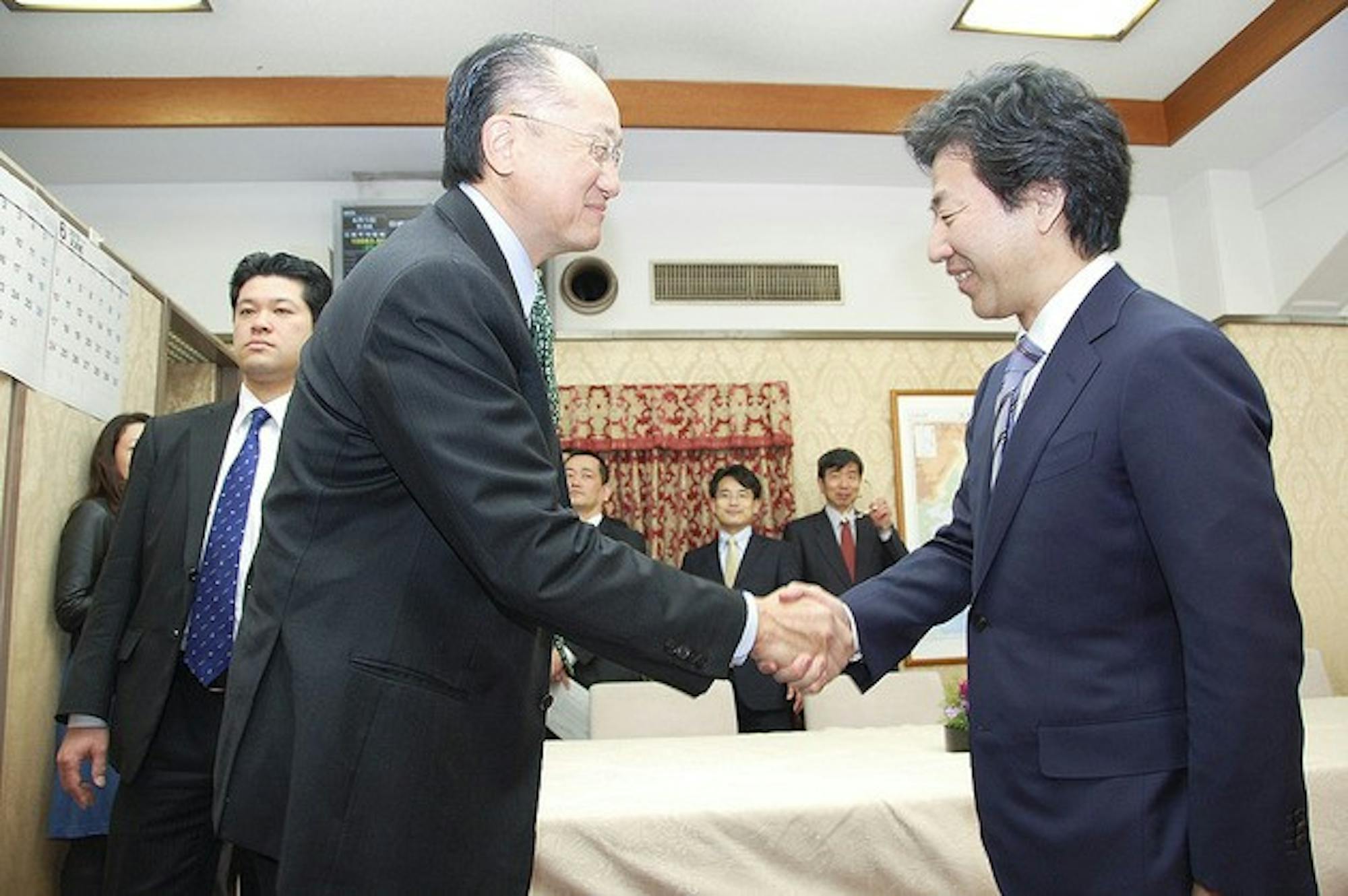
In outlining his proposed plans for the World Bank in an opinion piece, "My Call for an Open, Inclusive World Bank," published on the U.S. Department of the Treasury's website, Kim said he hopes the institution will have the resources to alleviate poverty with input from developing nations and superpowers, solve problems as they arise and effectively serve all of its constituents, including "clients, donors, governments, citizens and civil society."
"An era of extraordinary opportunity requires an extraordinary global institution," Kim said in the column. "I want to hear from developing countries, as well as those that provide a big share of the resources to development, about how we can together build a more inclusive, responsive and open World Bank."
The tour was originally scheduled to stop in Addis Ababa, Ethiopia; Beijing; Tokyo; Seoul, South Korea; New Delhi; Brasilia, Brazil; and Mexico City, according to Reuters. Kim and the Treasury Department, chaired by Timothy Geithner '83, have since extended the tour to visit Shaoxing, China and Brussels, Belgium, Bloomberg reported.
Economics professor Bruce Sacerdote said these countries were likely chosen as the places where Kim "has a good shot at getting support."
While the main purpose of the visits is to garner endorsements from key political and economic leaders, Kim has also met with other world leaders, including Rwandan President Paul Kagame on March 27, according to the Treasury Department website. The two men discussed the importance of the World Bank to countries like Rwanda, which benefit from its poverty-fighting initiatives.
"I was delighted to learn that Jim Kim has been nominated for this post, as he is a true friend of Africa," Kagame said in an interview published on the Treasury Department's website. "He's not only a physician and a leader who knows what it takes to address poverty, but also a genuinely good person."
Kim made his first stop on March 29 in Ethiopia. He met with Prime Minister Meles Zenawi and members of the African Union, an international organization intended to facilitate collaboration between African nations.
African leaders, including Zenawi, have been opposed to some of the World Bank's actions because they believe the U.S.-dominated institution imposes Western norms and ideologies on the continent, according to The Capital, an Ethiopian newspaper. Nigerian Finance Minister Ngozi Okonjo-Iweala has also been nominated for the World Bank presidency.
While in Addis Ababa, the only stop on the continent, Kim said Africa will be an area of focus if he is elected. Addis Ababa is the seat of the African Union and the United Nations Economic Commission for Africa.
In an interview with The Capital, Kim said it is too early for him to make announcements about specific policy goals but that he intends to "always be non-ideological" and focus on both "country involvement" and evidence.
Stopping in Beijing and Shaoxing, Kim met with Chinese Vice Premier Wang Qishan and spoke about the model that China and South Korea have used to alleviate poverty and promote economic growth, according to the Treasury Department website.
After a few days in China, Kim crossed the East China Sea and landed in Tokyo to meet with Japanese Finance Minister Jun Azumi, according to Bloomberg. Kim left with the nation's endorsement, according to The Daily Yomiuri, Japan's largest English-language newspaper.
"We decided he is an extremely suitable candidate for the World Bank presidency and we will support him," Azumi said in an interview with MSNBC, citing the value of Kim's work with the World Health Organization and Partners in Health.
On Monday, Kim returned to his hometown of Seoul, South Korea to meet with officials. That he received the nation's support was "expected," according to government department chair John Carey.
"They were proud of him when he was president of Dartmouth, and they're sure to be proud that he could be the next president of the World Bank," Carey said.
Kim reached New Delhi on Tuesday and will proceed to Brussels, Brasilia and Mexico City before returning to the United States.
As a result of the World Bank's weighted voting system, in which the 25 executive board members are allotted a percentage of the vote based on the monetary contributions of their country, Kim is likely to achieve the presidency over Okonjo-Iweala and for Columbian Finance Minister Jose Antonio Ocampo, the third nominee. The United States, Japan, the United Kingdom, France, Germany, China, Saudi Arabia and Russia are all independently represented on the executive board that selects the institution's president.
In terms of voting weight, the U.S. is the largest shareholder in the World Bank, commanding almost 16 percent of the vote.
By securing both American and Japanese support, as well as likely support in the European Union, Kim seems to have 54 percent of the votes already secured at this time.
"It would make sense that Japan would support Kim and China wouldn't," Sacerdote said. "There seems to be a divide between developed and developing nations."
An article in The Nigerian Daily, a Nigerian online news outlet, reported that the economic and political leaders of Brazil, China, India, Russia and South Africa are concerned that the weighted voting system disadvantages many countries and gives European nations, the U.S. and Japan too much power in the process. These five countries' leaders have joined to support Okonjo-Iweala to make the nomination process more competitive, suggesting that Kim is "less qualified for the position when compared with the experience and qualification of Dr. Okonjo-Iweala," the article said.
Sacerdote said he believes this criticism is misguided and that Kim's experiences leading the College are "right on," providing him the skill set necessary to lead a large nonprofit organization.
"He knows a lot about economics, a lot about developing nations and a lot about running a large organization," Sacerdote said.
The Nigerian Daily reported that all of Africa should and will support the Nigerian candidate. Brazil's lack of explicit support for Kim and the fact that Ocampo hails from Colombia also make it seem unlikely that Kim will receive support from South American countries.
Nonetheless, Sacerdote said that it is "smart strategy" for Kim to visit nations like Ethiopia, China and Brazil.
"Reaching out to places that don't support him in this election but that he'll need to work with in the future is a good move," he said.


