
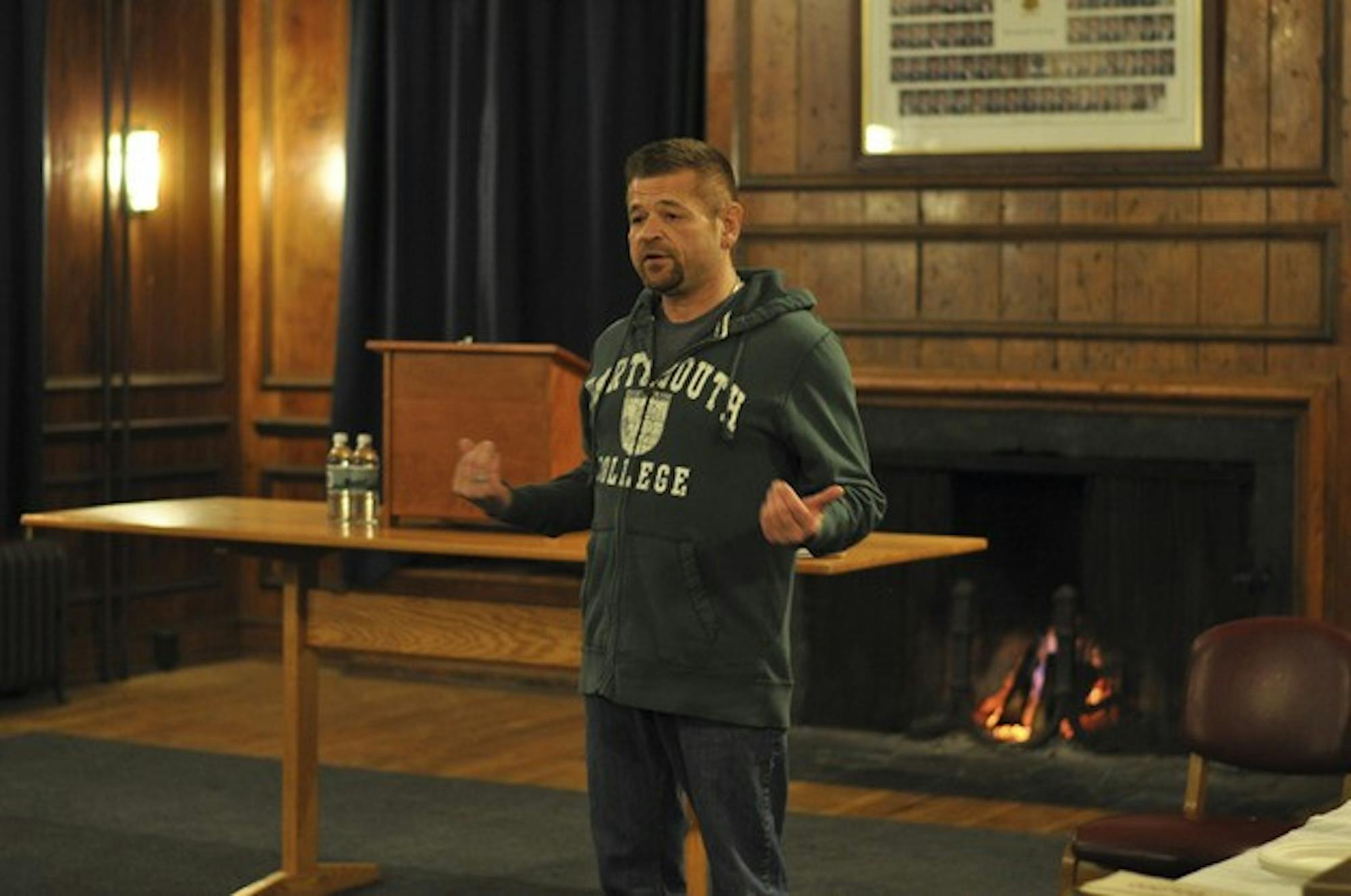
"When I was here, being gay was under the radar and not something people talked about a lot," he said. "There was a lot of fear about being outed or being harassed."
Tillinger discussed his troubled experience at Dartmouth and his later life as an HIV-positive man at a Tuesday talk titled "V-Men at Dartmouth: Sex, Drugs, Responsibility & Masculinity @ Dartmouth," held at Alpha Delta fraternity and sponsored by the Center for Women and Gender and the Men's Project.
"I'm not here to preach to anyone," Tillinger said. "I just want people to hear my story and learn that anything is possible and that most anything can be overcome as long as you're true to yourself and you're not ashamed of who you are."
Tillinger said he found out that he was HIV-positive in July 1986, one month after graduation. He also said that his constant search for masculinity throughout his life fueled his desire to attend business school because he saw it as a "masculine thing to do." His battle with HIV led him to become Mr. San Francisco Leather, a prestigious title in the gay community.
"In the gay world, it's a pretty big deal," Tillinger said. "It's like the gay community saying you are the figurehead for masculinity in our world."
However, Tillinger said that the title and his lifestyle did not feel right, which is part of what led to a crystal meth addiction. He said he used the drug, which is an entrenched part of gay communities in larger cities, to numb the feeling of not being accepted, which led to his becoming heavily addicted.
"I was trying to fill the hole, which was lack of love," Tillinger said. "When I moved to Santa Fe, [N.M.] from San Francisco, I started looking at churches and found the Unitarian church, which saved my life."
After grappling with his addiction and rehabilitation in Santa Fe, Tillinger said he returned to Dartmouth for his 25-year reunion and was struck by how many "decent" people with whom he was able to reconnect.
AD vice president for programming Max Pillsbury '12 said AD was interested in hosting the event to promote greater dialogue about issues of sexuality and sexual identity in more informal social spaces such as fraternities.
"Of late, there has been an attempt among the brothers at AD to think about what masculinity means at Dartmouth and talk about what that means both within and outside of a fraternity space," Pillsbury said.
Jordan Terry '15, an intern at the Center of Women and Gender, said his job was to organize the event and find a fraternity willing to host it.
"It was very important to host this event at a fraternity because it is perceived as a site of masculinity on campus," Terry said.
Tillinger said he hoped his story would help broaden campus dialogue about student diversity.
"What I would hope is that students realize that Dartmouth is not one singular defined experience for people," Tillinger said. "A Dartmouth experience can look like anything."
Tillinger agreed to speak at Dartmouth in conjunction with women and gender studies professor Michael Bronski's class, "Plagues and Politics: The Impact of AIDS on U.S. Society." He spoke yesterday in Bronski's class about his own experience with HIV.
"I think we don't do this enough integrate what happens in the classroom with events in Greek houses or events in other venues that reach other students," Bronski said. "We have too much isolation in the classroom ... it would be a shame for Werner to come with this incredible story and isolate it just to my classroom."
Tillinger said he aimed to focus on the challenges he has faced throughout his life as well as his search for masculinity.
"The fact that this talk is even taking place is amazing not even the talk or professor Bronski's class would have happened in my day," Tillinger said. "I am really grateful that Dartmouth is allowing this to happen it speaks a lot to Dartmouth and to AD and to the other groups that are sponsoring me here."


