
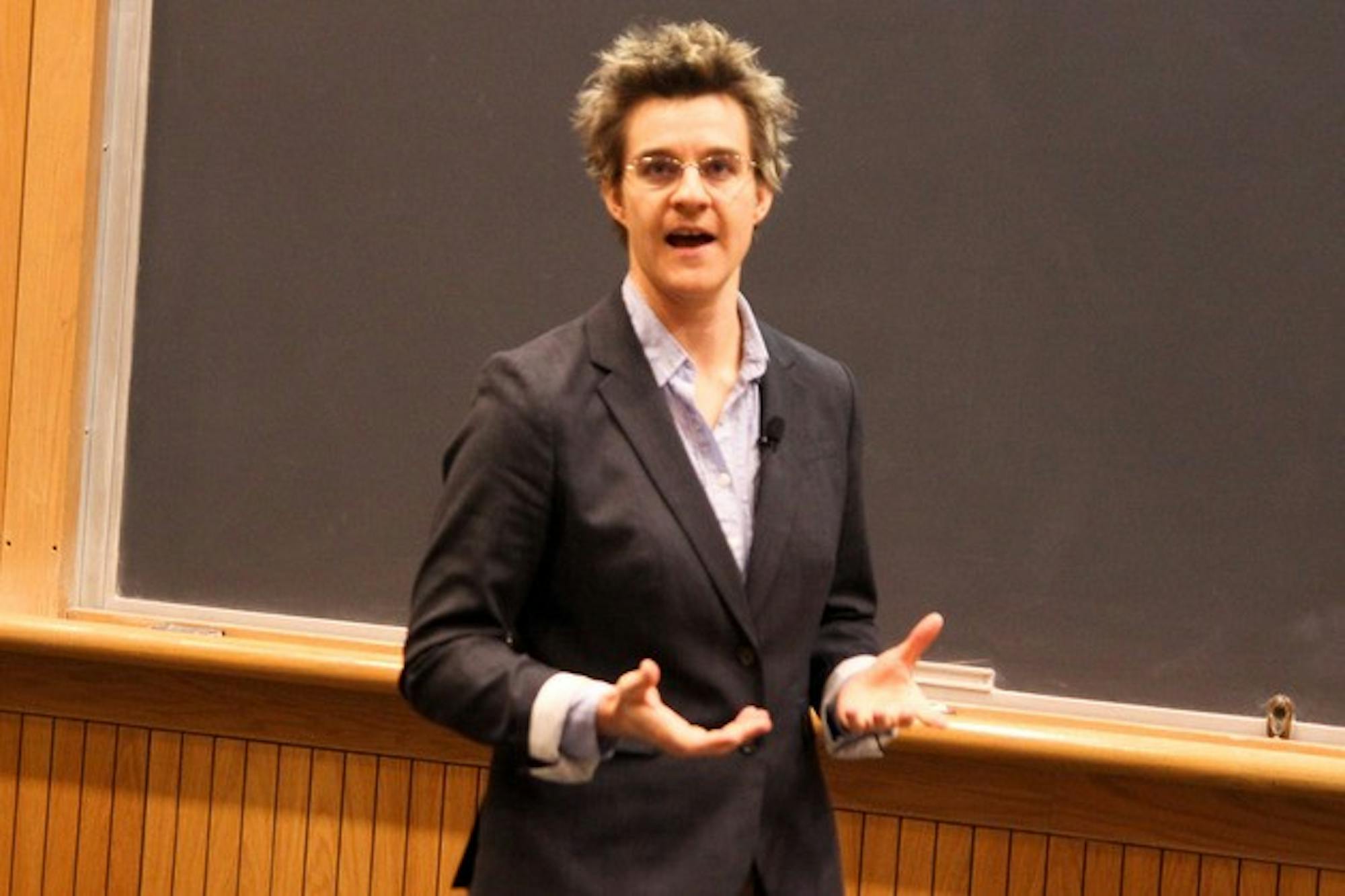
Chenoweth's lecture the final installment of the College's annual celebration of Martin Luther King, Jr. Day focused on the notion that nonviolent resistance is statistically more effective than violent insurgency and leads to more democratic and peaceful countries in the long term.
Chenoweth said she was skeptical about nonviolent resistance prior to her research on the impact of nonviolent strategies. As a security scholar, she had never been confident in the ability of nonviolent movements to revolutionize the political system.
"I am a convert in some ways," Chenoweth said. "I started out thinking I would study violence bullets flying through the air, that's sort of my bag."
As a pragmatist, she said she strayed from a movement she felt often conflated nonviolence with pacifism.
However, Chenoweth said she changed her views after discovering the pragmatic reasons for nonviolence as a more strategic and effective option than violent insurgency.
"I saw civil resistance as a necessary precursor to terrorism and insurgency, and I saw terrorism and insurgency as almost always following the practice of civil resistance," Chenoweth said in an interview with The Dartmouth. "I feel pretty challenged on both of those issues now."
Civil resistance or nonviolent resistance is defined as a form of active conflict where unarmed civilians use a variety of nonviolent tactics like strikes and boycotts to try to effect political change without using or threatening to use violence against the opponent, according to Chenoweth.
The mainstream view on resistance still largely proclaims that if violence does not work, nonviolence is even less effective, Chenoweth said.
Due to Chenoweth's initial skepticism, she carefully defined the criteria for her research, she said. Each case of civil resistance, for example, had to have at least 1,000 active participants.
According to the research, violent campaigns are more than twice as likely to fail in their objectives as nonviolent ones.
"Violence is becoming increasingly ineffective, and nonviolence is becoming increasingly effective over time," Chenoweth said. "Civil resistance can be an effective force for change in the world in almost any context."
Some of this success may be due to the public's greater willingness to participate in nonviolent campaigns than in violent ones, according to Chenoweth. Civil resistance relies on participants' consent and is often highly visible to the public. In addition, nonviolent movements which are less binding than violent movements offer greater flexibility to participants, she said.
"With a nonviolent campaign, people can participate when they feel like it," Chenoweth said. "But then they can go home to their families."
Violent campaigns are associated with a greater number of deaths, despite the "horrific" and visible nature of deaths of peaceful protestors, according to Chenoweth.
Civil resistance also typically leads to improved outcomes in society, Chenoweth said. While violent insurgency sometimes proves effective, more countries emerge peaceful and democratic as a result of civil resistance than violent campaigns.
"Win by the sword, rule by the sword," Chenoweth said. "Nonviolent campaigns are 15 percent less likely to experience a relapse into civil wars than violent campaigns."
Nonviolent campaigns are often successful because they access civilian power rather than relying on the typical instruments of regime elites. In this context, civilians act as the "agents of change" rather than merely being "caught in a crossfire," she said.
Chenoweth said she believes her research encourages those working toward change in a nonviolent way by "spreading the good news" that nonviolent resistance is empirically supported, she said in an interview with The Dartmouth.
The best way to succeed in civil resistance has not yet been definitively determined, according to Chenoweth.
Despite scientific findings, the mainstream view is still not supportive of nonviolent resistance.
"Often violence is serving very personal functions for people," Chenoweth said. "Rational insurgents should be able to substitute the method that works for one that doesn't, but people are hanging onto violence for dear life, and I don't know why."
Chenoweth said she hopes people will stop accepting the narrative that violent measures are the only way to overcome certain situations and will instead consider better resolutions to conflict.
The lecture, held on Friday in the Rockefeller Center, was co-sponsored by the Rockefeller Center and the Dickey Center for International Understanding.


