
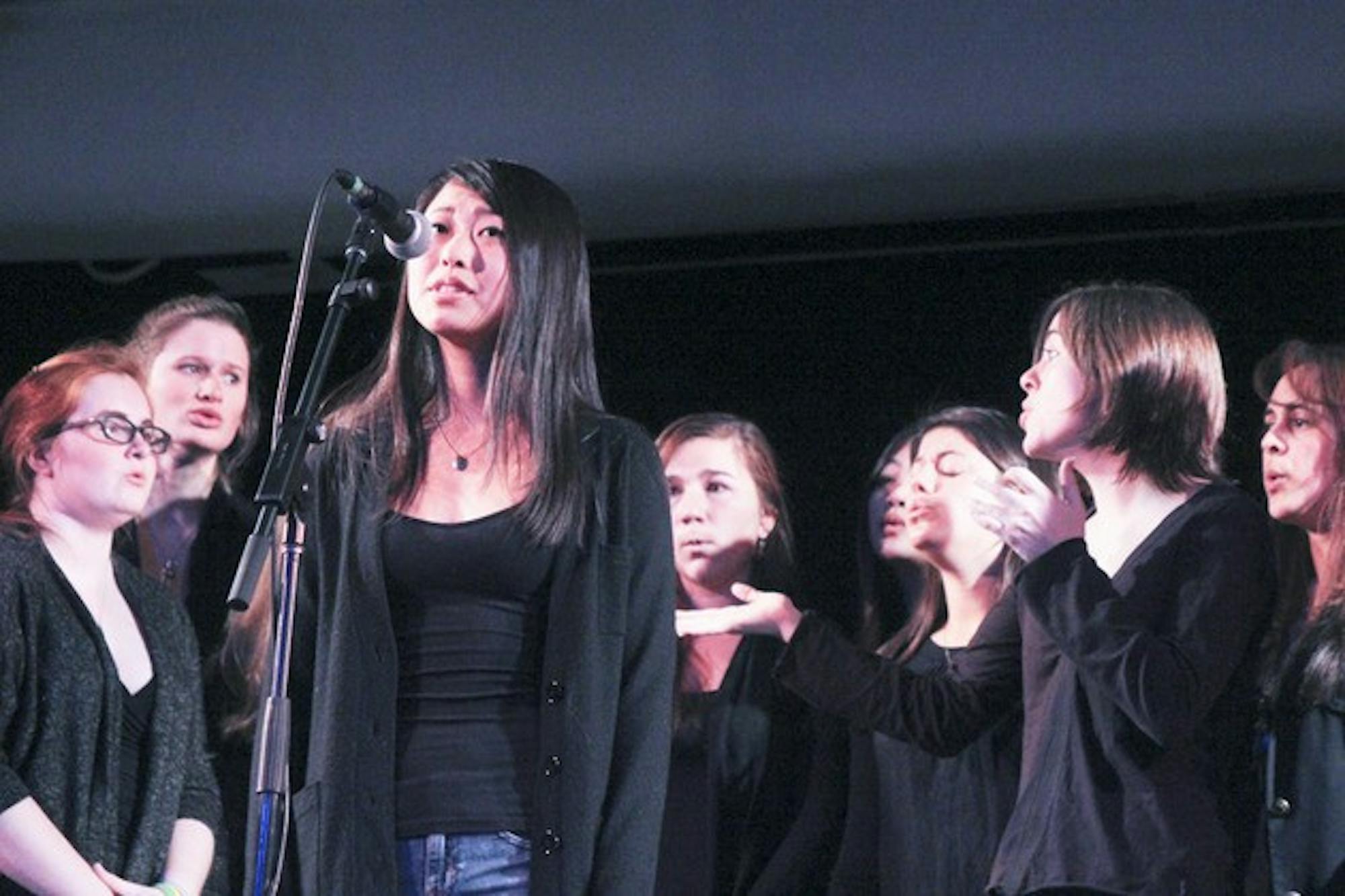
Speakers discussed their experiences with partner violence, repeated sexual assault, emotional manipulation and rape before a standing-room-only audience. The event opened with a performance by the Rockapellas a cappella group.
"Speak Out is an event that gives survivors of all different types of violence, especially sexual violence, a chance to share their experiences with the Dartmouth Community," Chelsea Hassett '13, a SAPA member and co-student event coordinator, said. "It helps individuals reclaim a voice by enabling them to speak out and tell their stories."
Speakers said the sexual violence they suffered manifested itself in different ways, and several said they came to feel as if they were partly responsible for what happened.
All speakers asked that their names not be printed because of the personal nature of the stories.
"Coercion is violence, and I didn't choose that, and I would never have chosen that," one speaker said. "What made me realize I was wrong to blame myself was when I shared my story with my friends at Dartmouth, some of whom shared similar ones. I understand now I deserve to be respected, I demand to be respected and I respect myself."
Another speaker said she came to view her sexual assault experience as a "loss of power" and encouraged people to recognize the power dynamic involved in acts of sexual violence.
"Sexual assault is any unwanted conduct," she said. "The moment they act against your will, it is their crime, not yours. It is not your fault."
The speaker said a possible way to combat sexual assault on campus is a "web of mentorship relationships to guide through and explain the power structures of violence," which she said she believes are integral to the culture of sexual assault.
Speakers also discussed "the shape-shifting ability of abuse" as they shared stories of emotional abuse, explaining that abuse is not just physical.
"Because he wasn't hurting my physical body, I thought I was okay," another speaker said. "My self-perception became skewed."
The speaker said that new friendships provided her with a support system and helped her realize the abusive nature of her relationship.
"I looked in the mirror and started to see myself again," she said. "When you are trapped in a cycle of emotional and verbal abuse, and they are the source of your self-worth, it feels like you can't live without them, but you can. You should be with people who build you up, not break you down, who want your voice to be heard."
Another speaker called for the Dartmouth community to speak out against violence.
"It is the normality of our silence that is so terrifying to me," she said. "Knowledge is great, but without action what is the point? Actions speak louder than words I ask that this knowledge does not go to waste."
Speak Out ended with a moment of silence in recognition of all those who felt unable to share their stories.
Hikaru Yamagishi '12, an organizer of VDay at Dartmouth, highlighted the need for continued engagement in conversation and action in a campus-wide email.
"One of the difficulties in addressing violence at Dartmouth is that most of these incidents are inherently private and confidential," Yamagishi said. "Speak Out is the one time in the entire year that sexual assault, intimate partner violence, harassment or bullying is accessible to the public, for those who choose to support survivors and awaken themselves to a very real aspect of our community."
Speak Out is organized by the Sexual Assault Awareness Program office with efforts coordinated by Hassett and Jason Tong '12, who both serve as SAPAs. SAPAs serve as a campus resource for students who have suffered issues of sexual abuse or intimate partner violence, according to the College's Health Promotion website.
Speak Out also has an important role for audience members who are victims of violence but decide not to participate on stage, SAAP coordinator Rebekah Carrow said. She encouraged survivors to "heal the way their heart tells them."
"Sharing stories is a real opportunity for individuals to heal, but it is equally important for survivors in the audience who may not feel able to speak out because it may enable them to re-examine events and see things differently," Carrow said. "What I hope for more than anything else is that people begin to find a certain sense of empowerment for starting to face their pain."
Carrow also said Speak Out was an "important means" for the Dartmouth community to support survivors of violence.
"Our presence is a strong action step to providing support for the issue in a broader sense," Carrow said. "In general, people have a set idea of what it is to be a victim and this stereotype can often hinder what happened. Tonight is a good opportunity for people to see that violence affects all sorts of people and this enables them to really come to terms with what has happened."


