
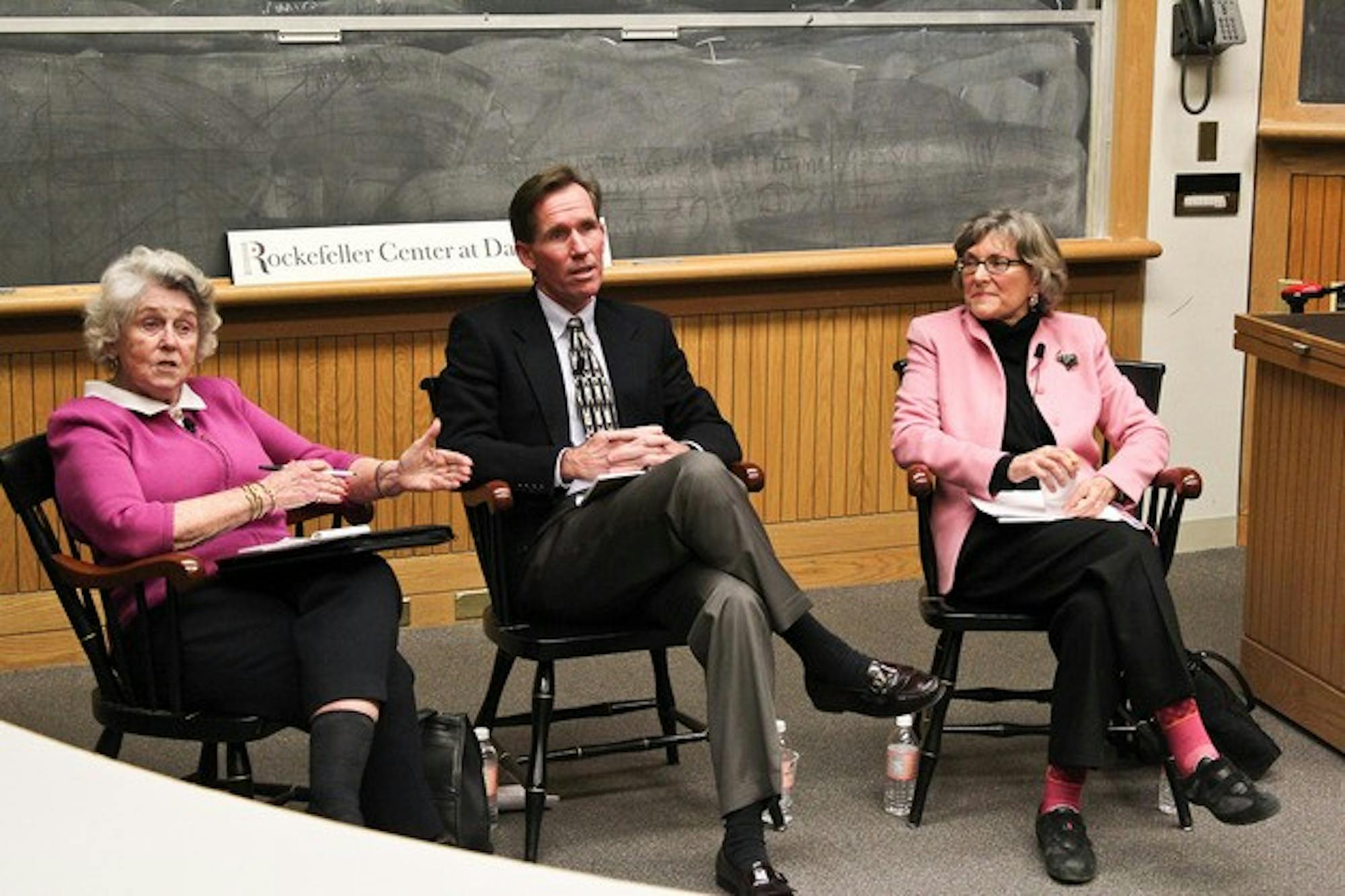
The former congresswomen, both self-identified moderates, spoke to students about the increasing polarization on Capitol Hill today and how Congress has changed since they were in office both during a Monday Lecture and in various College classes. Kelly served from 1995 to 2007, while Byron served from 1979 to 1993.
Bipartisan cooperation was much more common when they were in office, they said.
"If you wanted something to happen, you would go across the aisle and work with each other," Kelly said.
Today, Kelly said both parties are "weeding" moderate members of Congress out of office, contributing to an increasing "stalemate" in the government.
"The parties are eating their own," Kelly said. "They are eating out the moderate part of Congress."
Byron said members of Congress don't interact and build friendships as much as they used to. Instead, representatives spend most of their time campaigning, raising funds and talking on the phone with donors and constituents.
Still, Kelly said the public has the power to influence politics by electing new members. Politics is "incredibly fluid," she said, and in a democracy, the constituents can influence the flow of policy ideas through the election process.
"The public knows what they want they will fix their mistakes," Kelly said.
The 2010 Congressional elections were particularly detrimental to moderate coalitions in both parties, specifically the Democratic "Blue Dogs" and the Republican "Tuesday Group."
Byron explained that the increasing polarization in the government has led to an unpredictable Republican presidential election cycle. She said some of the candidates "refuse to give up" their campaigns.
Kelly said the Republican Party's failure to settle on a clear nominee is due to a philosophical battle among the candidates, which is "rending [the party] asunder."
"I think there's a dearth of statesmen in both parties at this point," Kelly said. "I think the leadership of both parties is not as strong as it used to be ... certainly not in the Republican Party."
Kelly explained that super PACs political action committees that can raise and spend unlimited funds in support of a candidate and interest groups are a "detriment" to the democratic process since outside money is "corrupting the [democratic] process." Interest groups are significantly influencing people's voting behavior, she said.
Both former representatives discussed the important role that young people play in politics. Byron praised young people who engaged in the political process during election time, including traveling throughout the East Coast to campaign in New Hampshire during the primaries.
"There is an enormous amount of manpower that young people bring to a political campaign or an area," Byron said.
The idea that young people are not active in the political process is a misconception, according to Kelly. The earlier young people begin to familiarize themselves with politics, the more significantly they can impact policy-making, Kelly said.
Gabriel Lopez-Low '15, who is currently enrolled in "Introduction to Public Policy," said that it was interesting to learn the structure of the political system from the perspective of members of Congress and connect what he learned in class with actual policy-making procedures.
"It was refreshing to see politicians of different parties who were able to sit down together and have a civil discussion on their careers and views," he said.
Mark Sheridan '15, another student in the class, attended the afternoon discussion moderated by Shaiko after hearing from both former congresswomen in his class earlier that day. He said he was somewhat less impressed by the presentation.
"They had some interesting perspectives on the polarization of politics, but I don't really think they had any solutions to what's wrong," he said.
Joanne Needham, coordinator of public and special events for the Rockefeller Center, organized and hosted the congresswomen's visit.
"It's very important that the Dartmouth students know what democracy is all about so that they can be educated voters and also take part in the democratic process," Needham said. "They come here for the purpose mainly of informing and inspiring the students of Dartmouth."


