
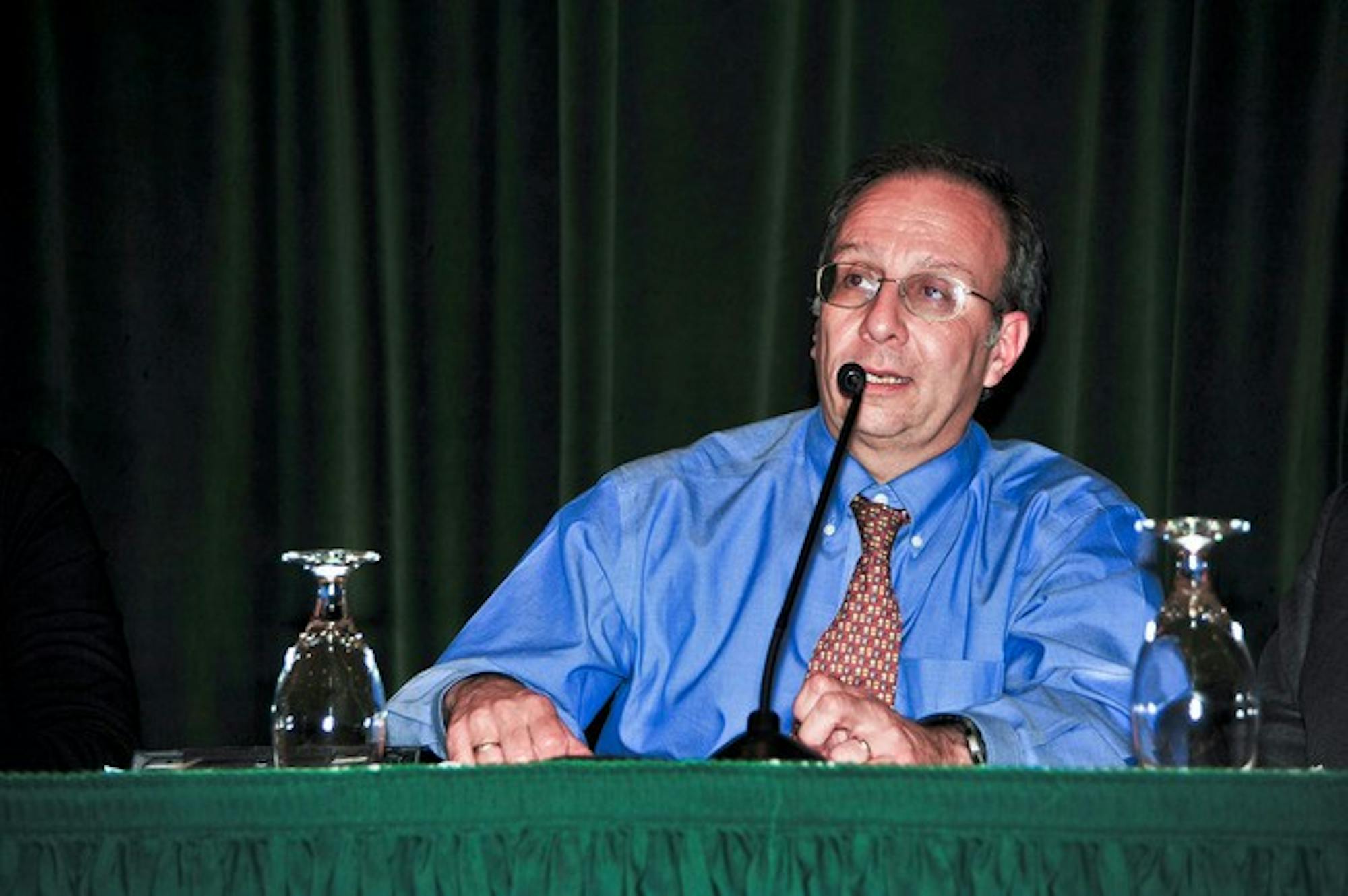
In response to a faculty-sponsored resolution passed in a May 23 Faculty of the Arts and Sciences meeting, which called for more details on the measures taken to close the College's $100-million budget gap since 2009, College President Jim Yong Kim, Provost Carol Folt and Executive Vice President and Chief Financial Officer Steven Kadish released a "Supplementary Finance Report" to faculty members on Oct. 10. The 40-page report, which includes specific information on new revenues and budget cuts pertaining to the Arts and Sciences division, was the primary topic discussed in Monday's meeting.
Religion professor Ronald Green, who proposed the original unanimously-passed resolution in the May 9 Faculty of the Arts and Sciences meeting and who has been one of the most outspoken proponents of increased administrative transparency, complimented the administration's disclosure of financial figures.
"The most important thing is that there's been a good dialogue between administration and faculty and I'm glad we went through this tumultuous exercise because it's alerted the administration to the fact that the faculty does have involvement and concerns in this area," Green said in an interview with The Dartmouth.
The report elaborates on cost reductions for fiscal years 2011 and 2012 specific to Arts and Sciences budget cuts, which totaled $5.5 million in cuts. To account for such cuts, administrators discontinued 40 courses for fiscal year 2011 to save $600,000, reduced department chair stipends to save $400,000 and deferred hiring 17 open tenure track positions in fiscal year 2011, which saved $1 million, among other measures.
At the meeting's outset, Kim said the expected return on the endowment for fiscal year 2012 is negative 5 percent, marking a 10 percent difference from the College's original projection of a 5 percent return. The lower projection is primarily due to a market downturn in the first quarter of fiscal year 2012, Kadish said in an interview with The Dartmouth.
Because Dartmouth experienced an 18.4 percent return on investments in fiscal year 2011 and implemented $100 million in spending cuts, Kadish said a negative return rate on the endowment in fiscal year 2012 would not have any major adverse affects on the College.
Kadish and Folt said that although the Arts and Sciences budget accounts for approximately 15 percent of the institutional budget, adjustments to the division's budget only accounted for approximately 8 percent of the savings required to close the budget deficit. Other College divisions contributed between 9 and 12 percent of the savings, bearing the brunt of the cuts in order to preserve faculty salaries and other expenses, according to Kadish.
At the meeting, which took place in Alumni Hall, Chair of the Committee on Priorities and religion professor Susan Ackerman also presented a summary of faculty responses she received regarding the Supplementary Finance Report since its mid-October distribution. The Committee on Priorities receives faculty members' input to advise the Budget Steering Committee on actions related to the Arts and Sciences, according to the Budget Steering Committee website.
Although faculty members were generally pleased with the increased amount of detail in the new report, some professors still want more information regarding specific budget reductions, such as cuts to non-compensation budgets, which finance outside speakers and off-campus coursework, Ackerman said. Faculty members have also requested more information regarding similar budget cuts at the Tuck School of Business and Dartmouth Medical School, according to Ackerman.
Even with the detailed report, faculty members have continued to express concern that the high level of staff cuts could impact faculty members' teaching and research, Ackerman said.
Green stood from his seat near the center of Alumni Hall and expressed his gratitude to the panel of administrators for the new information in the Supplementary Finance Report, but stressed the need for more faculty input in budgetary decisions and expressed concern about cuts to faculty benefit packages.
"I'd like to ask the question whether what we lost will ever be returned," Green said.
Green cited faculty benefits, especially retirement funds, as important ways to "generate the loyalty and willingness to contribute to Dartmouth."
Although other institutions may offer higher salaries than the College, comparable colleges and universities do not traditionally offer the same level of retirement or health care benefits that Dartmouth does, Green said in an interview with The Dartmouth.
Employees' retirement plans were reduced by lowering the College's contribution for employees aged 40 and above from 10 percent to 9 percent, and for those aged 35 to 39 from 10 percent to 7 percent. The health plan was also adjusted so that deductibles, co-insurance and co-payments were all increased.
"One of the very important things is retaining our faculty," Green said in an interview with The Dartmouth. "Our faculty are constantly being raided from elsewhere. We've lost a lot of people to other institutions. What is being done to make Dartmouth a place where people want to stay?"
Ackerman also said she was concerned that Dartmouth's faculty member recruitment and retention could be negatively impacted by the reduction in employee benefits.
"To have an attractive benefits package is a powerful tool in persuading people to take a job at Dartmouth College and a powerful tool to persuade people to stay at Dartmouth College when they have job offers elsewhere," she said.
Although cuts were necessary, the administration and the Board of Trustees do "not want to erode the College's competitive position," Folt said.
Savings from the benefits adjustments allowed the administration to preserve between 90 to 100 jobs, according to Kadish. This decision to detract from benefits "showed Dartmouth at its best as a community" because the recommendation to do so came from various faculty members, Kadish said in an interview with The Dartmouth.
Kadish and Chief of Staff David Spalding said in an interview with The Dartmouth that they could not provide an accurate timeline for returning lost retirement and health care benefits to faculty, but emphasized that the current benefit package is competitive, both nationally and in New Hampshire.
"What we did was an adjustment which was okay," Kadish said. "The important thing is that no faculty members were laid off. There is a very clear focus by the Board on making investment in the faculty, because that's the heart of the institution."
The College has also started a new primary care clinic and is working with Dartmouth-Hitchcock Medical Center to help ensure that Dartmouth employees and their families still receive proper medical treatment despite the reduction in health care benefits, Kim said during the faculty meeting.
"It just killed me to have to do what we did with the health insurance premiums, but what we did was pretty comprehensive," Kim said about mitigating the situation. "I hope that we can bring back health insurances premiums."
Leslie Ye contributed to the reporting of this article.


