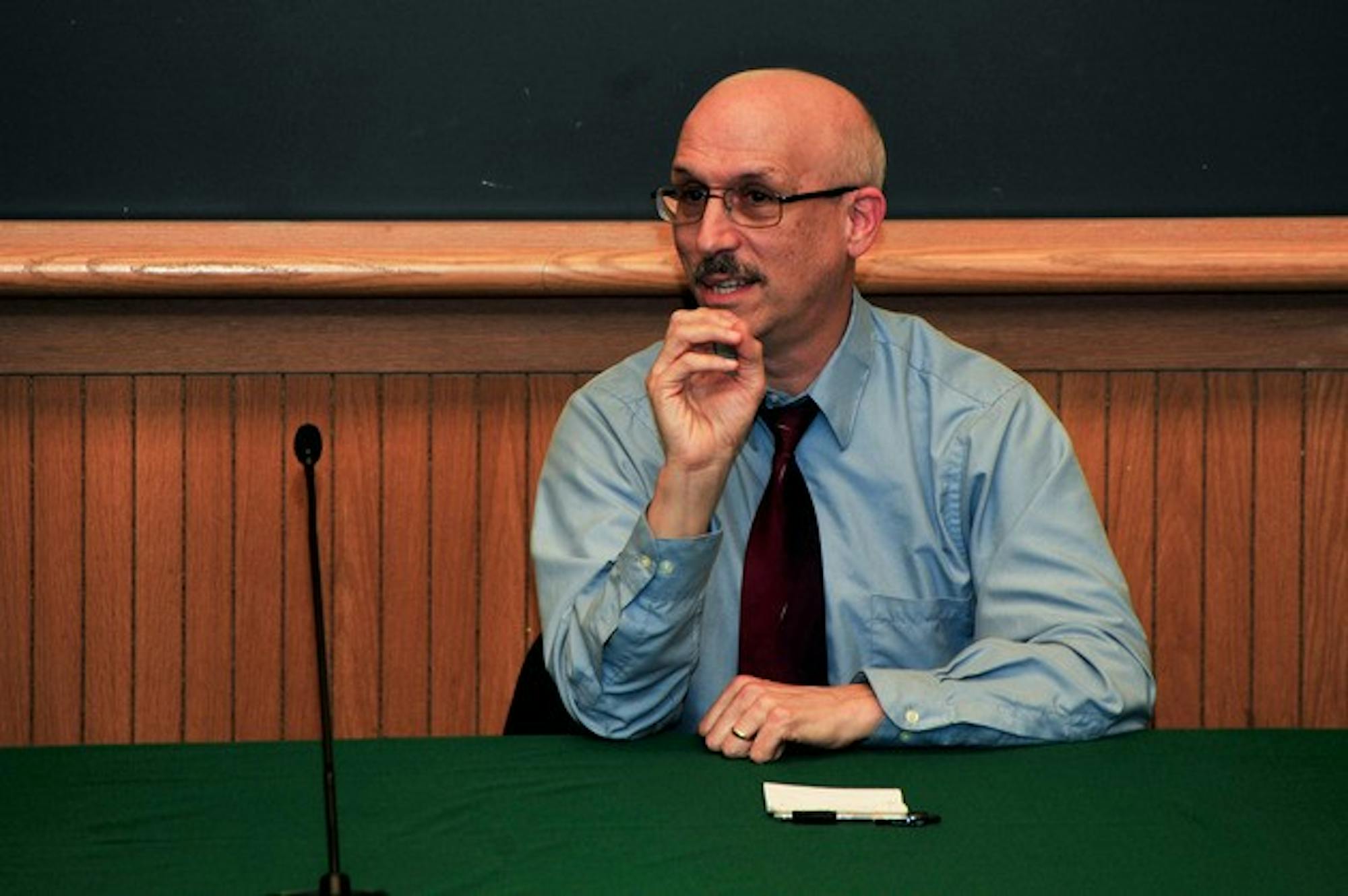
During the lecture, three leading cyber security experts discussed the background of current cyber operations technology and the degree to which governments and citizens should be concerned. Dickey Center for International Understanding War and Peace Studies Program Coordinator Daryl Press moderated the panel.
The audience of approximately 80 people which exceeded the seating capacity of the room included a diverse group of students in government classes and members of the Great Issues Scholars program who were asked to attend, as well as interested undergraduates, professors and graduate students.
"The attention and the interest in this topic is evident," Press said, citing the full crowd, the recent coverage of cyber operations in the media and the rising prominence of the issue in government circles. "Our societies depend upon information technology."
Libicki discussed the implications of recent cyber operations and suggested new ways of thinking about the field.
"Cyber war is as close as we're going to come to magic in conflict," Libicki said. "Its mystery lies in the complexity of the systems we attack."
Libicki also discussed increasing public wariness regarding cyber operations.
"What we have is a world where people have a high level of concern and fear," he said. "Fear is the wrong word ... if you talk about cyber weapons, you're really in the realm of doubt."
Libicki introduced the German term "zauber kampf," meaning "magic struggle," because the word "magic" reflects the mysterious nature of the field and the word "struggle" reflects the ambiguity of whether cyber attacks constitute acts of war, he said.
Panelist Herbert Lin, chief scientist at the Computer Science and Telecommunications Board of the National Research Council of the National Academies, described the nature of the current threats faced by cyber security.
The United States depends on information technology for military and civilian purposes, and depends on cyber security to defend it, Lin said. He delineated the defensive side of cyber security consisting of anti-virus programs and law enforcement and the more prominent offensive side, which includes cyber attacks such as the recent Stuxnet virus that targeted Siemens Corporation uranium enrichment systems in Iran.
Offensive attacks such as the Stuxnet virus are not surprising, according to Lin.
"A lot of people talked about it," he said. "It was a wake-up call for the policy community, but it was not a wake-up call for the technical community."
The success of an attack depends on access, vulnerability and the ability of the attacker to gain entry to a system, the weaknesses left open to exploitation, and the goals of the attacker, Lin said.
Lin cited the Stuxnet virus as an example of a cyber attack intended to destroy computer systems. The ongoing tension between the United States and China over intellectual property theft is an example of a cyber exploitation, a second category of operations whose goal is not to destroy but to solicit information, Lin said.
This explanation of categories and methods of cyber operations is complicated by "secrecy about [cyber operations], which clouds the discussion. And that's really, really problematic," Lin said.
Panelist Jon Lindsay, a postdoctoral scholar at the University of California Institute on Global Conflict and Cooperation, discussed the political effects of cyber operations and the newness of the field.
Although defense budgets are shrinking, the United States Navy and Air Force are seeking additional resources to devote to cyber operations, which are considered a new tool available for the military to use for offense and intelligence, he said.
"We're talking about using technology to bypass fighting altogether," Lindsay said. "The use of cyber force in intelligence is a huge boon."
Lindsay agreed with previous speakers about the uncertainty inherent in the field, and said cyber security is something that could "perhaps over the long term alter the balance in power between countries."
Following the three presentations, Press moderated a discussion that began with his own questions, followed by questions from the audience.
Questions from the audience mainly centered on recent attacks and their meaning for the country. As one audience member lamented the lack of information regarding cyber attacks given to the public, the panelists continued to stress the ubiquity of technological warfare.
"There's so much bad stuff sloshing around, especially on classified military networks, it would blow your mind," Lindsay said.
In response to a question about rising tensions between the United States and China, Libicki said "nobody really knows how to deal with this technically or procedurally."
Following the lecture, audience member Layla Dawood, a visiting scholar studying international relations, said the discussion "was provocative" in an interview with The Dartmouth.
"I think it makes us feel a little bit more concerned with things we sometimes don't think about," Dawood said.
The event, "Cyber Operations and National Security: A Panel Discussion," was coordinated by the War and Peace studies program as the first of four parts in its annual public lecture series, and was co-sponsored by the Institute for Security, Technology and Society.