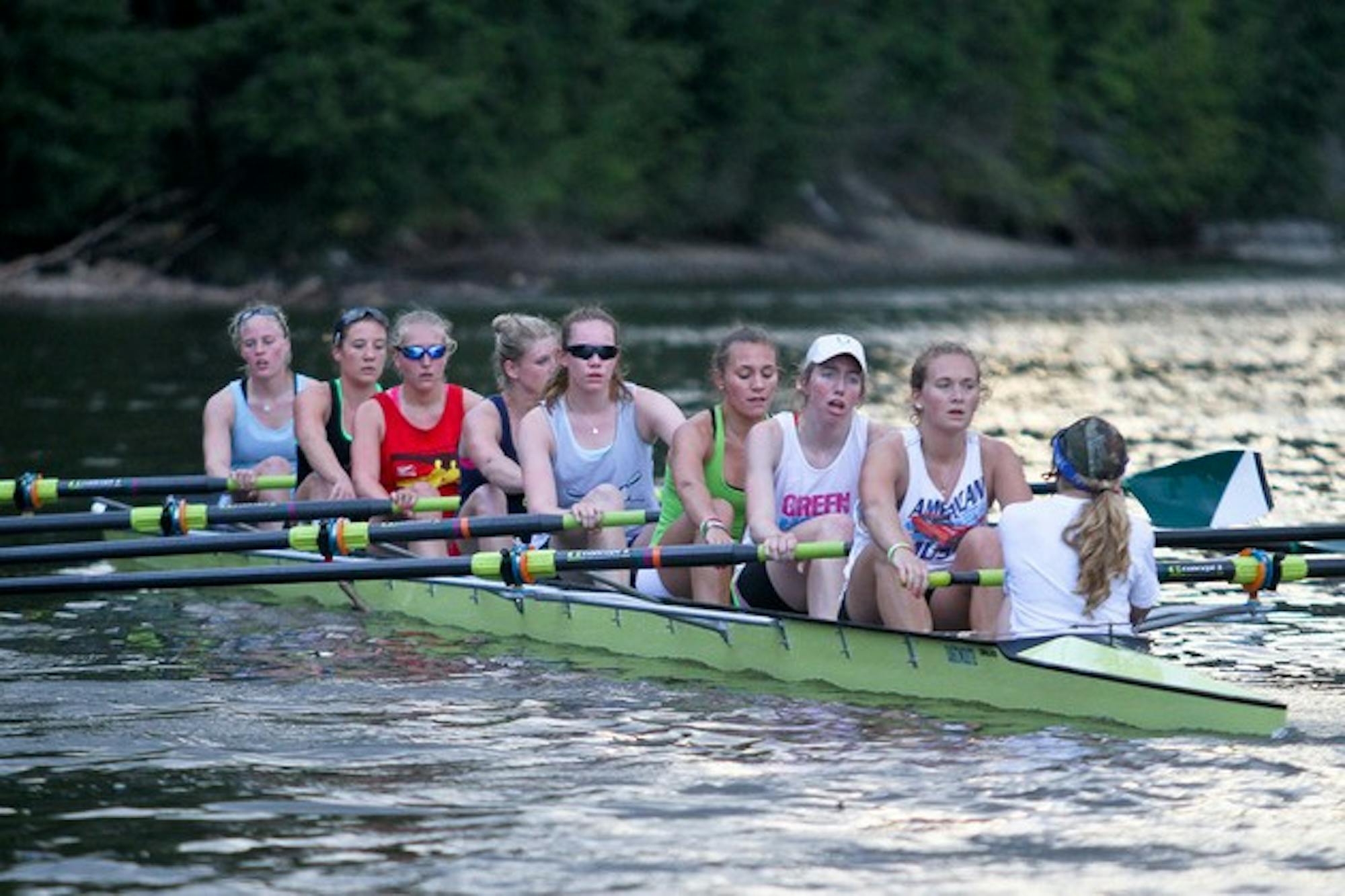
Competing in one of the largest and most prestigious races of the year, the men's lightweight eight finished eighth out of 17 boats and the women's eight finished 12th out of 37 boats. The men's heavyweight four and the women's four both finished in 13th place out of 53 and 20 boats, respectively, while the men's heavyweight eight crew battled its way to a 32nd-place finish in a 34-boat race.
"I was very happy with the result," lightweight captain Ian Accomando '12 said, adding that the lightweight eight's finish among the 17 competing crews "was a big step up" from its last-place finish in its 2008 heat.
Women's captain Jamie Chapman '12 said that the Head of the Charles is "very much a race to gain experience."
"It's good to know where we stand in relation to other crews in our league and country," Chapman said.
In addition to its bustling atmosphere, the annual Head of the Charles is known for its unique three-mile course through the heart of Boston. Because boats constantly jostle for the inside position on the Charles' numerous twists and turns, success depends on both the rowers' ability to feed off the crowd's energy and the coxswain's expertise in maneuvering the boats around tight bends.
The women's crews did both on Sunday. Women's head coach Wendy Levash said the atmosphere increased the rowers' intensity, while Chapman lauded women's eight coxswain Sarah Kler '12.
"She took a really good course and got the inside of turns which was huge," Chapman said.
Accomando acknowledged that the hectic environment overwhelmed the lightweight rowers at first, resulting in a disjointed warm-up session. He said that the team raced well overall, however.
"As we came out of the starting gate, our coxswain called us at 34 strokes per minute, a little higher than we had intended," Accomando said. "[But] as soon as the first stroke came about, you just knew that everyone was locked in and focused. We were able to execute our game plan."
Head of the Charles regulations state that slower boats must yield the right of way to overtaking crews. The rule helped at least two Dartmouth squads, as both men's lightweight eight and women's eight passed their opponents.
Despite a "really solid" week of practice, the heavyweight eight struggled from the start of the race, heavyweight captain Joe Polwrek '12 said.
"Really early on a boat passed us," he said. "I don't think we were expecting that."
Polwrek praised the heavyweight four's 13th-place finish, saying that the crew's members "did a really good job of rowing their race and racing together" despite their lack of experience racing as a group.
The heavyweight eight's strategy was to start off aggressively and "take a big shift" after one of the first turns, Polwrek said.
"We had that shift but maybe it wasn't enough," he said. "There's some pretty talented boats we're racing against."
The race marked the beginning of a long fall and winter training season, which Polwrek said is essential to success in the spring.
"[The] next step is holding the technical foundation and just raising the intensity," Levash said.
The men's lightweight and women's crews travel to Princeton University this weekend to compete in the Princeton Chase. The men's heavyweight crew next races on Nov. 5 in the Green Monster in Hanover.