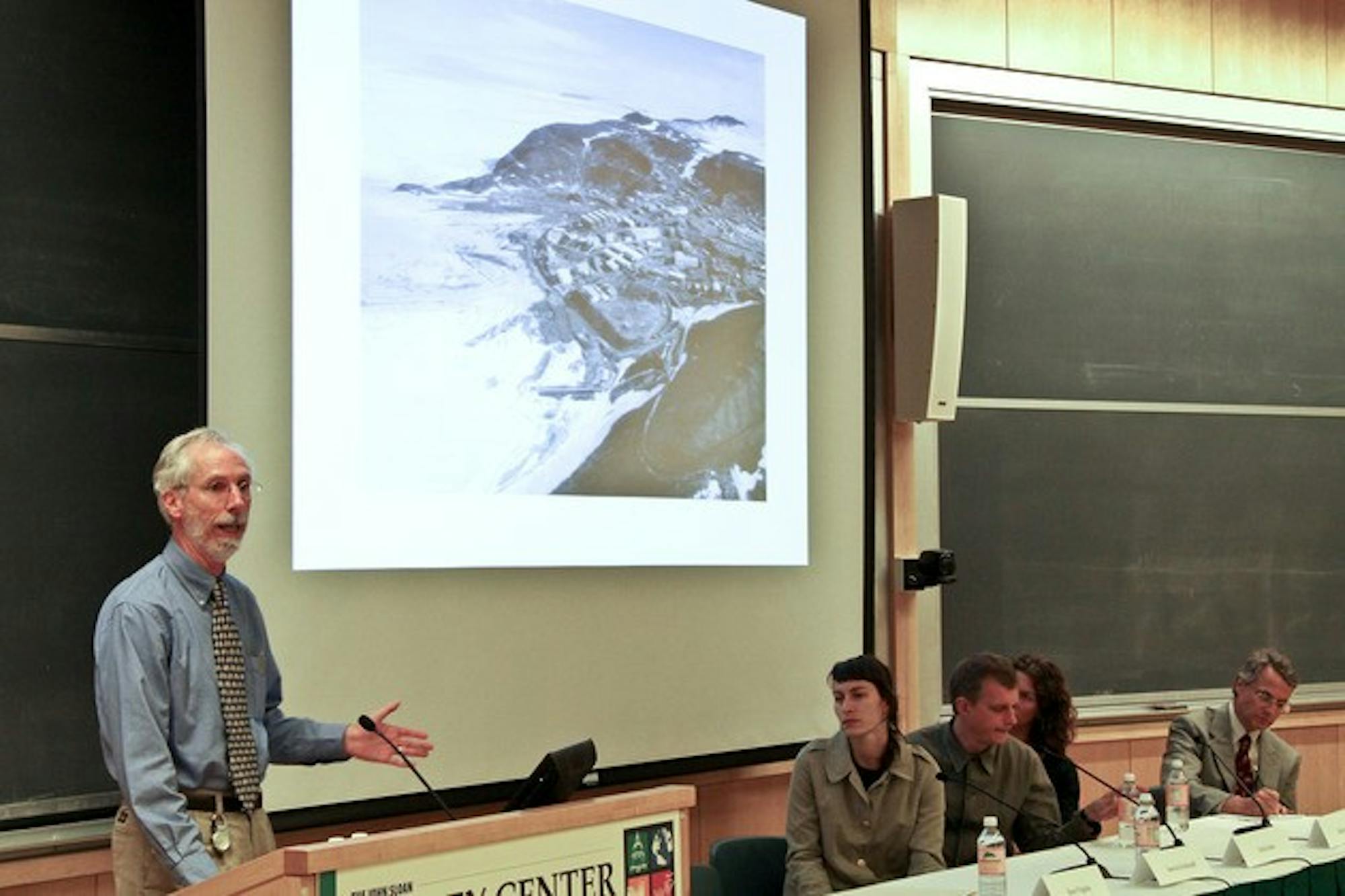
The panelists' various perspectives reflect the many facets of the important continent, Special Collections librarian Jay Satterfield, who moderated the discussion, said in an interview with The Dartmouth.
"The Antarctic is a continent in flux and you could look at it from different perspectives, and each tells a story," he said. "It's not just ice and water and heroic people in adverse situations it's about how they come together that makes the story."
Environmental science professor Ross Virginia, who serves as director of the Arctic Studies Institute at the Dickey Center for International Understanding, described the Nimrod Expedition, during which explorer Ernst Shackleton journeyed within 100 miles of the South Pole from 1907 to 1909. Shackleton was forced to turn back after he realized that his team would have starved on the return voyage.
"The men survived by killing penguins and elephant seals to supplement the small stores they could carry on the ship," he said. "They built snowmen to occupy their time and lift their spirits."
Virginia is currently working with a team of 30 scientists to determine how the Antarctic environment has changed over time, he said.
"I've gone to Antarctica 16 times and I'm leaving in December again," Virginia said. "I have polar fever and it's never going away. We want to know why [climate change] is happening and what are the future implications for these kinds of ecosystems."
The panel also featured Erik Sanko and Jessica Grindstaff, the artistic directors of the New York City-based theatrical company Phantom Limb. The directing pair explained their new visual imagery show, 69S, which depicts Shackleton's journey to the South Pole through puppetry.
Grindstaff emphasized that individuals should consider whether changes in behavior can help combat climate change.
"We want people to ask what to do now how do we deal with those moments of crisis now?" he said.
Earth science professor Meredith Kelly also spoke about public perceptions of polar environmental change and warned that the world's sea level could increase by 16 meters if the Antarctic ice sheet melts.
Satterfield praised Rauner Special Collection Library's Stefansson Collection on Polar Exploration the largest such collection in the country.
"I came here and discovered we had one of the best collections in the world, and we've used that collection to inspire and teach students and people around the world, and now we are using it to inspire a work of art," Satterfield said about the collection's relation to 69S.
The panel was co-sponsored by the Institute of Arctic Studies, the Hopkins Center and the IGERT Dialogues in Polar Science and Society Seminar Series. It was presented in conjunction with Phantom Limb's 69S, which will be performed in Moore Theater on Sept. 30 and Oct. 1.