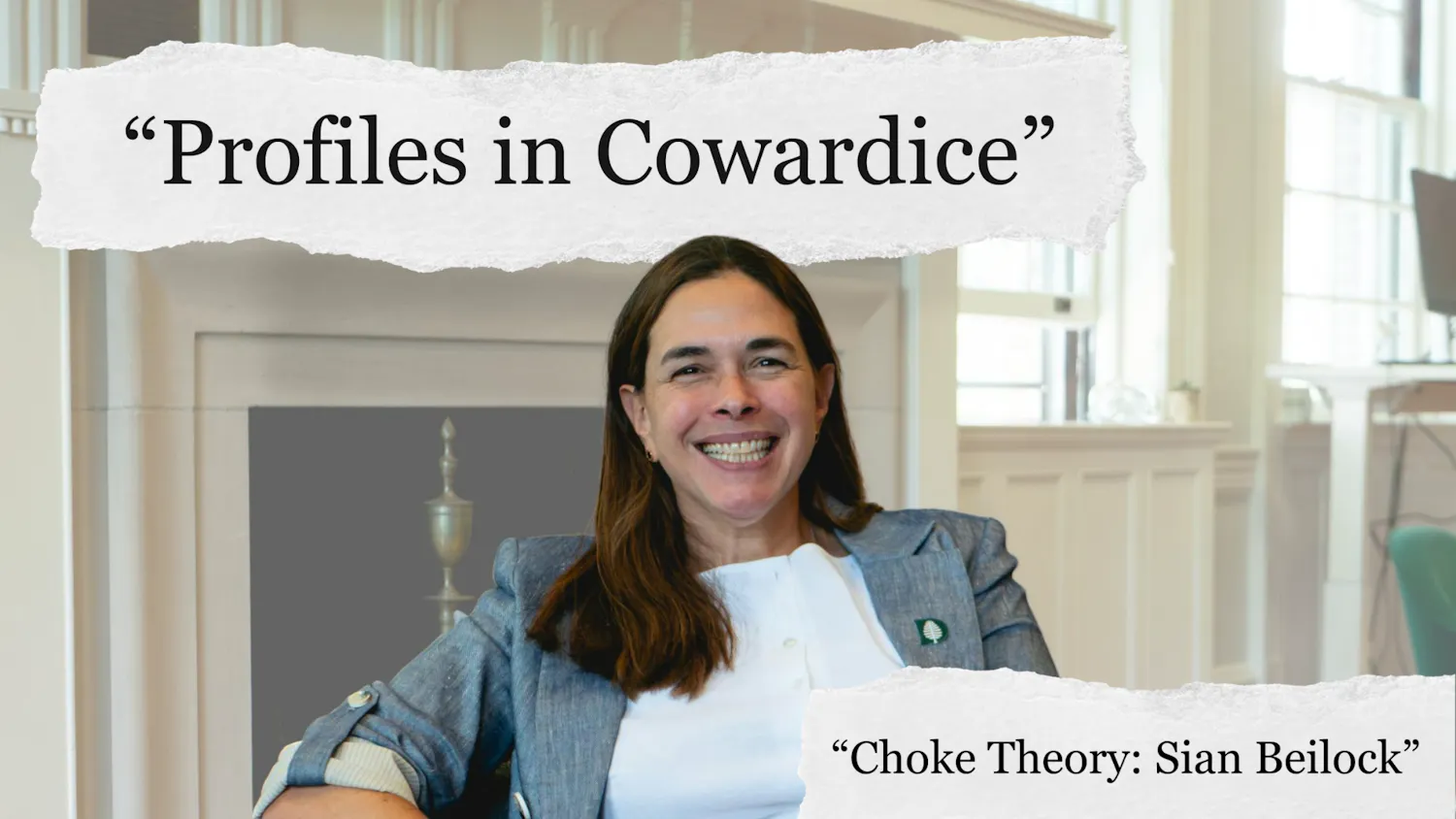
Government professor Deborah Brooks became an associate professor at the College on July 1, making her the first female junior faculty member to attain tenure in the government department in 18 years.
Brooks, whose past research has focused on public opinion, polling, campaign advertising, and the role of gender in politics, is currently finalizing a book "He Runs, She Runs: Gender Stereotypes, Double Standards, and Political Campaigns" that has been accepted for publication by Princeton University Press and will be released in 2012.
Two other female faculty members in the government department Linda Fowler and Lisa Baldez already have tenure, but they were hired at the senior level and received tenure in Dartmouth's government department at the time of hire.
After earning her bachelor's degree from the University of California, Santa Cruz in 1993, Brooks went on to earn her Ph.D. in political science from Yale University in 2000. Her dissertation, "When Candidates Attack: The Effects of Negative Campaigning on Voter Turnout in Senate Elections" won the 2002 Carl Albert Award for best dissertation in legislative studies.
From 1998 to 2003, she served as senior survey research director for The Gallup Organization. Brooks said that during her time at Gallup, she spent a lot of time analyzing polling and politics. The research she did at Gallup played a significant role in her later academic research, including her interest in the role of gender in politics, she said.
Brooks said her greatest contribution to the field of political science was "challenging the assumptions that are floating out there about American politics, about how people think about American politics." She said that a colleague of hers once described her as a "one-man wrecking crew for conventional wisdom" because her research challenged so many assumptions about how Americans think that had been widely accepted by journalists and academics.
"I think assessing the conventional wisdom is one of the greatest things that political science can do as a field," Brooks said.
Brooks wanted to study assumptions such as the one that says women are always less supportive of going to war than men. Through empirical research, Brooks found that women are actually more supportive of going to war than men in some cases, such as wars fought for humanitarian purposes.
In her upcoming book, Brooks offers a comprehensive study on the expectations voters have of male and female candidate behavior. Contrary to the conventional wisdom, particularly following the 2008 election and media attention on Hillary Clinton and Sarah Palin, Brooks said she found that women are not held to double standards by American voters, nor do they fare worse than men for "seeming tough." She added that her research shows that female candidates are not held to higher standards than men by the media.
Brooks said her goal in her research is to "try to get into people's heads" and study how Americans think about politics and politicians. Coming from a working-class background has helped her in her research because it has allowed her to think about what the American people are thinking, and not just what academics and journalists are thinking about politics, she said. Hannah Katterman '12, who has taken two classes with Brooks and helped with her research for her upcoming book, said she hopes the book will show women that they are not at a disadvantage in political campaigns and more women will be inclined to run for office.
Although Brooks was able to stay on the tenure track, she said that the reason so few women are able to attain tenure at institutions that operate under a "publish or perish" mentality the idea that if one fails to consistently publish research, one cannot stay on the tenure track is that professors' productivity is often assessed during the years that many women elect to have children. The challenge that women face on the tenure track is not unique to Dartmouth, but it is inevitable at all institutions that emphasize research, she said.
Dartmouth "does as much as it can" at the dean level to be supportive of women on the tenure track who choose to have children, according to Brooks. The College allows women to take a quarter off of teaching for maternity leave and to petition to add a year to the tenure clock for each child they have, she said.
"It helps to equalize the playing field but it by no means is completely equalizing the playing field," Brooks said.
Brooks said she is inspired by the women who fill many high-level administrative positions at the College.
"I think it helps to set up an environment in which women feel supported by the deanery to do their best," she said.
Students interviewed by The Dartmouth said Brooks succeeded in her efforts to make the coursework relevant to her students, particularly by bringing in guest speakers who could offer different perspectives on the subject.
"She's well-informed and she knows a lot of people," Alexandra Kurkul '13, a student in her class on the American political system, said.
Brooks encourages students in her class to express their opinions on the materials and promotes discussion, according Kurkul.
Katterman said Brooks was able to help students understand the material by pulling in outside sources and assigning a variety of different projects.
"She really diversifies the way she teaches, which I think is great," Katterman said.