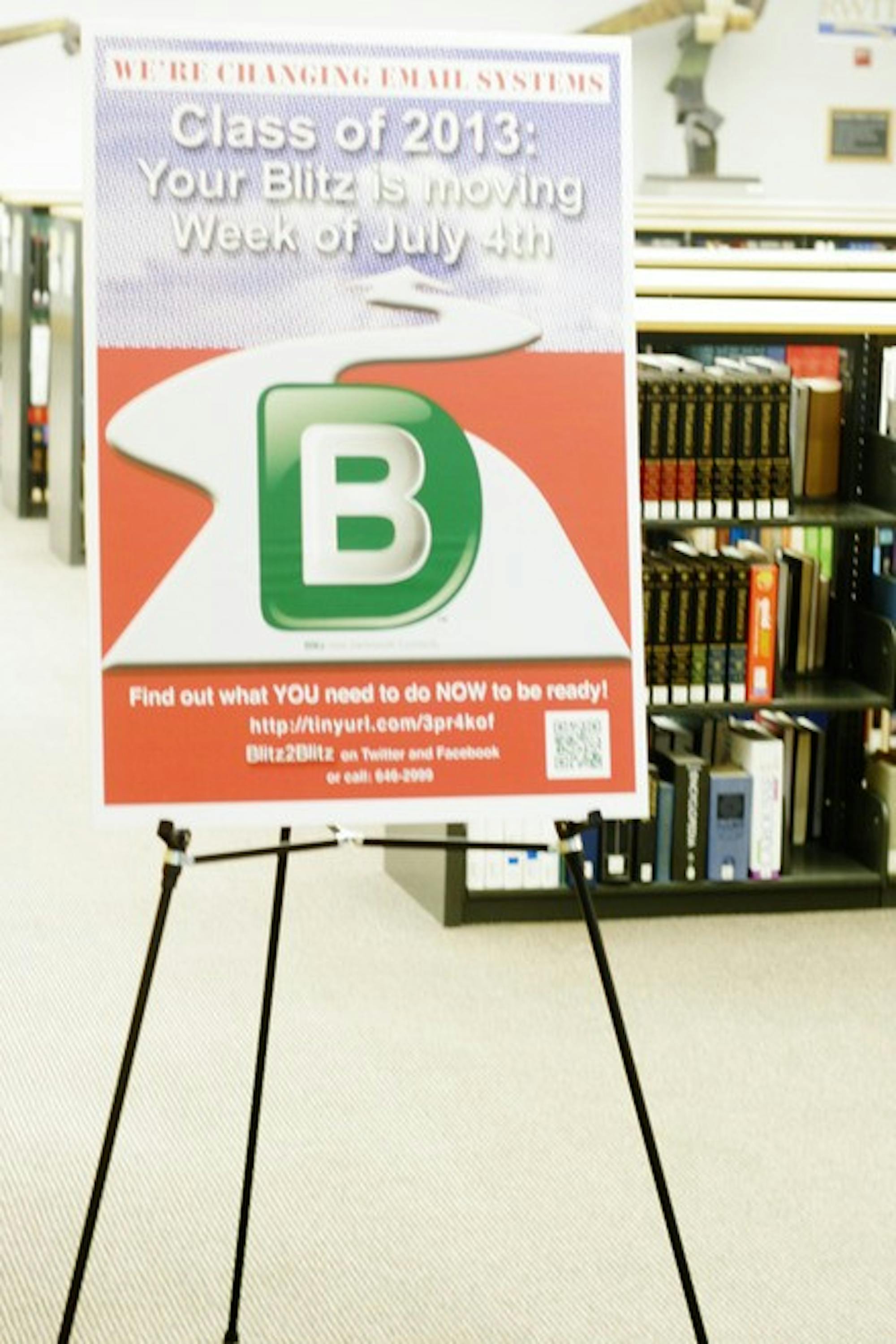
The email systems of the remaining members of the Class of 2013 will migrate by the end of this week, and BlitzMail users from the Thayer School of Engineering, Dartmouth Medical School and non-academic staff will transition over the next several months, according to Susan Zaslaw, project manager for the Blitz-2-Blitz transition.
Zaslaw said that the migration process went mostly as planned, despite some minor setbacks.
"We expected that there would be road bumps, because when you're doing a change of this magnitude, it's hard to test the magnitude part of it, and sometimes you get thrown curveballs," she said. "But I would say in general, things are going as we expect."
Two major problems occurred during the migrations: mailbox failure, usually caused by students remaining logged onto their BlitzMail accounts, and message failure, caused by problems with message size and file names, according to Zaslaw. Aspects of the new transition were also not communicated efficiently, she said.
"I think the one thing that really tripped us up was that we didn't communicate the fact that mail would trickle in," Zaslaw said. "I think there was an expectation with some students that they would log into their new account and all their mail would be there, when in fact what was really happening is that it was processing in the background and trickling in over time."
All other students will transition to the new system in early October, and incoming freshmen have already been added to the Microsoft system. Academic departments will migrate after all students have transferred their accounts, Zaslaw said.
Students said they were mostly content with the transition process, though some reported minor problems.
Jacob Evanter '13 said the transition process was relatively smooth, but that he still had difficulties setting up the new system through Microsoft Outlook. He also said he found the new web-based program too complex.
"It works, but it gives me all these new features," he said. "It ruins the simplicity that made Blitz great."
Katelyn Burgess '13 said she had a smooth transition and prefers the new system.
"I actually think it's easier to use than Blitz," she said.
The program saves messages and replies on the same thread instead of treating them as separate messages, which marks an improvement from the previous system, she said.
The use of threads was cited by a number of students as a positive feature of the new system.
"It doesn't seem like I have five million messages for one subject," Emily Smith '13 said.
Some students said they missed having a separate program rather than accessing email through their internet browser. However, most said they would likely adjust to the new program over time.
"Ultimately, it will be better," Brooke Elmlinger '13 said. "I think we'll get used to it."
Andrew Finch-Craver '13, who works at the Computing Services help desk, said that most students' problems with the new program have been successfully addressed.
"The biggest problem has been confusion over how the system is supposed to work," he said.
The confusion has been compounded by compatibility problems between operating systems, because some older Macintosh and Blackberry systems do not support the necessary software, he said. However, the majority of problems are minor and most students are simply adjusting to the new program, Finch-Craver said.
"Some people have been happy with the web service, but a lot of people haven't been happy with it because it's different," he said.
Vice President for Information Technology Ellen Waite-Franzen said previous waves of migration have gone relatively smoothly, but that there are always difficulties when dealing with transitions of this size.
"There will always be some failure, because human interaction, user interaction causes failure," she said.