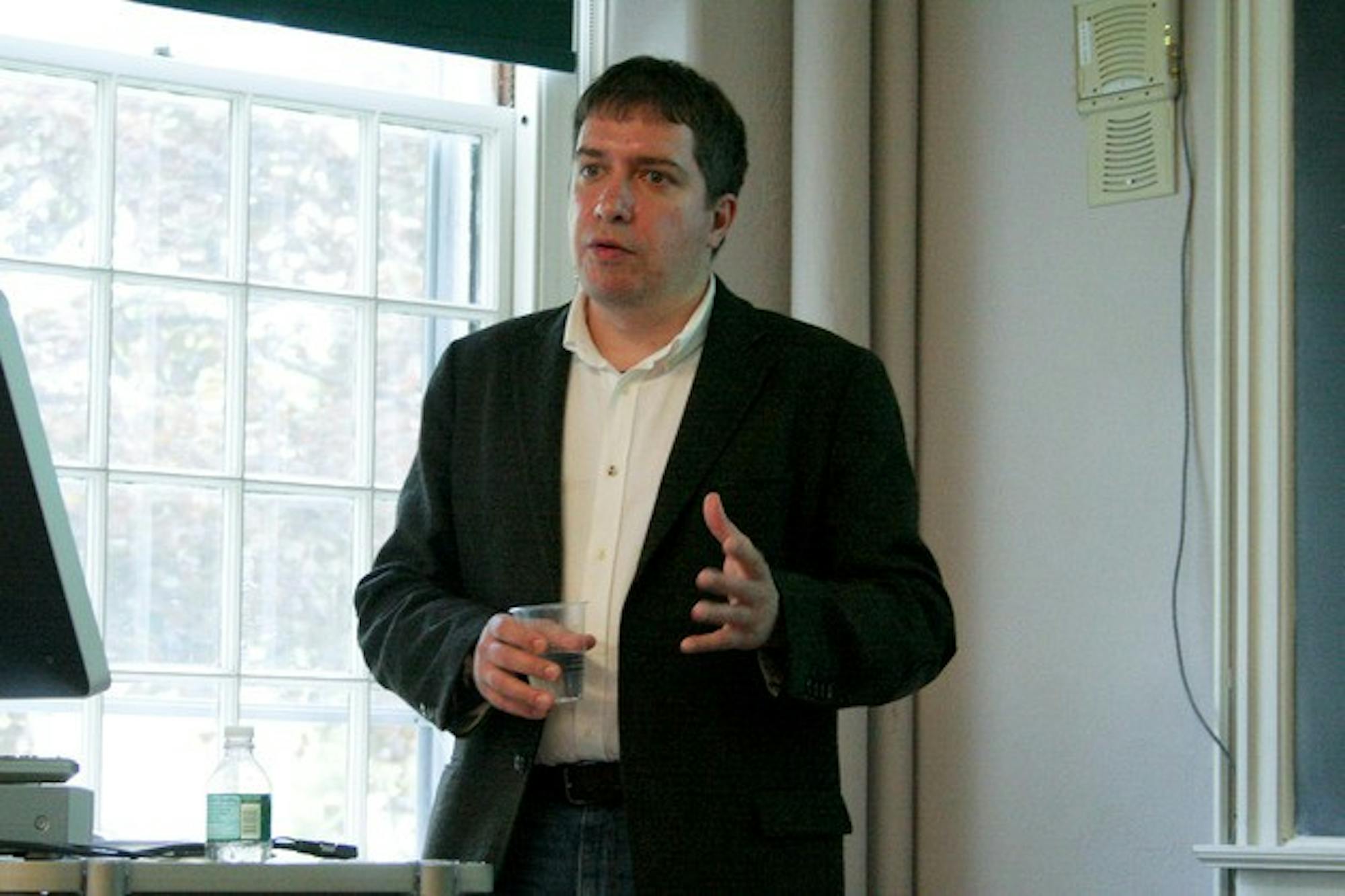
Trudolyubov, who created the first opinion page in the Vedomosti newspaper, said social networks play an insignificant role in contemporary Russian politics.
In Russia, which has a population of 141.9 million people, there is substantial political censorship, according to Trudolyubov. Web 2.0 applications which facilitate information sharing and collaboration among Internet users are blocked, and bloggers are subject to arrest if they are not considered pro-government bloggers, Trudolyubov said.
Russia's population is becoming increasingly aware that Russian President Dmitry Medvedev's use of social media networks is minimal and constitutes what may be considered "fake politics," Trudolyubov said. Medvedev provides more substantive information through televised speeches and press conferences than he offers through social media outlets, he said
"Medvedev the blogger is simply a show, a PR move," Trudolyubov said. "He is just using social networks to appear modernized."
While 77 percent of United States residents have regular Internet access, the Internet in Russia reaches only 37 percent of people, according to Trudolyubov. In Moscow, however, the number of Internet users has more than doubled from 2002 to 2010.
Despite poor communication between Russian political leaders and citizens through channels such as the Internet and social media, Trudolyubov said he is optimistic that mainstream Russian politics will soon incorporate social media networks.
"Even in smaller towns, the Internet is taking hold and starting to compete slowly with television as the main political source," he said.
Medvedev who Trudolyubov identified as "The Modernizer" is losing his "struggle for relevance" in Russian society by failing to utilize communication technology to create the image of a modern state, Trudolyubov said. Because Medvedev prohibits citizens from publishing dissenting opinions on the Internet, his push toward social media fails to engage the Russian public.
"Since Medvedev has been really destructive and has compromised the liberal democratic agenda, Russia should be in the mood for a political change," Trudolyubov said.
Although the web is a "vital coordination tool," it does not guarantee open and informative political debates, Trudolyubov said. The web is easily manipulated by dictators because they can propagate their own political agendas through multiple media outlets simultaneously, he said.
"There will always be an official agenda if reporters are not free," Trudolyubov said. "[Current restrictions] discredit the values of competition, democracy and civic, political action."
Due to recent Russian political leaders' failures to communicate through social media, Russia is confronted by "useless" politics, Trudolyubov said. Current communication efforts merely enhance elite political figures' social capital instead of truly informing or educating citizens, he said.
Trudolyubov challenged journalists throughout Russia to improve the quality of Internet reporting. Russian political leaders hope to model their 2012 presidential election on the 2008 U.S. presidential election by using social media outlets to inform the public in real time.
Trudolyubov's lecture, "Putin, Medvedev, And Facebook: Social Networks and Civil Society in Today's Russia," was co-sponsored by the Dickey Center for International Understanding and the Russian department.