College officials predict a $2.6 million surplus a figure that represents a "small margin" during fiscal year 2012, Provost Carol Folt said.
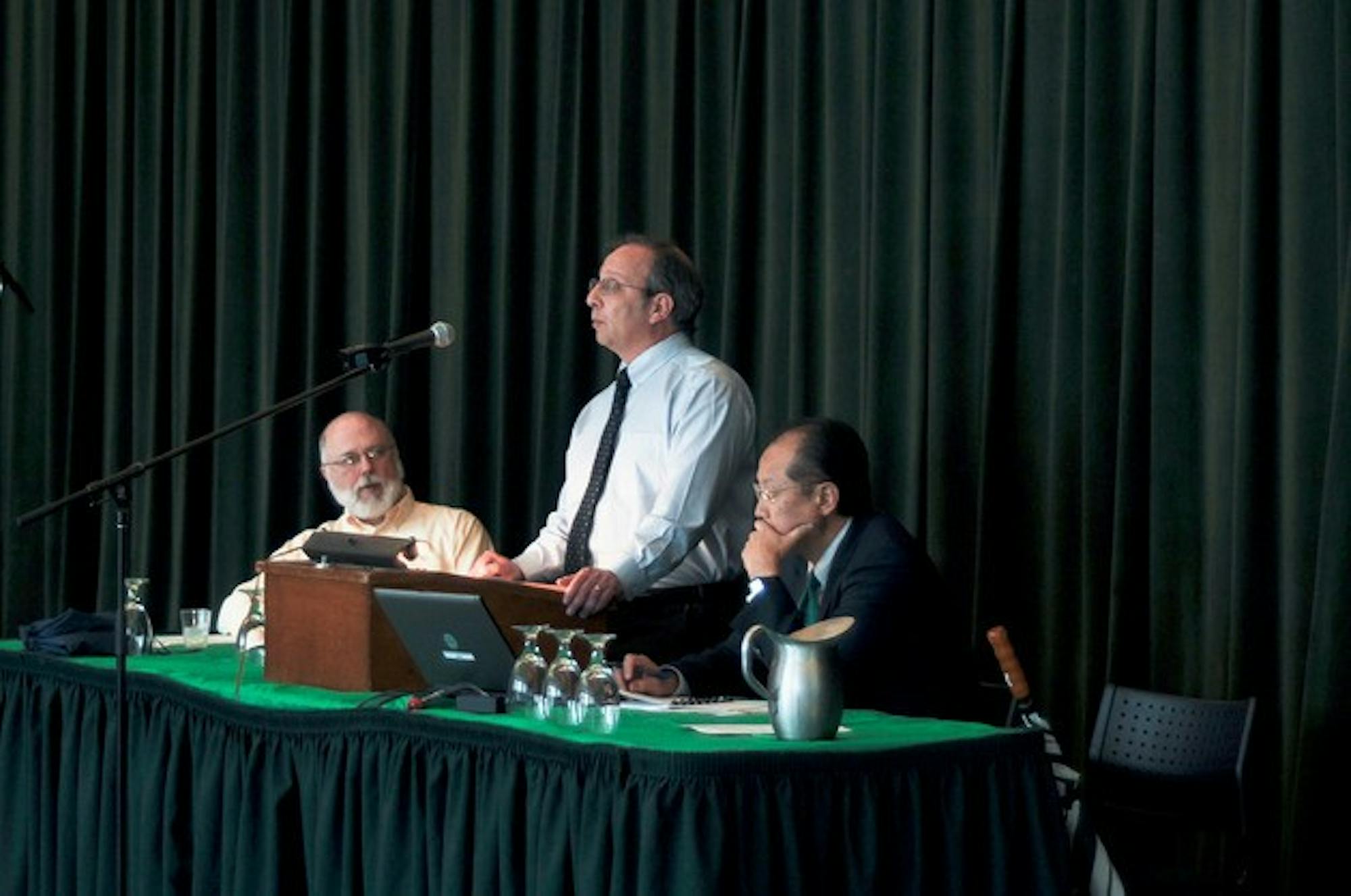
Folt, Dean of the Faculty of Arts and Sciences Michael Mastanduno and Chair of the Committee on Priorities and art history professor Adrian Randolph presented the report along with Kim.
The breakdown still lacks adequate transparency and details, according to Green, who authored both resolutions. The resolution passed at Monday's meeting requests that the Committee on Organization and Policy "recharge and strengthen" the Committee on Priorities so that it can "more effectively serve the Faculty," the resolution, which was obtained by The Dartmouth, said.
The resolution also requested that the Committee on Priorities deliver detailed accounting figures to faculty members two weeks before the first Faculty of Arts and Sciences meeting in Fall 2011.
This latest amendments seek to increase administrator transparency and faculty members' involvement in the budgetary process, Green said in an interview with The Dartmouth.
"The information will give faculty a better understanding of the nature and solidity of our progress and it will inform the administration that in times of real turmoil like this, the faculty has to be consulted with more actively," Green said.
Monday's resolution came as a surprise to the administration, according to Senior Vice President and Chief Financial Officer of the College Steven Kadish.
"I really believe we actually provided all the information that Professor Green was requesting," Kadish said in an interview with The Dartmouth. "We're not trying to hide anything or hold back."
The report presented by Kim and other administrators aggregated various numbers that individually affect the ability of faculty members "to pursue [their] scholarship and teaching," Rockefeller Center Director Andrew Samwick said. Such numbers including how library resources were affected and the result of reductions in academic departmental assistants' hours should have been clearly separated out, he said.
The issue of communication and governance between individual committees, faculty members and the administration was addressed several times throughout the meeting by presenters and faculty members in attendance.
Folt apologized for the College's decision to raise its percentage for overhead, or associated program costs, which includes money required to support new programs at the College and sponsors IT infrastructure, facilities and other administrative expenses.
Following the establishment of associated program costs in 1999, 14.29 percent of programs provided by gifts and endowments went toward associated program costs, according to the report. Under the new budget plan, this amount will increase to 19.1 percent, allotting the College $2 million, The Dartmouth previously reported.
Faculty members did not learn about this change until after the decision was already made, Green said.
Folt admitted that the College handled the situation incorrectly.
"Quite frankly, we didn't sit down and say, How are the Arts and Sciences going to respond to this?'" Folt said during her presentation.
Samwick, who voted in favor of the resolution, said he has learned through his experience on the Committee of Priorities that it is difficult to ensure "relevant communications" when administrators move quickly to address budgetary concerns.
Communication between faculty members and the administration has decreased since last year, Kadish said.
"As far as tackling the budget gap, we had about 80 percent of it resolved last June and we didn't keep the same level of communication up as last year," Kadish said. "One of the really interesting issues [is] what information could be communicated, and to whom and when. Hindsight is 20-20 I think we can learn how to do that better."
Mastanduno said he would send emails with budget updates to faculty members once a term in order to improve communication and transparency.
Faculty members also expressed concern regarding the decision to cut the contingency fund used to buffer unexpected costs by $3.3 million. Despite questions regarding how the cuts might decrease financial security, Kadish said Kim believed the College could afford to take the risk rather than make different cuts.
The presentation also addressed future spending plans. The possibility of "getting out of the bunker" of a financial deficit is real given that the College prioritized preserving "critical core elements" throughout the budget reduction process, Mastanduno said.
The College hopes to procure resources to restore the 35 courses cut last year, provide research funds for technology updates, phase out the Writing 5 exemption for first-year students based on SAT scores and increase the number of fellowships available to professors, Mastanduno said. This year, the College increased the number of senior faculty grants from two to six, he said.
Mastanduno also addressed ways to establish more efficient course assessments, strengthen advising services at the College and maintain a high level of teaching.