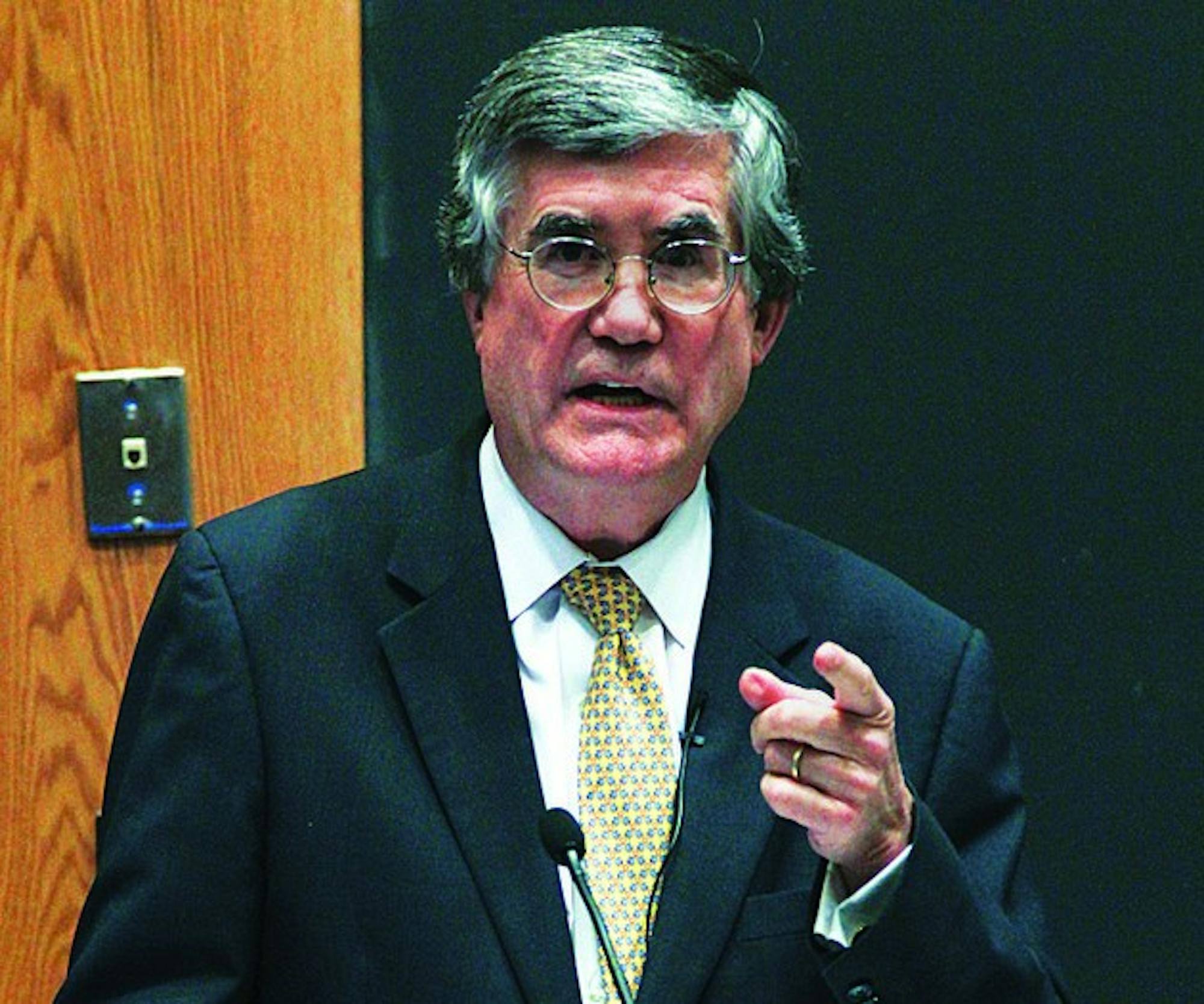
Broderick, who was chief justice of the New Hampshire Supreme Court from 2004 to 2010 and currently serves as dean and president of the University of New Hampshire School of Law, said that although leadership requirements vary based on the position, the best leaders establish and maintain their tight relationships with their constituents.
"In my opinion, leadership is never about you," he said. "It's about visioning a destination, and inspiring those you need to achieve your goal. It's about making your goal their goal."
Leaders must develop a personal connection with their constituents by acknowledging their needs and offering them resources to better their conditions, Broderick said.
Broderick, who co-chaired Clinton's 1992 New Hampshire campaign, recalled an occasion after a "particularly bad week" when, late for their flight, Broderick and Clinton were walking to the shuttle van when they were approached by a woman and her child who wanted to speak to Clinton, Broderick said. He watched Clinton chat with the woman and her son, wrapping his arms around their shoulders. The woman, who had recently lost her husband, asked Clinton to encourage her son to try harder in school, Broderick said.
"Most people would just walk past her and say, I'm late'," he said. "[Clinton's action is] called leadership. Nobody saw it. Unless I told you, you would never know."
Broderick also spoke of an occasion when he and Biden were at a train station in Delaware and saw an elderly black worker shining the shoes of a young white man. Biden approached the shoe-shiner, who he had met before, and greeted him, according to Broderick.
"Biden jokingly said to the guy, Don't let George do what he always does to me. He shines one shoe and tells me my train is here,'" Broderick said. "I guarantee you George won't look at himself the same way. [Biden] lifted him up."
Influence and stature do not reflect what leaders can do for themselves, but rather how they can use their authority to fulfill the goals of the position, according to Broderick.
"Power and authority never equal privilege," he said. "They reflect your responsibilities to others and your obligation to achieve something of value."
Broderick said he established meetings and lunches with middle to lower-level workers including clerks and janitors to learn about their ideas for improving the court system.
Although Broderick's opinions would often differ from those of his colleagues, he put his pride aside and always respected the final decision because it reflected the opinions of a "collaborative leadership," he said. This type of selflessness is indicate of true leadership, according to Broderick.
"My job was to find out what I thought and best express what I thought," he said. "I didn't think it was my job to force people one way or the other."
At the conclusion of the event, Broderick discussed challenges facing the current generation of students and his experience dealing with youth in his job as dean and president of UNH School of Law.
One key challenge that students face is overcoming the tendency to have high expectations for success despite low expectations for effort, Broderick said. Current students are also obsessed with technology and the virtual world, which can lead to a sense of disconnect in everyday life, Broderick said.
"A virtual world doesn't have much," he said. "Community matters. You can live life in your basement, but I don't think that's good."
Broderick also serves as an adjunct professor at the Tuck School of Business.