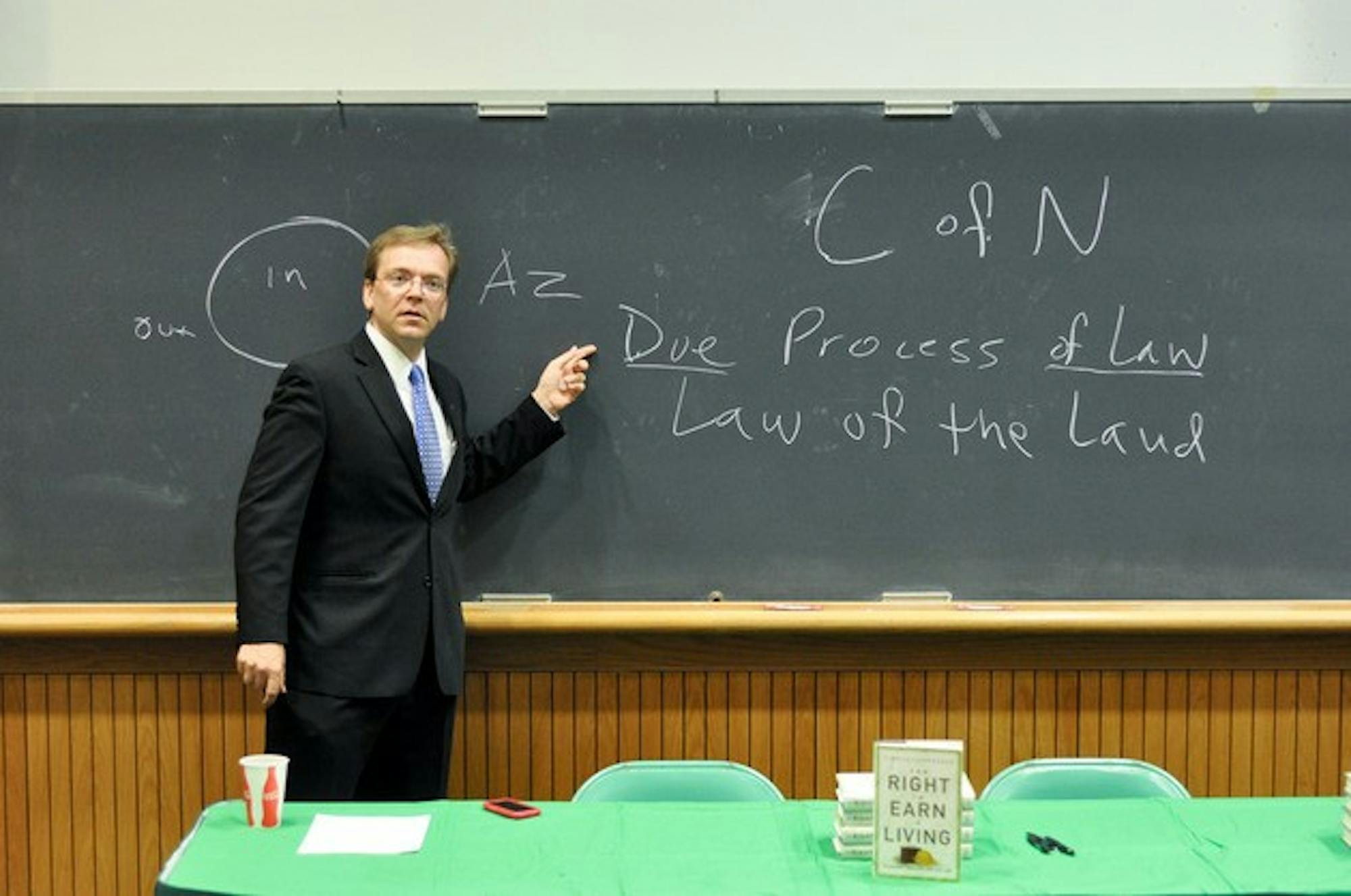
The government's creation of "barriers to entry" including licensing requirements and certificates of necessity threatens Americans' civil liberties by preventing businesses from easily entering the market, he said.
Sandefur, the principal attorney at the Pacific Legal Foundation, gave an example of a "barrier to entry" by describing a current case in which he is representing a St. Louis, Mo., moving company that is allowed to move goods within and from St. Louis to outside states. The business, however, is prohibited by state law from moving goods between St. Louis and other parts of Missouri unless the company is granted a state-issued "certificate of necessity."
"How do you prove there needs to be a new moving company?" Sandefur asked. "Nobody knows. There are no standards in the law and no rules."
Most states require a certificate of necessity for many types of businesses, including taxi cabs and even hospitals, according to Sandefur.
Sandefur described an incident in which an investor applied for a certificate of necessity to build a hospital on the island of Maui, Hawaii. Although the island has only one hospital that serves 145,000 people, the investor was denied on the grounds that the new hospital would compete with the government-run hospital, according to Sandefur.
"There has to have been one person [during the last three years] who has died because he didn't get to the emergency room in time," he said. "Who is it that thinks it's a better idea for people to die than there to be free competition in the hospital industry?"
The use of these barriers to entry violates the 14th Amendment, which delineates that no state "shall deny you of life, liberty, or property without due process of law," Sandefur said.
The law referred to in the amendment should espouse rationality and fairness instead of government interests, according to Sandefur. Irrational and unfair decrees should not be considered laws but rather resolutions or pronouncements, because they violate "the authority to make law" as according to the Constitution, he said.
Outside of the implementation of barriers to entry, the Supreme Court has misinterpreted what constitutes a law on several occasions in U.S. history, Sandefur said.
Sandefur cited the 2002 case of Susette Kelo, who sued the city of New London, Conn., for unlawfully seizing her property and giving it to a private developer, as an unjust example of governmental interference.
The Supreme Court decided in 2005 that the seizing of land was legitimate since it eventually "created jobs," according to Sandefur.
"Under that theory absolutely everything the government does is constitutional, like if government steals your property," Sandefur said.
The Supreme Court decisions of Korematsu v. United States and Buck v. Bell also violated the Constitution's 14th Amendment, according to Sandefur.
College Libertarians co-president Joshua Schiefelbein '14, who organized the event, said he enjoyed listening to Sandefur's "incredibly energetic" lecture.
"His talk showed us what we need to start fighting," Schiefelbein said. "We can't live successful lives if we need to abide by regulation after regulation. He showed us we need to get out in the community and challenge these absurd laws."