
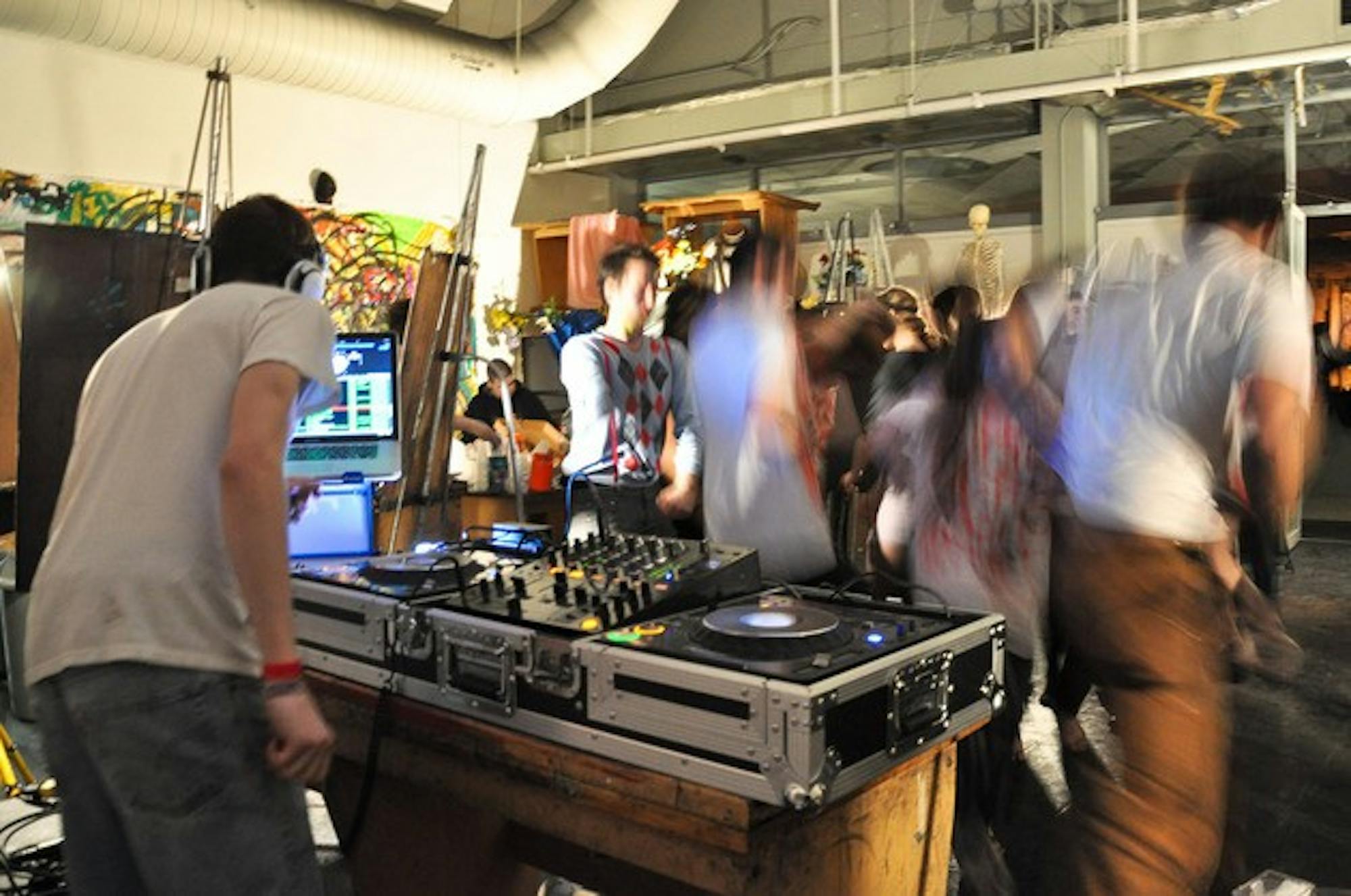
When students open their inboxes to find a blitz about a fraternity foam party, they typically react with either enthusiasm or indifference certainly not terror. However, for Matt Knight '11, also known as DJ Postman, the announcement of a foam party inspires more trepidation than excitement.
"The environmental hazards of playing in frats are staggering," Knight said.
Knight is just one of many students who brave the sludge-coated frat basement floors and, at foam party time, layers upon layers of soapy suds in order to serve the Dartmouth community as campus DJs.
During the day, DJs are ordinary students, studying medicine or engineering like many of their peers. But despite their prosaic daytime pursuits, DJs play a crucial role at night: setting the tone for the party.
To help get in the character of their nighttime alter egos, students go by DJ names. While some DJs assume titles inspired by their own names, others take a more creative approach.
Both Patrick Chen '12 (DJ Chuck Chambers) and Trey Roy '09 (DJ Enzo) said they were inspired by their peers' names when choosing DJ titles.
"There was this dude in high school who was always called Chuck Chambers," Chen explained. "He hated that name, but at the time I thought it was the best thing ever."
Similarly, Roy chose to adopt the name of one of his friends.
"I had a friend freshman year whose nickname was Enzo," Roy said. "Enzo Ferarri pretty badass, and it's short and sweet."
But DJs face obstacles greater than creative name selection. As Knight noted about foam parties, fun can often present tricky environmental hazards.
"You've got to be prepared for snafus," Knight said. "I play on vinyl, and in a damp environment you've got to be on your toes."
Karen Schuster '12 (DJ Kashew) said students' behavior can also pose problems for DJs.
"For some reason, people love making out in front of the DJ booth," Schuster said. "That can be a little awkward."
According to Ryan Collins '13 (DJ Ryco), drunk students occasionally destroy DJs' sound equipment.
"I've had cups of beer thrown at my speakers," Collins said. "One kid was playing with my crossfader once and just ripped it off and ran off with it."
Collins said he is not too fazed by these setbacks, however.
"The equipment takes some abuse," Collins said. "But it's all part of the chaotic atmosphere."
Destruction of equipment aside, DJs praised the combination of Dartmouth's Greek scene and isolated location for making it possible for student DJs to hone their skills. According to Chen, urban universities do not offer the same kind of opportunities for student DJs. Whereas campus DJs are only competing with one another for gigs, students at other schools have to go up against professional DJs who have experience playing in clubs and other large venues.
"At another school with clubs, there are guys who do it as a career," Chen explained.
Barbara Richards '13 (DJ Ryu) expressed the same sentiments, adding that the DJs would not be as approachable at a larger school.
"Here, the DJs are all local students," Richards said. "They're celebrities in their own right, but they're very accessible. You can blitz them or meet them and so, in a sense, it creates a community."
Richards is a member of The Dartmouth Web Staff.
As part of this campus music community, DJs operate within a network of sorts, with upperclassmen showing new DJs the ropes and helping them break into the music scene. In recent years, however, the network has suffered due to the departure of prominent '09 and '10 DJs, including Ruslan Tovbulatov '09, Dan Kagan '09 and Greg Dona '10.
Fortunately, a few have remained on campus for graduate studies. For example, Jan Gromadzki '10 (DJ Janski) and Roy are currently students at the Thayer School of Engineering. In addition to continuing their studies, Roy and Gromadzki have served as role models for younger DJs.
"The DJ community is generally pretty supportive," Schuster said. "Greg Dona is now DJing in [New York City]. I admired him and followed his blog, and he was nice enough to meet with me [to offer advice]."
According to Richards, Dartmouth students can establish themselves as campus DJs by networking with prominent upperclassmen DJs.
"You first start out by getting to know other DJs," Richards said. "My first gig was Sig Ep's paint party last spring, and I got that through knowing DJ Enzo."
When Collins was starting out as a DJ, he contacted Gromadzki to get advice. Gromadzki recalls taking similar action when he was looking for his first campus gigs.
"When I was a freshman, I remember talking to an older DJ, asking him what the scene was," Gromadzki said.
Roy takes a more official approach to mentoring aspiring DJs by teaching a miniversity class on the subject. Chen, one of Roy's former students, said he looks up to older DJs like Roy and Gromadzki.
"I was the guy at the parties freshman and sophomore year who was just trying to figure out what track [Gromadzki] was playing," Chen recalled.
Collins and Chen both said that it was difficult to gain momentum as a new DJ.
"It took pretty much all of freshman year to make the connections I needed," Collins said.
However, once DJs have established their reputations, "there are almost too many opportunities," Collins said. Social chairs of different Greek houses often approach DJs at parties to inquire about future gigs, Collins explained. Once DJs have broken into the campus music scene, one gig leads to another.
Roy said membership in a fraternity plays an important role in establishing the connections necessary to gain momentum as a campus DJ.
"Having a house is your foothold in the Greek party scene," Roy explained. "It's where you'll get the most exposure."
Knight admitted that Greek affiliation is helpful, but added that he does not think it is necessary for success.
"I tend to put enough faith in the campus to not be so insular as [that]," Knight said.
Whether or not Greek affiliation is crucial for success as a DJ, it does help to have the support of a fraternity a dynamic that makes it especially difficult for female DJs to make a name for themselves.
According to Schuster, male DJs usually start out in their own houses, making it easier for them to gain traction and establish themselves on campus. Whereas affiliated male DJs automatically have a venue to display their skills, female DJs must branch out more since sororities don't typically host dance parties.
In addition to Greek affiliation, DJs said they are limited by the often narrow musical preferences of the Dartmouth audience.
Each DJ has a different approach to the restrictions of mainstream music demand.
"You have to be flexible and be able to adapt to a crowd's taste," Richards said. "Be aware of what's popular, what's new, what's hip."
Knight said adapting to popular demand often means DJs only get to play music at the top of the pop charts.
"You kind of have to stick to the top 40," Knights explained. "But I'm not ashamed to admit I like the music."
However, Collins and Chen both said they wish there was greater freedom to play a more diverse range of songs.
"There's a lot of music out there and Dartmouth parties just get a tiny sliver," Collins said.
Chen added that DJs who try to push musical boundaries are typically not successful.
"You can't just play obscure Dutch house," Chen explained. "The floor will empty if you try to push it."
Gromadzki, a Switzerland native who has served as DJ for Panarchy since his sophomore year, said he enjoys being able to play more obscure music at Panarchy.
But even Gromadzki has had to tailor his playlists to suit audiences at times.
"I got yelled at for playing house music at a dance party once," Gromadzki said. "But now it's [become] mainstream trends change."
The location of a gig also plays a large factor in the DJ's satisfaction. Fraternities, take note your basement configuration matters.
"My favorite is probably Chi Gam," Collins said. "They've got a riser in their main room and it's just the right size."
Chen explained that the most coveted gigs are recurring parties like Gammapaloza and the Panarchy Rave, and Collins added that these parties are always eventful for the DJs.
"One thing Dartmouth students know how to do well is have a fun time," Collins said.
And even though DJs appear to be stuck behind their turntables, they claim to have just as much fun as everyone else at the party.
"Any Heorot dance party [is fun]," Knight said. "There's just something about them. They're just ludicrous."


