"As we commemorate Peace Corps' 50th anniversary, it is an honor to pay tribute to the thousands of Americans who have served and supported this agency since 1961," Peace Corps Director Aaron Williams said in a statement. "[Rassias] was a pioneer with our essential language training programs that have contributed to the success of Peace Corps in many West African host countries."
Saturday's event, part of a larger celebration of the Peace Corps' 50th anniversary, honored Rassias along with other New England residents who have contributed to the Peace Corps, according to Chamberlain.
Rassias, who was also recognized in 1996 for his contributions to the Peace Corps, said the short amount of time in which Peace Corps volunteers had to learn the language was one of his key concerns in formulating his method.
"We needed to take immediate action to get people to function," he said in an interview with The Dartmouth. "We were able to create the appointment of getting language as thoroughly as you can to the student and to do so with energy."
IT Director at the law firm Berger Montague John Berger, who learned French using the Rassias method before his Peace Corps deployment in 1967, said he was "hit hard" with language instruction during his month-long immersion.
"I had to apply myself in a way that I'd never done," he said.
By the end of the month, Berger had managed to rise above his previous learning difficulties, he said.
"For some reason, it did an end-run around all of my learning problems," he said in an interview with The Dartmouth. "I went from knowing nothing to learning French."
Berger attributed his success to the Rassias method, which has been used by the Peace Corps since 1965.
Dartmouth began teaching its language classes with the Rassias method in 1967.
Berger, who served as a Peace Corps volunteer in Upper Volta now Burkina Faso from 1967 to 1969, said his French training was so effective that he was able to use the Rassias method of total immersion to teach himself Moore, the African language used in the village where he served.
"[Rassias] didn't teach me French, he taught me how to learn," he said.
Berger said his experience learning Moore was so effective that he is still able to speak it 40 years after he learned the language.
Berger said he could converse with the Burkina Faso immigrants who work at a nearby Shell gas station.
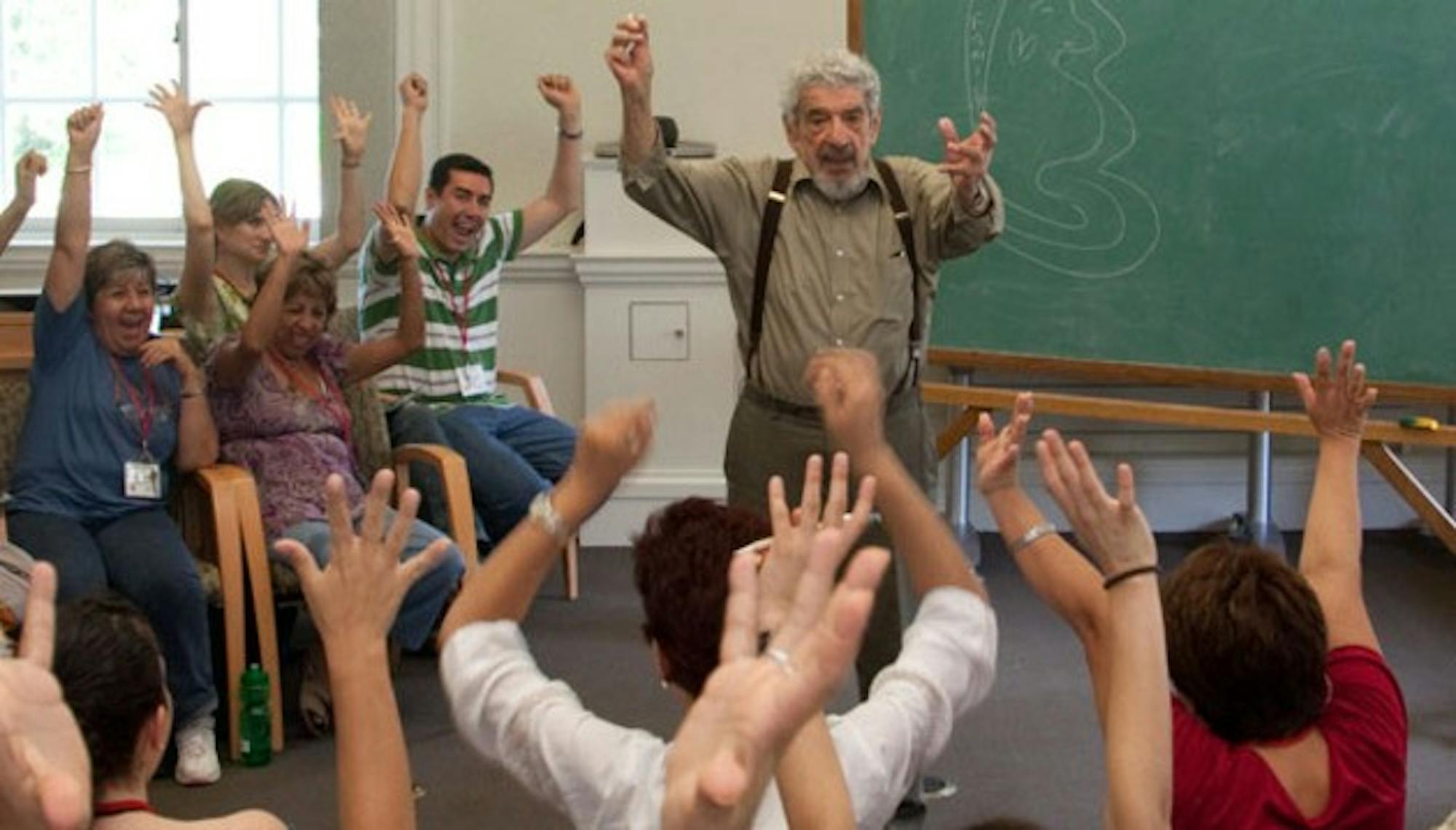
In addition to teaching language in a fast-paced manner, Rassias said that the key tenets of his method included "rhythm, movement and motivation," as well as a focus on the individual students themselves.
"The student is why we're here," he said. "The direction has to be to that target."
Rassias, who joined Dartmouth's faculty in 1965, served as a consultant to the Peace Corps during the formation of its language program, according to a College press release.
Cultural education in conjunction with language training is essential for understanding the greater context of languages, Rassias said.
Rassias used the example of an American woman who was chased out of a Greek shop after using an open hand to indicate she wanted five of a particular item, as the Greeks consider this gesture to be extremely obscene, he said.
"[People learning languages] are not here to conquer, [they're] here to compliment," he said. "One single word could cause a war."
The true success of Rassias' language programs has arisen not only from the use of particular learning strategies, but also from the engagement that it brings from the students, Rassias said.
"It became something that was joyful," he said. "They realized that something was happening."
Rassias served as a consultant for the Peace Corps' language programs during the organization's first 10 years and directed the first language program in French-speaking West Africa, according to the College's website.