The minor is designed so that students can learn the concepts and tools needed to move society toward a "sustainable transition," Anne Kapuscinski, environmental studies professor and director of the program, said in an interview with The Dartmouth.
After a year spent designing the curriculum, the environmental studies department unveiled the minor in Fall 2010, according to Kapuscinski. She said she will not know the exact number of students currently registered for the minor until a more formal evaluation of the program is conducted next year.
The sustainability minor track requires six courses, including a prerequisite introductory environmental studies course, according to Kapuscinski. Students have the opportunity to create a "flexible and engaging" curriculum by selecting courses in broad areas such as problem-solving, design and innovation and interactions between society and the environment, she said. Elective courses in the minor are organized into four clusters ecosystems and sustainability challenges, social justice, ethics and identity as well as creative expression, Kapuscinski said.
"Our curriculum was the outcome of a lot of discussion," she said. "We designed subject areas so that students would get exposed to fundamentally different ways to think about sustainability [and] its challenges, as well as different techniques and tools for solving sustainability problems."
The minor will also include formal and informal opportunities to explore sustainability inside and outside the classroom, according to Kapuscinski.
"Students who declare the sustainability minor will have positioned themselves well to get involved in research activities," she said.
This term, two environmental studies classes that fall under the minor will perform analyses that will contribute to the College's sustainable planning process, Kapuscinski said.
"The students will look at existing scenarios and develop a quantitative model for new sustainability in the year 2050 for the Upper Valley," she said.
Students pursuing the minor will also contribute to a sustainability "working group" composed of faculty that will organize campus-wide sustainability events.
The minor will also create an interdisciplinary opportunity for students to experience relevant course work in a variety of departments including anthropology, biology, geography, engineering, government, history, philosophy, speech, earth sciences, studio art and Native American studies.
"We developed the minor based on what real-world multi-dimensions are out there and what ways of thinking bear on this challenge," Kapuscinski said. "For example, we incorporate history because a lot of scholars have figured out that sophisticated analysis on how we got to the present in the first place can allow us to prepare for the future."
This interdisciplinary approach will allow students to examine philosophies and world views behind sustainability, Kapuscinski said.
Anthropology professor James Igoe who teaches the course Environment, Culture and Sustainability that will count toward for the minor said anthropology is a discipline "committed to cultural relativism" at its roots.
"I hope anthropology can contribute something that's uniquely holistic [to the minor]," he said. "I seek to work with students to understand how mainstream American culture came to see environmentalism in certain ways and how we interact and intervene with our environment."
The sustainability minor is a "wonderful opportunity" for students planning to pursue a multitude of career paths, Sustainability Director Rosi Kerr '97 said.
"Sustainability is inherently interdisciplinary so there are huge opportunities available to explore it," Kerr said. "I came from the business community and I see it as great training because sustainability is relevant to so many fields anything from renewable energy to the private and non-profit sectors, global development and so much more."
Jonathan Wachter '10, who served as the program assistant for the creation of the new minor, emphasized the importance of the minor's interdisciplinary nature.
"My big hope is that the minor program will continue to evolve," he said. "We did our best to make the minor come from a collaboration of people and departments, but I also hope that there will be opportunities for other faculty members to take advantage of getting involved if they hear about it."
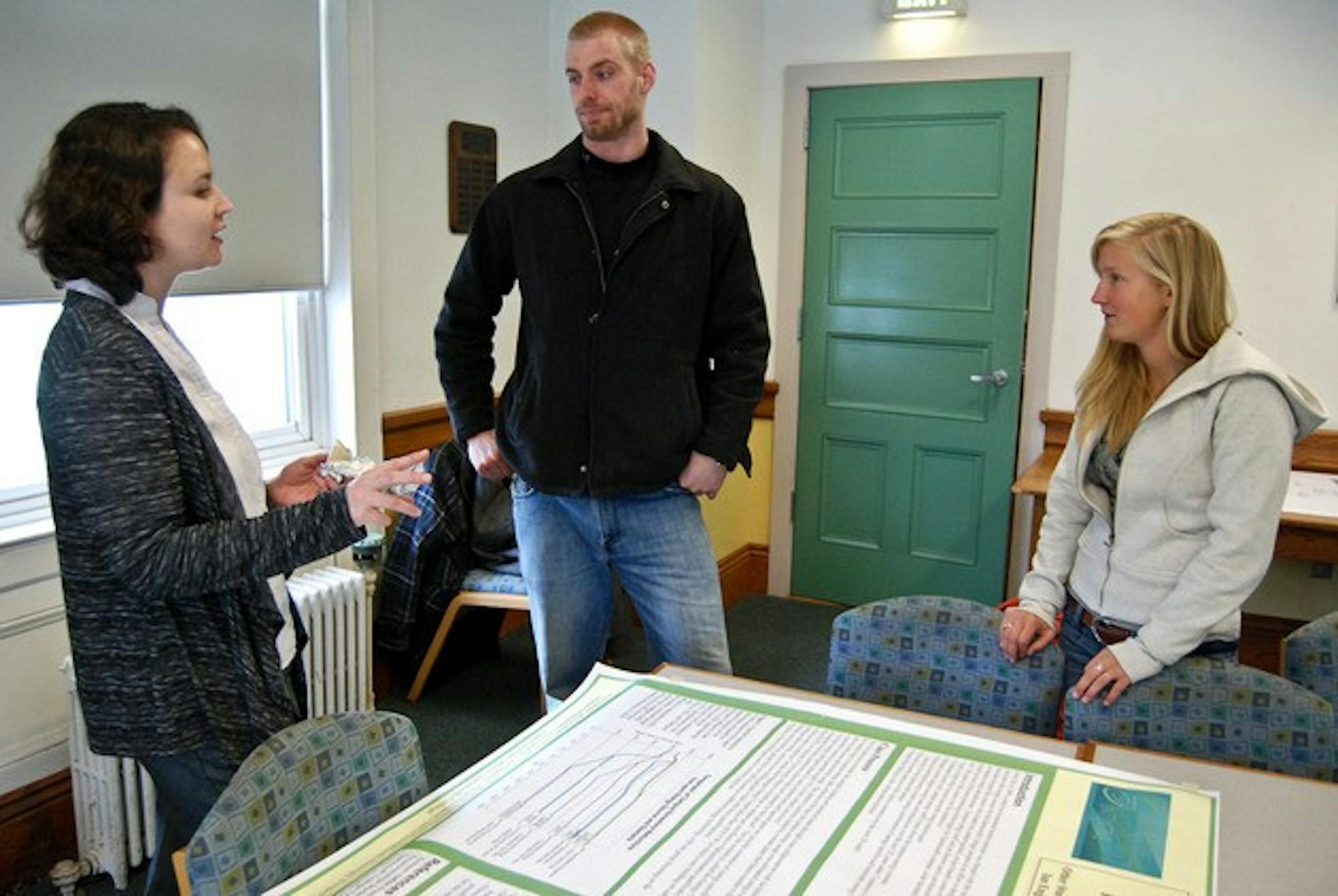
Students with a variety of academic and extracurricular interests attended the meeting, according to Kapuscinski.
"There were a diversity of students at the information session today," she said. "More importantly, there were a lot of students who I didn't recognize, which is a good sign we designed this minor for majors across various disciplines in mind."
Students who attended the session expressed excitement regarding the new minor in interviews with the Dartmouth.
Jocelyn Powelson '14 said the minor appeals to her because she is "passionate" about international environmental issues.
"I'm definitely looking into the minor and trying to get more involved in sustainability on campus because I hope to do something related to environmentalism perhaps in third world countries," she said.