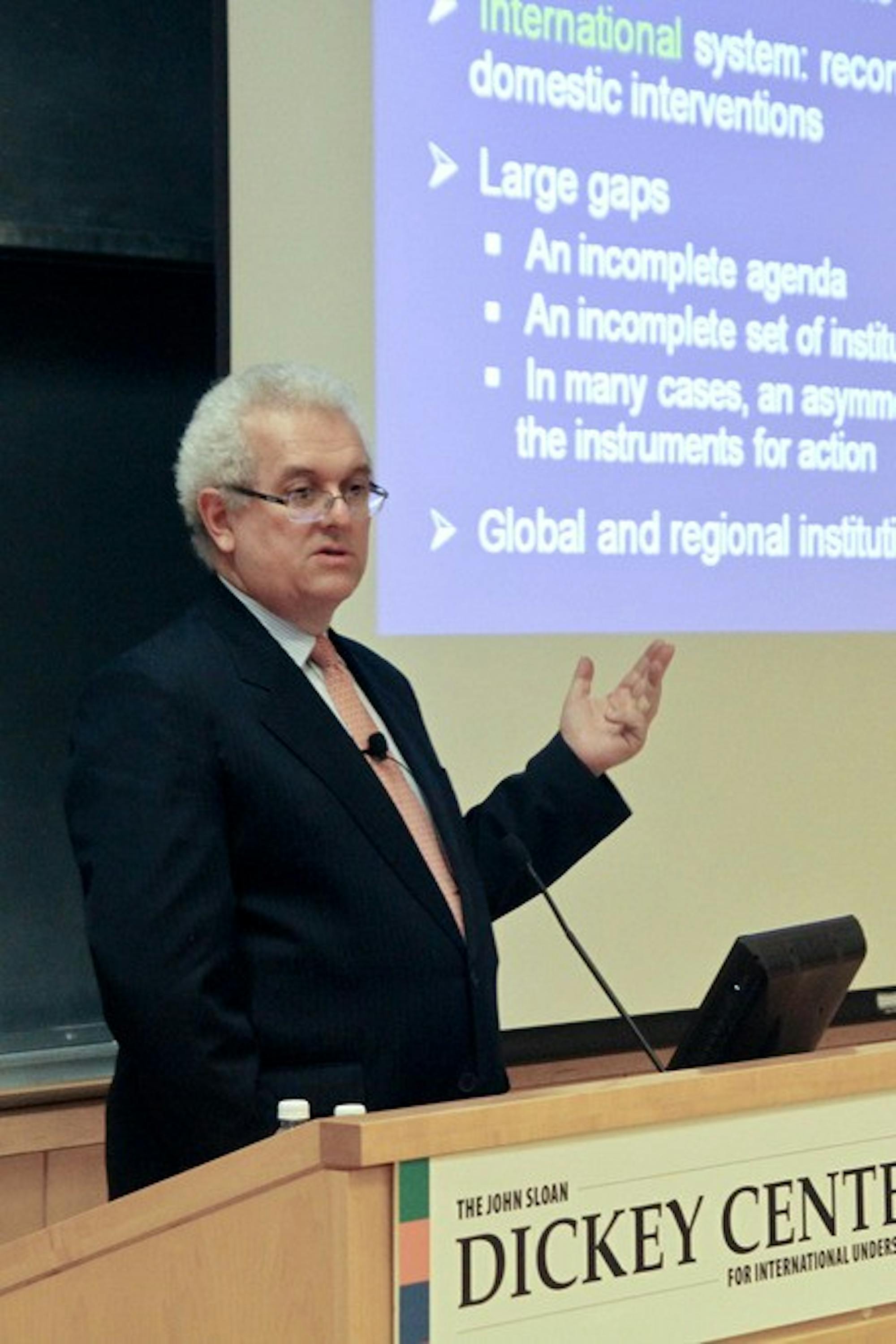
The veto power awarded to powerful states in the U.N. Security Council and the IMF, combined with the relatively low representation of developing nations in these international institutions, creates an uneven ground for economic decision making, according to Ocampo.
Currently, the IMF's leader is always a European selected by the European Union and the head of the World Bank is always an American picked by the United States president, Ocampo said. These countries are overrepresented in international economic decision making, while developing countries in Asia and elsewhere are overlooked, he said.
Ocampo praised recent reforms proposed at the Seoul Summit a meeting of the G-20 government leaders to discuss the global economy this past November. At the Summit, attendees proposed a redistribution of seats and votes in the IMF and the World Bank, Ocampo said.
Ocampo, who lamented the lack of control at the helm of current international institutions, said he supports a 2009 proposal to address the challenge of creating "a representative institution at the apex of the system."
As someone who helped form the proposal, Ocampo said the new system would be based on constituencies and would be supported by "the entire U.N. system," rather than just the organization itself. These changes could help ensure that the voices of more nations are heard, he said.
"What people like me would like to have is a governing structure that has the powerful countries sitting down at the table because otherwise it would be an irrelevant body but at the same time representing everyone," Ocampo said.
International institutions' current structure also leaves "large gaps" that prevent effective policy on several issues relevant to developing nations, he said.
Due to these inadequacies, there is no true framework for addressing issues such as international migration, Ocampo said. International institutions lack the tools they need to thoughtfully offer solutions to these problems, according to Ocampo.
"There is a huge asymmetry between the agenda accepted by the international community and the instruments international institutions have to orchestrate that agenda," he said.
The decentralized structure of these institutions adds to the challenge of addressing issues relevant to developing countries, according to Ocampo.
The "original sin" of many international institutions is that they were designed to favor the interests of developed and powerful states, Ocampo said. Many of these institutions formed after World War II under conditions that led to "huge international inequalities" that are still perpetuated today, Ocampo said.
Despite his concerns, Ocampo said he is still optimistic that international institutions can become more equitable.
"At the end of the day, competition among powers has always been good for developing countries," he said.
Ocampo served in several U.N. positions including the U.N. Under-Secretary General for Economic and Social Affairs. He currently works as a professor of international and public affairs and director of the economic and political development concentration at the School of International and Public Affairs at Columbia University.
Ocampo spoke at the College as a Class of 1950 Senior Foreign Affairs Fellow, which was funded by a gift from the Class of 1950. The members of the Class of 1950 were the first to spend four full years under the presidency of former College President John Sloan Dickey '29, The Dartmouth previously reported.