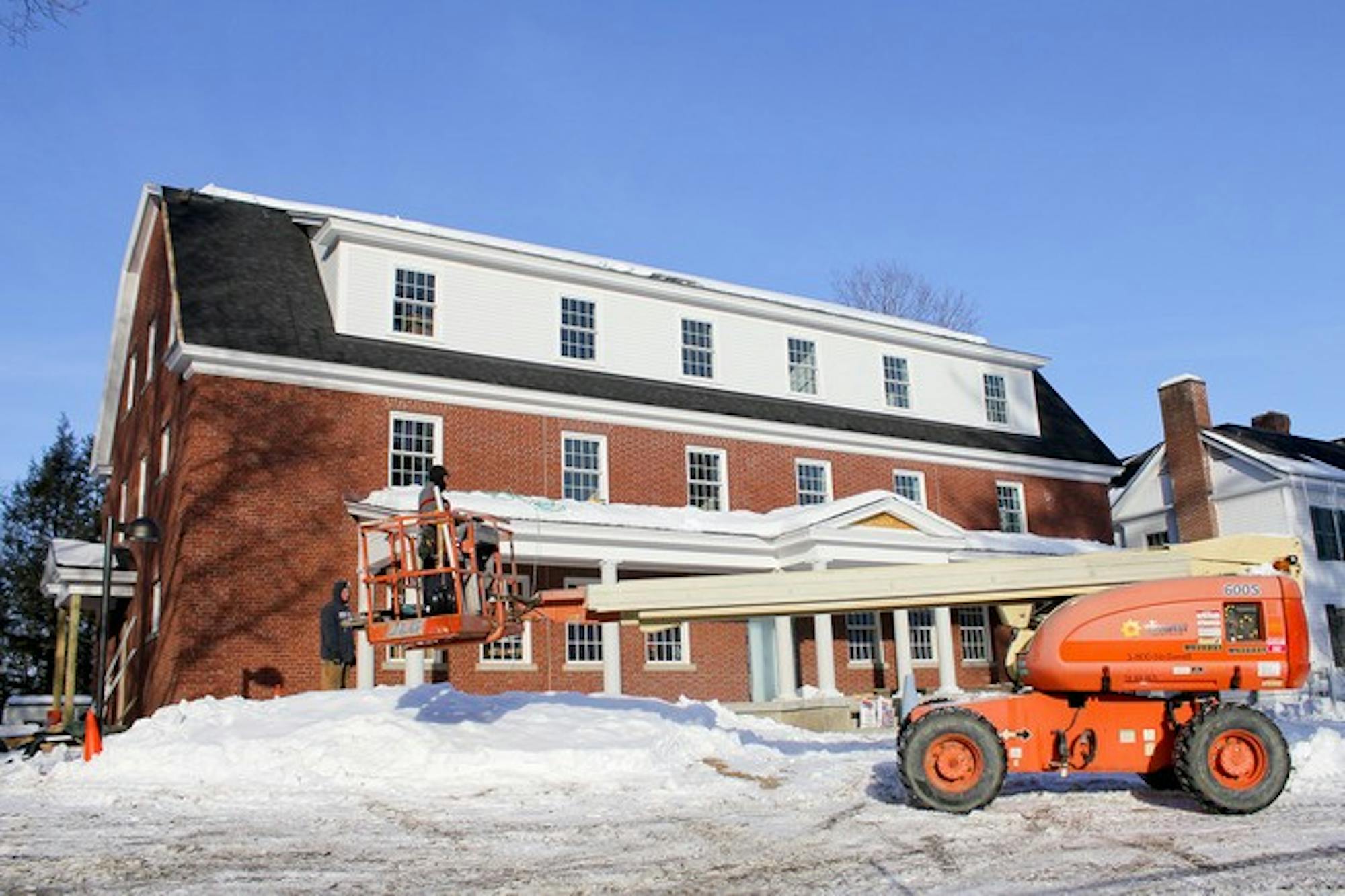
The fraternity planned to open its physical plant in January, The Dartmouth previously reported. Plans were delayed when the factory subcontracted by Domus Building, the construction company hired by the fraternity, sent modular boxes that lacked both proper certification and quality control, Domus representative Jeff Palmeroy said in an interview with The Dartmouth.
"Boxes arrived and both the state of New Hampshire and the town of Hanover identified issues they wanted fixed before the building went forward," he said. The town first raised questions of code compliance when the modular boxes units that contain pre-assembled pieces of the building arrived in September stamped with the wrong code certification, according to Hanover Township Building Inspector Ryan Borkowski. The New Hampshire state fire marshal subsequently decided to review all boxes and plans for safety issues, Borkowski said.
"Any time there's a code issue with the modular, the state has to be involved in repairs and corrections," he said.
Hanover building inspectors, New Hampshire building inspectors, Domus representatives and a representative from the New Hampshire fire marshal's office held an on-site meeting shortly after the arrival of the modular boxes, Borkowski said.
"The primary reason we had that meeting was to delineate who was responsible for what," he said. "We set parameters for anything that needed to be fixed who was responsible, when and how to fix it." Fire marshals evaluated the plumbing, electrical wiring, sprinklers and fire safety system as areas that did not comply with regulations, according to an e-mail in the town of Hanover planning and zoning department records obtained by The Dartmouth.
Domus is currently working with the factory to address the code violations, said Borkowski. Borkowski was unable to provide the name of the factory that produced the insufficient parts.
"I haven't seen the final report, but that's because they've been doing all the work," he said. "I received an e-mail this week saying they're pretty much done with the corrections and a report will be forthcoming."
Normal construction on the house has resumed while Domus representatives handle the concerns with the factory, Berg said.
Hanover does not regulate the quality of modular homes unless the town is concerned with the health or safety of residents, Borkowski said.
"There are code issues and there are workmanship issues," he said. "The code issues, which are the minimum for safety that's what the town cares about."
A modular home is assembled on-site from pieces produced in a factory and delivered in boxes, according to Borkowski. The boxes are inspected in the factory by a third party for quality control and code compliance. Inspection company PFS Corporation Northeast Region was responsible for inspecting and certifying the modular boxes for Sig Ep's new physical plant, he said. The construction of a modular home is much more complex than many people realize, Borkowski said.
"This is not a simple building," he said. "This is a commercial residential dormitory with mixed use on the first and second floor."
Palmeroy said any delays are ultimately for the students' benefit.
"This is about ensuring that the fraternity gets a quality, safe building," he said.