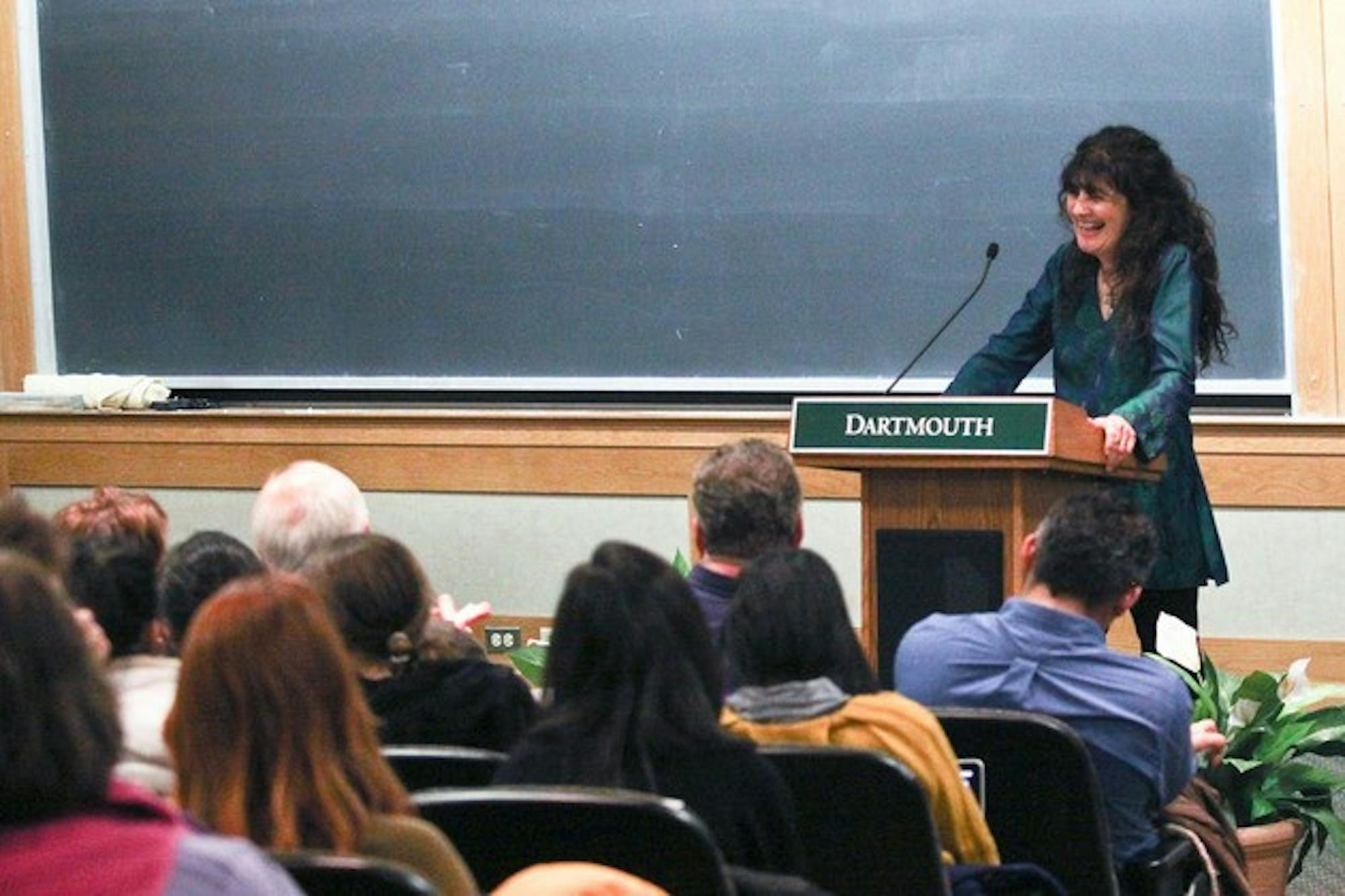
Reichl a former restaurant owner, restaurant critic for The New York Times and editor-in-chief of Gourmet magazine said it took American writers a very long time to feel comfortable admitting that they were actually writing about food.
Reichl cited a comment by 1930s food writer Mary Frances Fisher, who had said she was motivated to write about food because of its close relationship to love and security. Although Reichl said she once agreed with Fisher's statement, she now sees Fisher's reasoning as an "apology" for writing about food rather than seemingly more important subjects, she said.
Reichl attributed recent cultural changes toward writing about food as a revolt against the "eat it and beat it" attitude she encountered while growing up.
"The I hate to cook' cookbook was on the kitchen shelf, fast food was on the table and both cooking and eating were something to be done with speed and efficiency," she said. "Is it any wonder there was a backlash?"
Part of the country's shift in attitude is due to changes in immigration patterns and laws, according to Reichl.
"The history of American food is the history of immigration," Reichl said, adding that there was only decent Chinese food in America after 1966, when immigration laws changed so that Chinese chefs could enter the country.
When people migrated to the United States in the past, they planned to stay for a long time and therefore tried to assimilate quickly by behaving and eating like Americans, Reichl said. Now, many immigrants choose to retain dining customs from their home countries.
"People come to this country now often thinking they're going to go home, and even if they don't, they are very proud to hang onto their food ways," Reichl said.
During the 1980s, America experienced a "cookbook revolution" which reflected people's desire to read not only about cooking, but also about eating.
"Some found it ironic that just as Americans stopped cooking, they started reading cookbooks," Reichl said.
Despite the country's general enthusiasm to read about food, the United States is unlikely to become a nation of cooks anytime soon, according to Reichl. This trend will benefit restaurants, food writers and the makers of food-centric reality television, Reichl said.
"We're destined to remain a nation caught in the grip of a strange food obsession," Reichl said.
To illustrate her message about changing attitudes towards food, Reichl recalled a 1926 "Winnie the Pooh" story she read as a child in which the two characters, Piglet and Pooh, show remarkably positive attitudes towards food. In this story, Pooh says that food is the most exciting part of his day, Reichl said.
A.A. Milne wrote "Winnie the Pooh" just after the Victorian era in England, during which people were not only discouraged from enjoying their food, but were prevented from doing so by the strict social rules of table etiquette, according to Reichl.
Reichl said Victorian meals were "food exams" rather than "food adventures" because of the strict prescribed norms.
During the third century in Greece, food took on a more significant role in people's daily lives, holding "a central place in the intellectual discourse of Greek society," because food was no longer seen as just a necessity for survival, Reichl said.
An Epicurean tradition called Poems of the Table in which each dinner guest was instructed to memorize a famous poem praising a particular dish and the cooks were expected to prepare the dish exactly as described in the poem exemplifies how Greek culture explored food's purpose beyond more than just sustenance, Reichl said.
Reichl also discussed the importance of food under the Ming dynasty in China, where literary men wrote poetry in response to food given as gifts.
"What this tells us is that food in this society is no longer merely something to eat," Reichl said. "It's now virtual. It has become social currency."
The French were the first society to stamp their food with a nationality, Reichl said. By establishing French cuisine as a reflection of the nation, the French "branded" their cuisine, she said.
"Food writing does more than simply reflect a society," Reichl said. "It also has the ability to transform a society."
Reichl's lecture is the second installment in the College's three-part Winter 2011 Montgomery Endowment Lecture Series, "Tell Me What You Eat, I'll Tell You Who You Are."
Calvin Trillin, a journalist and author of several books, spoke at the College in a lecture titled "Eating with the Pilgrims" on Feb. 1. Dan Barber, the founder and chef of the restaurant Blue Hill in Greenwich Village, will deliver a presentation on Feb. 22.