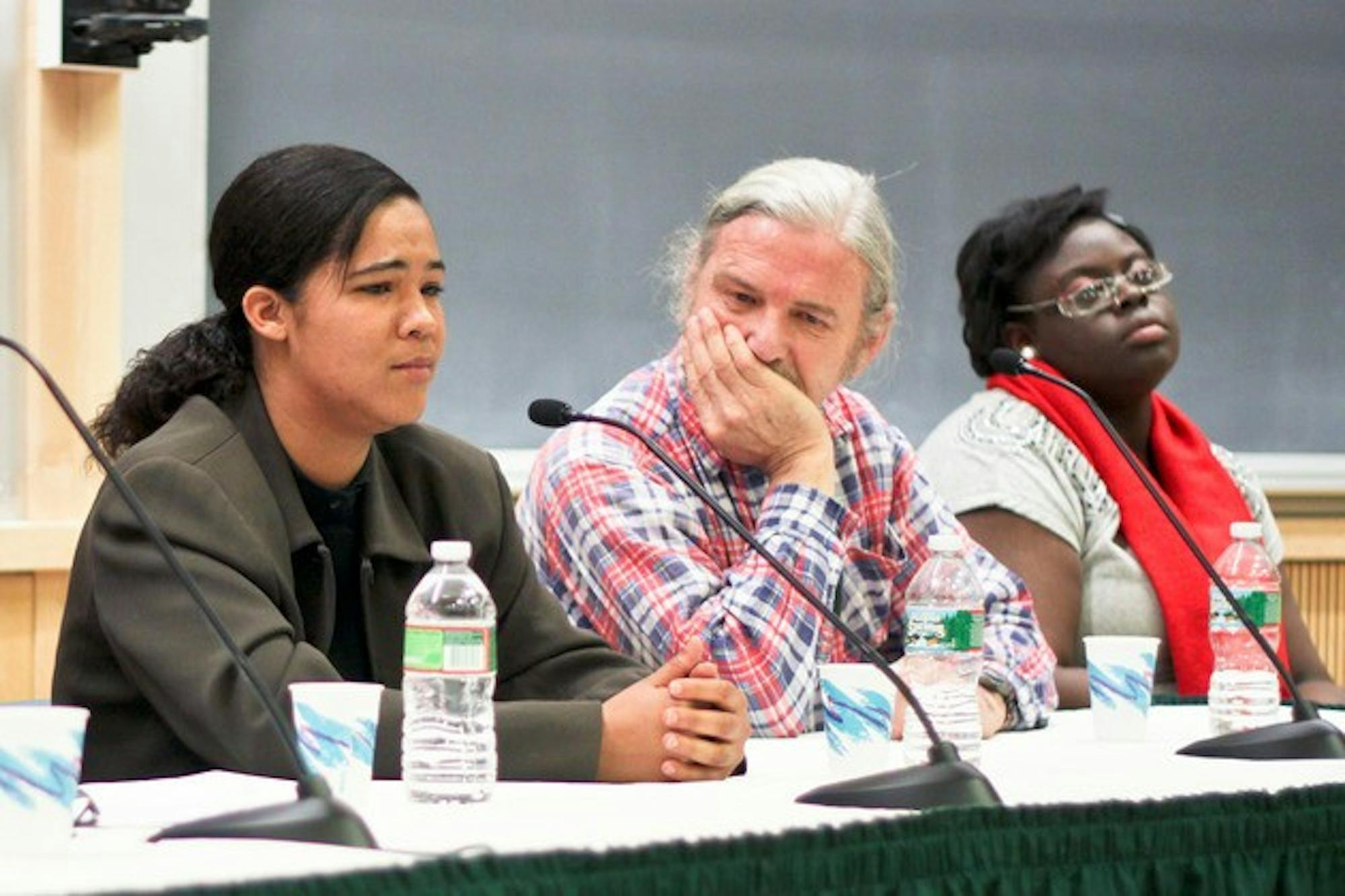
The last names of the panelists have been withheld due to the sensitivity of the discussion.
Cornelius, who had been homeless from 1979 until 2007, said he became homeless after his alcoholism caused him to "lose his job and his family." During this time, he was forced to move among homeless shelters, where he would sleep in "smelly" rooms with over 40 men. When the shelters were closed during the day, he had to move to alleys, the city hall or the local library, he said.
Cornelius said he often had to resort to extreme measures to make ends meet.
"We used to go dumpster diving," he said. "We picked up cans out of dumpsters and got a nickel for each can."
Cornelius said the worst aspect of being homeless is that other people "don't think of you as human."
"People look at you like you're from Mars, like you're from another planet," he said. "The guy that's sitting on the bench and dirty is just as human as anybody else."
Cornelius said after receiving help from Alcoholics Anonymous, he has been sober for four years and is now reconnecting with his family. He said he has his own apartment and no longer needs to work, since he is eligible for Social Security benefits.
C.C., another panelist, is a female veteran of the War in Iraq who became homeless after struggling with post-traumatic stress disorder.
After returning from the war, C.C. had trouble keeping a job due to the recession and "bounced from couch to couch, staying with different friends," she said.
"I was scared to stay with anybody because no one knew what I was going through," she said.
C.C. said she used her last unemployment check to fly from her hometown in Houston to the National Center for Post-Traumatic Stress Disorder in Boston. Unable to afford housing, she lived in a homeless shelter for over a year while receiving treatment for PTSD, she said.
"That was the first time in my life I'd been in a shelter," she said. "I volunteered in some shelters you know but I never thought it'd be me [living there.]"
Now living in an apartment, C.C. plans to move back to Houston to study photography at an art institute. Her "mission" is to use her experience to help other female veterans readjust to American society, she said.
"My own experience made me realize that all homeless people have a story," she said. "Very intelligent people that didn't have certain privileges are out on the street. I realize there's still a lot that I can learn from them."
Tayjana, a 12-year-old panelist, said she was homeless for approximately two years after she said her family was evicted from their home.
"I just couldn't understand how I could be a kid and homeless," she said.
Tayjana and her family initially lived in a hotel, but eventually moved to a shelter, she said. After Tayjana's mother wrote letters to the mayor and other city officials, the family was eventually able to move to a three-bedroom apartment in October 2010, she said.
The event was organized by the Pine Street Inn Speakers Bureau, a program of the National Coalition for the Homeless, which seeks to change public perceptions of the homeless, according to the organization's website.
Porsha Olayiwola and Charlotte Sida, members of the Coalition, said at the event that they hope to dispel stereotypes associated with homeless individuals.
"We really wanted to bring diversity in stories surrounding homelessness, as well as put a different face to homelessness," Olayiwola said in an interview with The Dartmouth.
One of the stereotypes associated with homelessness is substance abuse, Olayiwola said. Most people who develop addictions only do so after they become homeless as a way to "cope" with their situation, she said.
The leading causes of homelessness are job loss, domestic violence, health issues, natural disaster and a lack of affordable housing, according to Sida.
Sociology professor Matissa Hollister, who was involved in bringing panelists to the College, said the event was a "really great way to get a first-hand account on the big gulf that divides the homeless and housed individuals."
Students interviewed by The Dartmouth said they enjoyed hearing a new perspective on the issue of homelessness.
"[Homelessness] is one of the issues that doesn't hit you in the face every day here at Dartmouth," Sam McElhinney '11 said. "It was really powerful to hear the misconceptions and stereotypes of homelessness from those who experienced it."
The event was titled "Faces of the Homeless Social Class in America."