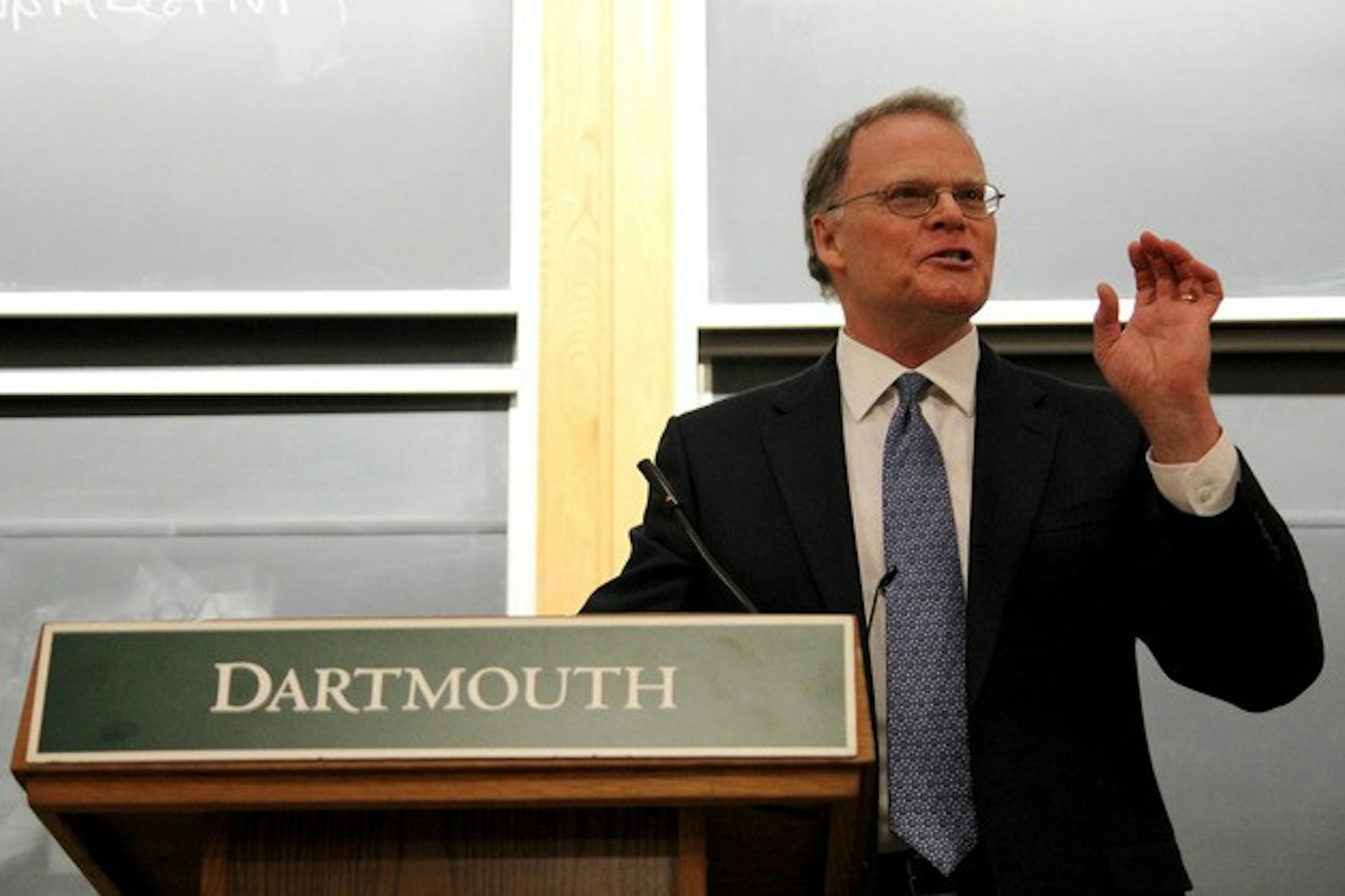
While Obama generally occupies a moderate political position, he is "demonized" by both Republicans and Democrats because he does not display the stark partisanship of the current era, Kloppenberg author of "Reading Obama: Dreams, Hope, and the American Political Tradition," an intellectual biography of Obama said. Kloppenberg cited the example of Obama's health care legislation, which created a "peculiar hybrid" of public and private options that opened the bill to attack from conservative and liberal politicians.
"[Obama's] voice sounds off-key in an atmosphere of dogmatic hyper-partisanship," he said. "It's too tepid for the left it's too willing to compromise for people who think they have the truth and on the right, he is labeled un-American."
Although a partisan Congress has criticized Obama's moderate stance on issues, Americans overall tend to occupy moderate positions on most issues, according to Kloppenberg. As a result, Obama's presidency has had a unifying effect on the country overall, Kloppenberg said.
While some members of the audience comprised of students and professors questioned Kloppenberg's claim that the electorate views Obama as an advocate of moderate policy, especially considering recent defeats in the House of Representatives, Kloppenberg said these Republican victories are not necessarily related to the public's opinion of Obama's competence.
The 2012 election, when Obama himself is on the ballot, will serve as a real test of Obama's popular support, Kloppenberg said.
Regardless of his political ideology, Obama is unlikely to adopt the label of "moderate" in order to avoid alienating the Democratic Party, Kloppenberg said.
"I think he wants still to be a Democratic president for Democrats in addition to a post-partisan president for independents," he said.
Obama's moderate ideology reflects a distinct shift in American intellectual history that occurred between the late 1940s and the 1980s, Kloppenberg said. Epitomized by the United Nations' Universal Declaration of Human Rights, the middle of the century was characterized by confident statements of universal truths, he said.
At the time Obama entered college, however, academics were less likely to refer to absolute, fixed principles, and instead focused on shifting or relative principles, Kloppenberg said. This intellectual change marked Obama's political ideology, according to Kloppenberg.
"[Obama] sees democracy as the opportunity to engage in deliberative discourse, to bring people together with different points of view who have different convictions and to see what happens from those exchanges," he said.
While Obama's progressive politics have been criticized for being "un-American," the recent focus on individual liberties as the only true American values ignores a long history of progressive initiatives that are firmly entrenched in American tradition, according to Kloppenberg.
"If you're more successful as an individual, it's not only due to your own efforts, it's due to contributions that other people have made," Kloppenberg said. "If you're successful, you owe more. It's a kind of institutionalization of the principle of empathy [underlying progressivism]."
Former President Franklin Delano Roosevelt's concept of a "second bill of rights" one that would implement economic reforms in the United States similar to those adopted by Northern European nations after World War II motivates much of Obama's policy agenda, according to Kloppenberg.
"From Obama's way of looking at this, the second bill of rights holds out an ideal, it holds out a goal toward which the New Deal had been moving in a sort of roundabout way, but the fruition of which he thinks it is his generation's duty to bring into being," Kloppenberg said.
The lecture, entitled "Reading Obama," was sponsored by the Henry and Amy Nachman Fund in History.