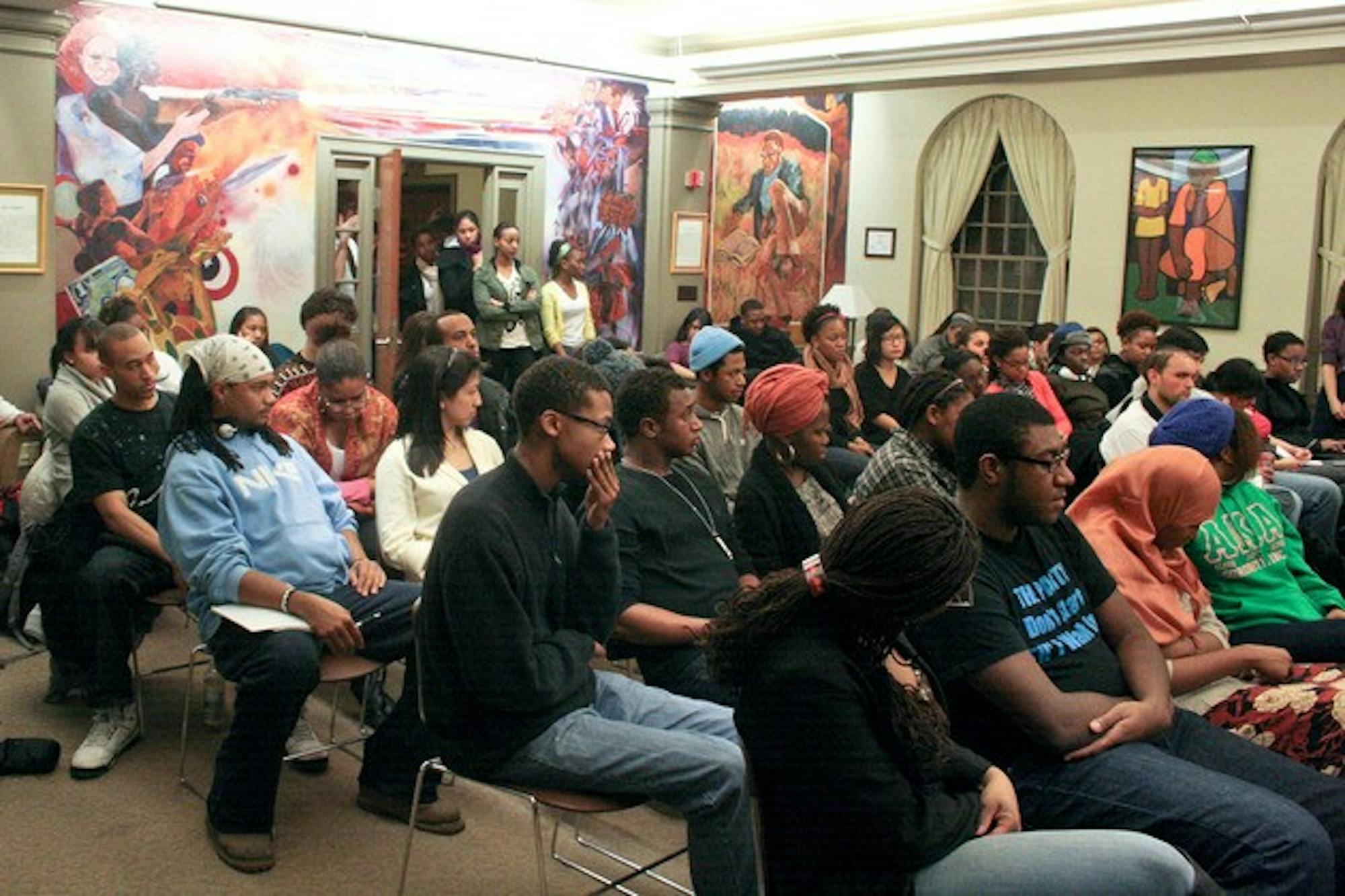
Kim said he arrived at the meeting, which was sponsored by the Afro-American Society, with an intent to "listen" to students and did not have any "magic solution" to insensitivity that students encounter on campus.
"The real hard thing is and one of the things I've learned over the last 18 months is that it's really hard to legislate student behavior," he said to the crowd.
Inter-Community Council co-chair Maya Granit '11 said the issues brought up during the student forum demonstrated a "disconnect between the highest level of the administration and the information that goes down to the student level."
Kim said he appreciated the passion of those in attendance.
"We have made it clear we want to fix the advising system, and we will find the money to fix the advising system for everybody," he said. "You want concrete? I don't know if we have that yet. In six months, we'll definitely be able to tell you."
Jalil Bishop '14 said students themselves should have an active role in changing the social norms on campus.
"We understand our role in this whole thing, it's not all [Kim]," he said.
FACULTY DIVERSITY
The lack of professors from minority backgrounds across departments makes it difficult for some students to choose research and major advisors, Danielle Coleman '12 said in the forum.
"Black professor retention and recruitment, from a student perspective, is not where it needs to be," she said to Kim. "You may list some things you guys are doing, but I'm a strong believer in perception as reality. It's extremely important while we're here for our four years for us to be able to identify professors who can take us along their way."
Students who research topics such as racial mass imprisonment the topic of her own thesis are "more hard-pressed" to find knowledgeable professors, she said.
Kim acknowledged that the College has few minority senior faculty members, citing data that rank Dartmouth last among the Ivy League institutions in that area.
Dartmouth does, however, have the highest number of minority junior faculty members, demonstrating the College's recent successful minority faculty recruitment, according to Kim.
Kim said that in 2009-2010, 47.4 percent of appointments for faculty were members of minority groups. That same year, 36.4 percent of faculty who left the institution were minority faculty members, a jump from recent years, Kim said.
The College struggles to retain minority candidates due to its rural location in the predominately Caucasian Upper Valley region, and the high demand for talented minority candidates at other top universities, according to Kim.
"If you are a member of a minority group, and you're really good at what you do, everybody on earth is going to try to poach you," Kim said. "So if we bring in a young faculty member and they do really well and get a lot of publications and become known as a great teacher, they're going to get offers from every other great university in the country and they're going to be pursued very aggressively."
When asked by Coleman about "specific" initiatives to retain professors, Kim said that with every "good" faculty member, the College "matches or better salaries" in negotiations and practices.
"It'd be nice to hear a long-term plan that says what your commitment to diversity means in specific terms," Granit said. "If we're going to recruit 40 percent students of color, they better be supported once they get here." Kim said that a central advising system currently being planned by Inge-Lise Ameer, associate dean for Student Support Services, would help close the achievement gap between first-generation and multi-generation college students.
"If what you want to hear from me is a general commitment to diversity, sure, that's easy," Kim said. "What's harder is to set up an advising system that really works. If you look at what we're doing now, we are killing ourselves to find an advising system that works for everyone. It has to really tackle things like, is there an achievement gap between first generation and multi-generation students, and if there is, what are we going to do to try to bridge that gap?"
Granit said she was concerned that Kim does not demonstrate a significant or long-term commitment to overall diversity.
ADVISORS
During the open forum, several audience members asked about acting Advisor to Black Students Samantha Ivery's resignation and acting Dean of the College Sylvia Spears' decision to not seek the permanent deanship. Kim advised students to contact the staff members themselves as he could not comment on "specific details about negotiations and packages."
"I was informed by [Spears] that she did not want to be part of the search," Kim said. "And for [Ivery], there might have been issues with graduate school. She's been here for four years in that job, which is a very difficult, intense role where four years is the average tenure."
Kyle Battle '11, a member of the Dartmouth chapter of the National Association for the Advancement of Colored People, said the dean search committee must consider the need for future advisors to be able to foster diversity and relate to students.
"I'm not sure if you guys are aware of the interaction we have with people like [Ivery] or [Spears]," Battle said. "They've been, for me personally, a very integral part of my Dartmouth experience, whether it be finding money, dealing with problems within our community or whatever else might come up."
The First Year Student Enrichment Program a mentoring and pre-orientation program which helps introduce first-generation college students to college academic and social life must also be supported by the new advisor, Battle said. Both Spears and Ivery were instrumental in founding and establishing FYSEP in Fall 2009, The Dartmouth previously reported.
Spalding said students' descriptions of the position matched the top criteria that administrators will consider on the dean of theCollege search committee, which recently added two students Uthman Olagoke '11 and Julie Dossantos '13 after students submitted a petition for increased transparency and diverse representation throughout the search process.
One audience member said that because "we're already losing staff," she was concerned that the proposed central academic advising location would not have adequate manpower.
"We may or may not," Kim said. "But we'll still set up ways of measuring whether it's effective or not, and we'll let you know."
Granit said that while she appreciated the idea of a centrally planned advising system, students lacked information about the source of funding and other "concrete" details about the proposed plan.
SOCIAL SPACES
Many minority students, according to Battle, are not comfortable in "white-dominated" social spaces on campus.
Antonio Brown '11 said the "only current alternative" to the mainstream Greek life was One Wheelock, which has a very limited capacity to serve as a social outlet for students.
Kim said the renovations to the Class of 1953 Commons and the Main Hall of Baker-Berry Library would provide new social spaces for student use. He added that the Top of the Hop could function as an additional space where students could gather.
Brown said he was worried about support for such alternative events.
"I work for programming for One Wheelock, and a lot of programs I've tried to push are held back because they were afraid it would compete with the Greek system, and they don't want to compete with that," Brown said.
TUITION
Affordability is a priority for Kim and was the central topic of the Board of Trustees' Friday meeting, Kim said. Students should not choose classes "based on financial considerations" as might be the case when courses require expensive books, he said.
Eliminating the three-day period between Thanksgiving and exams would relieve a "huge financial burden" on students unable to afford travel costs or the cost of food when Dartmouth Dining Services closes temporarily in the interim period, Battle said.
Any decisions regarding the academic calendar and the possibility of shortening Summer term would be made by faculty members, according to Kim. A decision regarding the calendar will be reached in the spring, with changes to potentially take place in the fall of 2012, Kim said.
If no changes are instituted, Kim said he would consider initiatives to relieve the financial burden on students who stay on campus during the three-day break.
STUDENT PANEL
Members of the event's student panel, Lauren Glover '11, Michelle Domingue '12, Bishop and Vanessa whose last names has been withheld on her request, due to the personal nature of her comments began the event by discussing their own Dartmouth experiences as students of color inside and outside the classroom.
Vanessa said her experience "negotiating" between the spheres of privilege at school and lack of privilege at home has influenced her perceptions as a government major.
"You don't encounter a lot of students of color in the classroom [in government classes]," she said. "Having a father in prison made issues in class become very real for me that didn't actualize for a lot of my classmates, which is something I struggled with a lot at Dartmouth. The ability to share my experiences has helped my peers to gain a broader perspective. And for me, it allowed me to engage critically in my work and understand where people from more privileged backgrounds come from."
In response to the student's stories, Kim related his own experiences as an Asian-American, both as a child and an adult.
"In the 70s, the only Asian images were Hop Sin, a servant and Kung Fu," he said. "Although I preferred Kung Fu, the point for me was not whether it was a positive or negative stereotype the fact was that it was a stereotype."