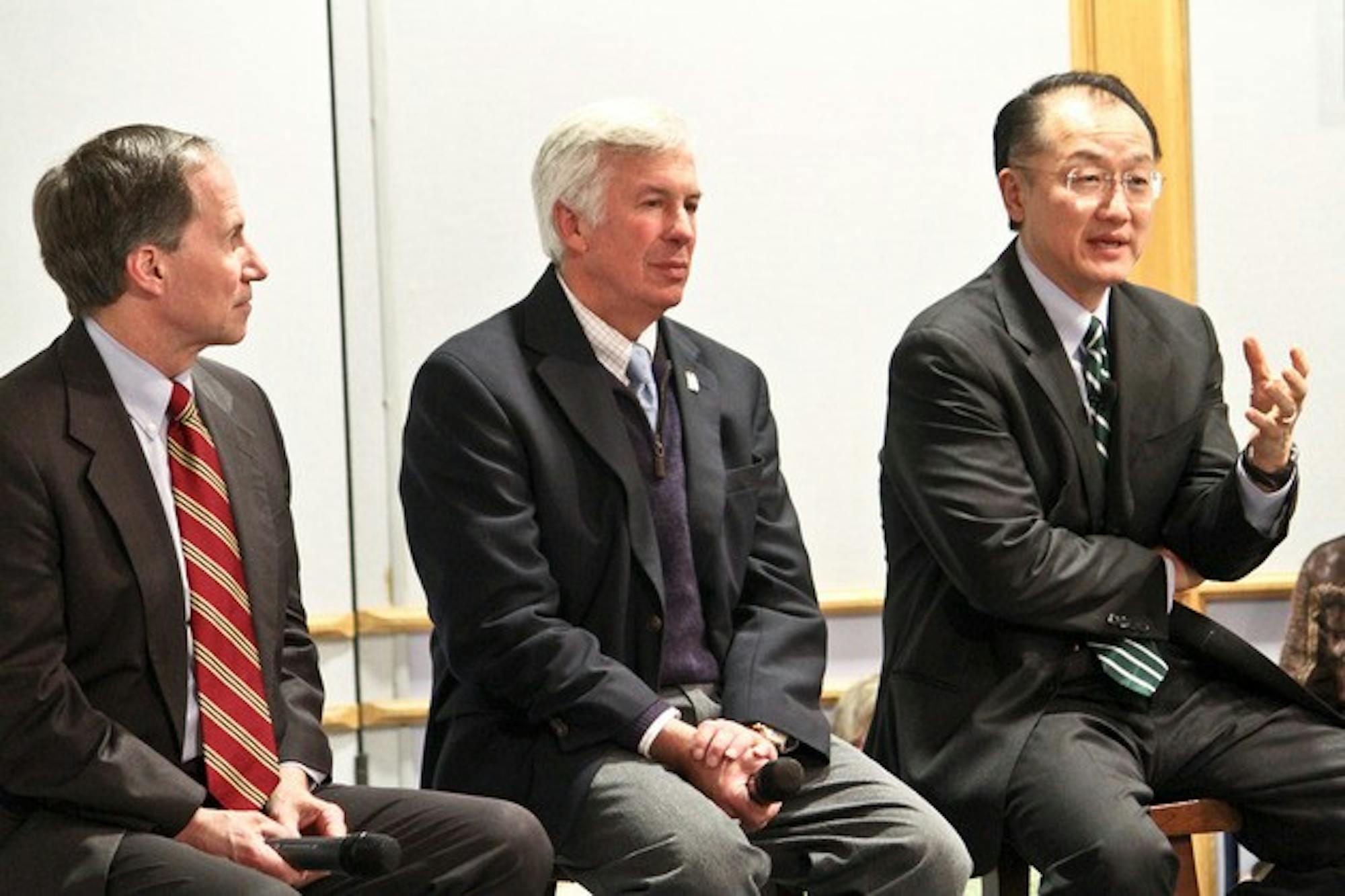
One audience member, who said there was "a lot of unfocused enthusiasm in [the] room," asked the panelists how people at DHMC could get involved in the Center. Kim said employees will be crucial to the implementation of the Center's initiatives.
"I know physicians are often cynical, saying God, that sort of hyper-enthusiastic involvement crap,'" Kim said. "We're not going to give you a watered-down version of [the updates]. Sooner than you think, everyone in this room would be asked to rethink the ways things are done."
Mulley said that since his November arrival, he has seen early progress in the creation of the center.
"A lot has already happened," he said, citing collaboration between The Dartmouth Institute for Health Policy and Clinical Practice faculty members and the Center's members.
The first of three application rounds for the Center's master's program has already begun, Kim said.
"One cycle is over and we have admitted 10 students," Mulley said. "We've turned a couple of folks down. The last cycle's deadline is March 5. This master's program is one in seven [academic programs that will be implemented], and it starts on July 5."
A diverse group of candidates submitted applications for the program, Kim said.
"We're hoping to have a couple of teams from developing countries as well," he said.
Both Kim and Mulley emphasized the Center's importance in developing the field of health care delivery science.
"It's my strong belief that in addition to the sciences we have now basic, clinical, evaluation we really think there should be another science," Kim said. "I call it a science in the most aspirational sense, as it is not really a science yet."
Medical students, faculty and community members can use the Center as a "great opportunity" to expand the field, Weinstein, who also serves as director of TDI, said in the presentation.
Health care delivery science is something "that doctors and nurses can make a career out of," as the field has received increasing visibility due to recent health care reforms, Kim said.
The Center will interact with other organizations, including state governments, and offer solutions to cut health care costs, Kim said.
"If we create a good example here, it will force the question more powerfully than any piece of legislation," he said.
The Center will conduct research to maximize the efficiency of health care delivery, according to Kim.
"We will start with case studies, and then make hypotheses," Kim said. "We want to [conduct] randomized controlled trials that will bring very powerful information about how an area changes when you roll out a program. Health services delivery can bring to the medical field wonderful new methods that will help us solve such problems."
After Dartmouth announced the Center's creation in May 2010, leading institutions such as McGill University, Cornell University and the Mayo Clinic in Rochester, Minn., publicized the establishment of similar centers, Kim said.
"We are ahead of many others," Kim said in the presentation. "There are very few places in the world where there is a college ready to have a program [like this] and a world-class facility like [DHMC]. We are the right people at the right time. "
The Center will tackle relevant issues in health care delivery, including rising costs of care and doctor-patient relations. Increasing health care costs negatively affect on our economy, Weinstein said.
"Every country today faces this problem [of growing health care costs]," he said. "We spend $6 billion a year, and that cost is growing at 9 percent every year."
Lack of communication with patients is a major problem in health care today, according to Weinstein. When patients are better informed, they can make better and less expensive choices, he said.
"What an incredible opportunity [this is] to engage patients in the decisions about their own health care," Weinstein said.
Kim appointed Mulley as the Center's executive director on Sept. 28, The Dartmouth previously reported.