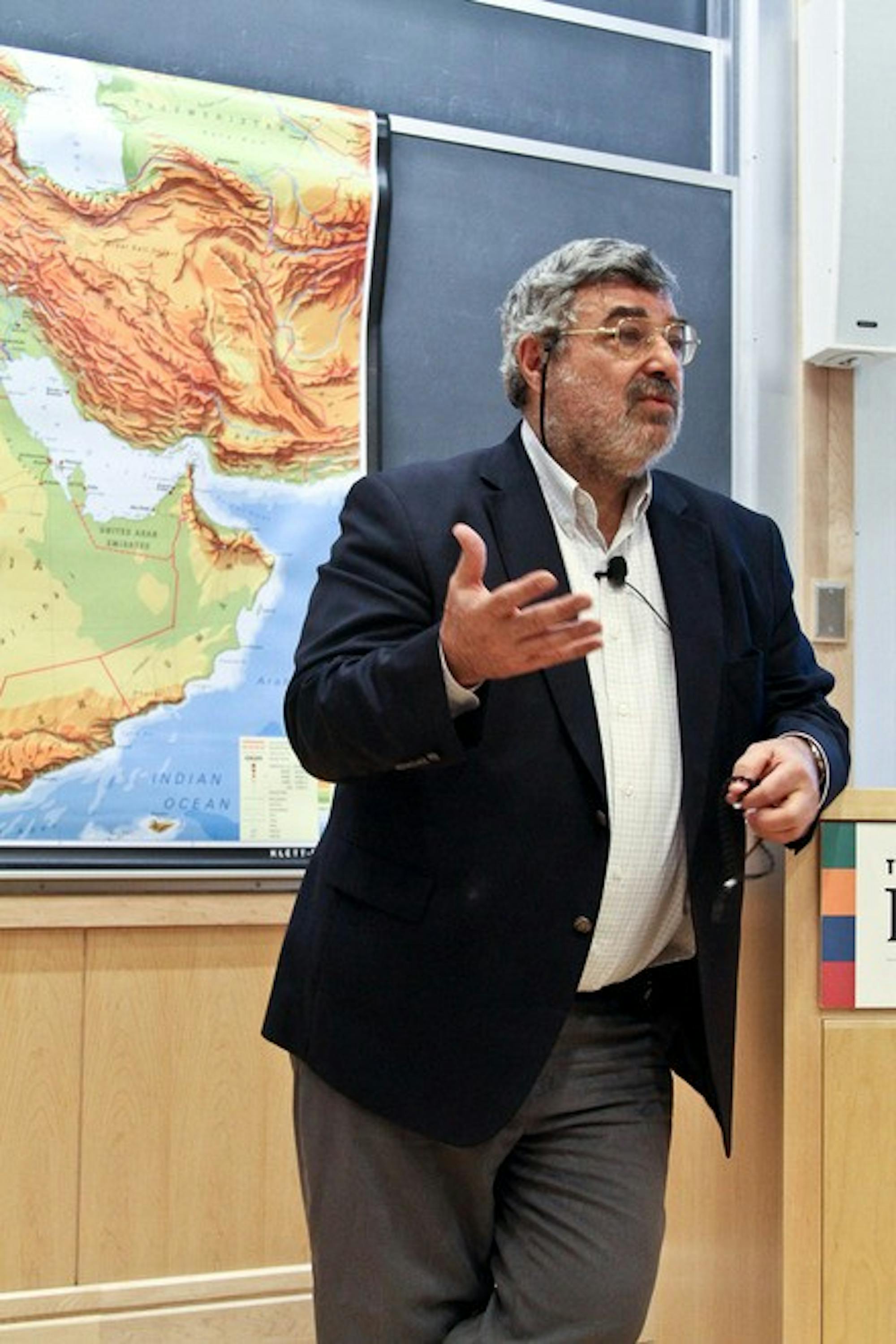
The recent push toward governmental overhaul is "the single most important thing that's happening in the Arab World since the establishment of the Arab world," Khouri said.
Poor country conditions resulting from other factors such as the Arab world's rapid urbanization and increasing population which has grown from 60 million in the 1940s to 350 million this part year also contribute to the area's turmoil, according to Khouri.
Young and middle- to low-income people have been especially alienated by the political system, according to Khouri. Citizens of more affluent Arab nations, such as Qatar, are less likely to organize on a mass level, he said.
"The students who are best educated and who have the most potential are the ones who want to get out of their country," Khouri said. "A third of the youth want to leave or emigrate permanently, mainly for economic reasons, because they don't have enough money or access to jobs."
In Tunisia, political discontent has also fueled demonstrators who "don't want to live in a system that does not give them their full rights," Khouri said. According to "The Silatech Index: Voices of Young Arabs" the Gallup Organization's first comprehensive poll of young people in the League of Arab States only 35 percent of young Arabs feel that elections are "fair, free and credible," Khouri said.
"Behind this data is a much bigger problem of serious discontent anchored in socioeconomic disparity and distress combined with the policies of an autocratic government which doesn't give the average Arab the opportunity to express him or herself," he said. "This has gone to creating a combination of tensions and frustration that has created a situation that has been combustible for decades."
Khouri used the example of Mohamed Bouazizi a Tunisian grocer who committed suicide after police whacked his head in public when he attempted to reclaim his confiscated cart and produce to exemplify the "economic disparity and political heavy-handedness by the police-state."
"Something snaps when you can't feed yourself, can't get a job, can't vote in free elections or you don't feel the system is giving you a chance," Khouri said. "We all affirm humanity and citizenship rights, and our God-given birthright of freedom, equality, opportunity to speak, to debate, to go to theatre, walk on streets, listen to music. People are saying, We want to live as normal human beings.'"
Groups like the Muslim Brotherhood, a long-banned religious and political organization in Egypt, represent a mechanism through which religious institutions challenged an unjust system, according to Khouri. Such groups should be included in a transitional coalition government, instead of being marginalized as they are in the current system, he said.
"What you need to do is start immediately with a kind of collective leadership," Khouri said. "You need to include groups like the Brotherhood, student groups, labor unions, private business interests, one or two political parties and human rights groups all these represent important constituencies. Everyone can feel like they have a say."
In order to ensure a "successful transition" of power in Arab countries, armed forces, security, police, military establishments and the expenditures of the royal families must be subject to civilian oversight, Khouri said.
"Arab government and societies have remained the only totally non-democratic region in the world because executive agencies control money and guns," he said. "When you control money and guns, you can only break that mechanism of control with oversight, which is what a civilian transformation should focus on."
Any transition in governmental structure for Middle Eastern countries will take "a bit of time," Khouri said.
A democratic transition in Egypt would not jeopardize the 30-year-old peace treaty with Israel, despite some political analysts' concerns, according to Khouri.
"I'm sure the vast majority of Egyptians don't want to go back to war with Israel," he said. "I don't think a new Egyptian government that's more democratic will, for instance, play a role as this government does by helping Israelis lay siege to Gaza. If Israel and Hamas have a political conflict, you don't starve people, which has happened because of Israel's seizure of Gaza. People don't want to be part of this dehumanizing, indifferent attitude."
Cell phones and the Al-Jazeera television network are the two most important tools currently helping empower people in the Arab world, as opposed to the much-discussed roles of social media such as Twitter and Facebook, which tend to have an impact only after the fact, according to Khouri.
"Once courageous people start to do something, media helps to accelerate and expand the movement," Khouri said. "What satellite stations have done is to make it clear that your battle is the Arabs' battle."
Student attendees interviewed by The Dartmouth said they appreciated the in-depth knowledge of the region Khouri displayed during the presentation.
"He gave a very measured analysis of the situation, which wasn't necessarily a critique," Graham Findlay '14 said.
Linguistics and cognitive science professor Ioana Chitoran said Khouri "made it clear" that the current events in the Arab world are not "special situations."
The lecture, entitled "Routine Turmoil or Historic Transformation? Understanding the Changes Underway Around the Arab World," was sponsored by the John Sloan Dickey Center for International Understanding.