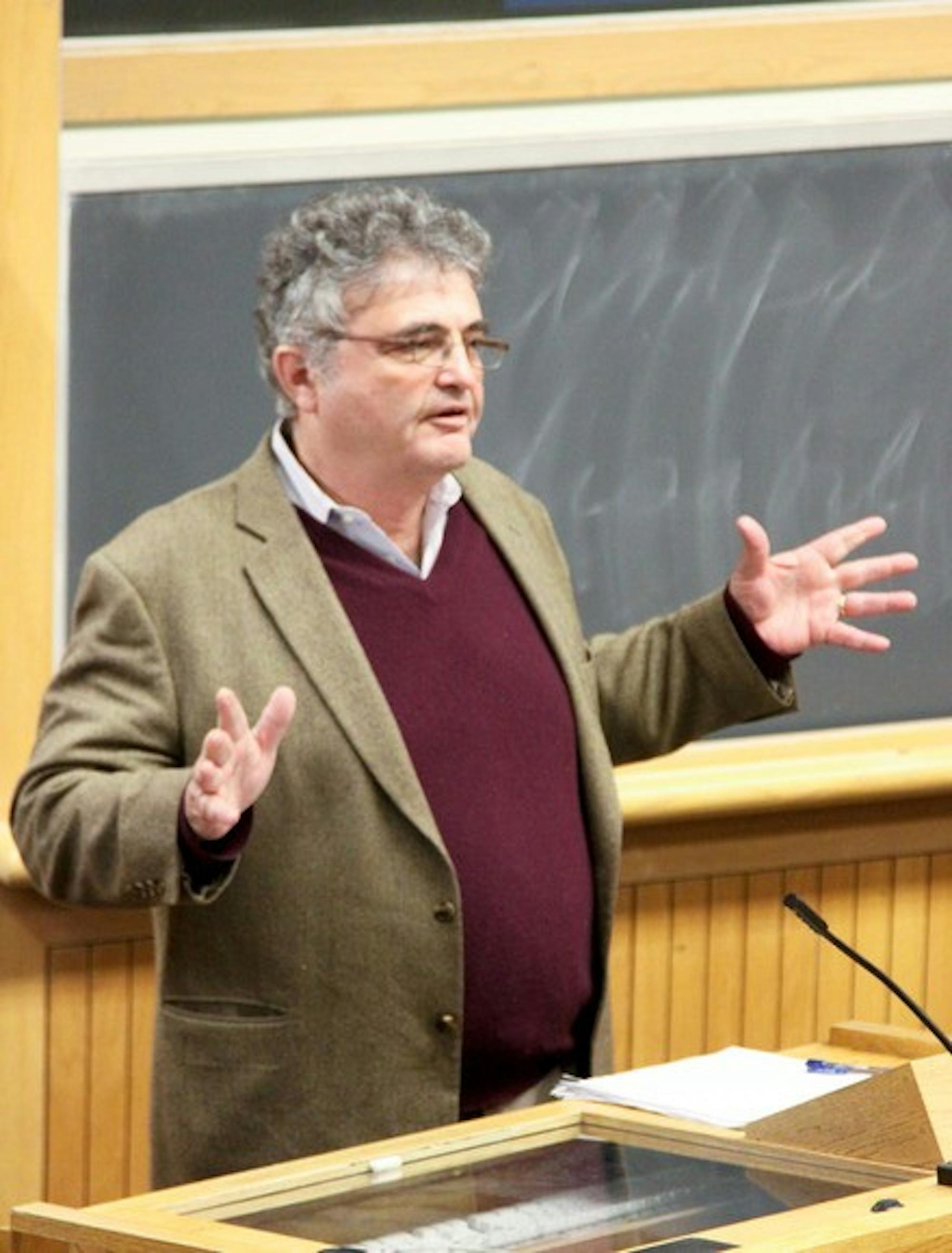
Vilnius, known as Vilna in Yiddish, formed its own national identity within the larger context of the Diaspora, during which Jewish individuals were exiled from Israel and scattered across various regions, Kassow said. Leadership in Vilnius changed seven times between 1915, when Germany brought an end to 120 years of Russian rule, and 1922, when newly-independent Poland took over, Kassow said.
After the city's Jewish elite took hold, the absence of a clear non-Jewish elite which existed and exercised political dominance in other Eastern European cities allowed the Jewish community to create distinct cultural institutions and develop a sense of pride in Jewish culture and the Yiddish language, Kassow said.
The use of the Yiddish language played a central role in the development of Jewish institutions, according to Kassow. Vilnius was the only major Jewish city where Yiddish was the dominant language, and its use became a "source of pride" among community members, Kassow said.
One Jewish student from Krakow, Poland, for example, spoke Polish with the Vilnius natives in his company, but switched to Yiddish when Poles passed them on the street out of a sense of pride for their native language, Kassow said. This sense of unity did not exist in other Jewish communities in Poland, according to Kassow.
The prominence of the Yiddish-speaking Jewishcommunity was particularly noteworthy since it was not nearly as wealthy or significant to global Jewish culture as other Jewish communities in Berlin, New York or Moscow, according to Kassow. Vilnius' population of 55,000 Jews was only one-sixth the size of the population in Poland's capital, Warsaw, and the city was of little importance to Poland at large, Kassow said.
The role of Vilnius in border disputes also contributed to the identity of the Jewish community. Shifting ownership of the city enabled Jews to establish a stable culture, Kassow said. The territorial disputes also meant that nations such as Poland actively courted the Jewish elite, which bolstered the community's importance, according to Kassow.
"Being Jewish was an advantage," Kassow said in an interview with The Dartmouth.
The impact of the loss of the Vilnius Jewish community during the Holocaust may not be fully understood for generations, Kassow said.
"There were millions of Jews who were creative, vital, resilient," he said. "One sign of how great the loss is is that most people don't realize how big it is."
Kassow currently serves as a consultant for the Museum of the History of Polish Jews, scheduled to open in Warsaw in 2012. His lecture, "The Uniqueness of Jewish Vilna," was sponsored by the Jewish Studies program.